How the U.S. Army chief is retooling for future war

Add Axios as your preferred source to
see more of our stories on Google.
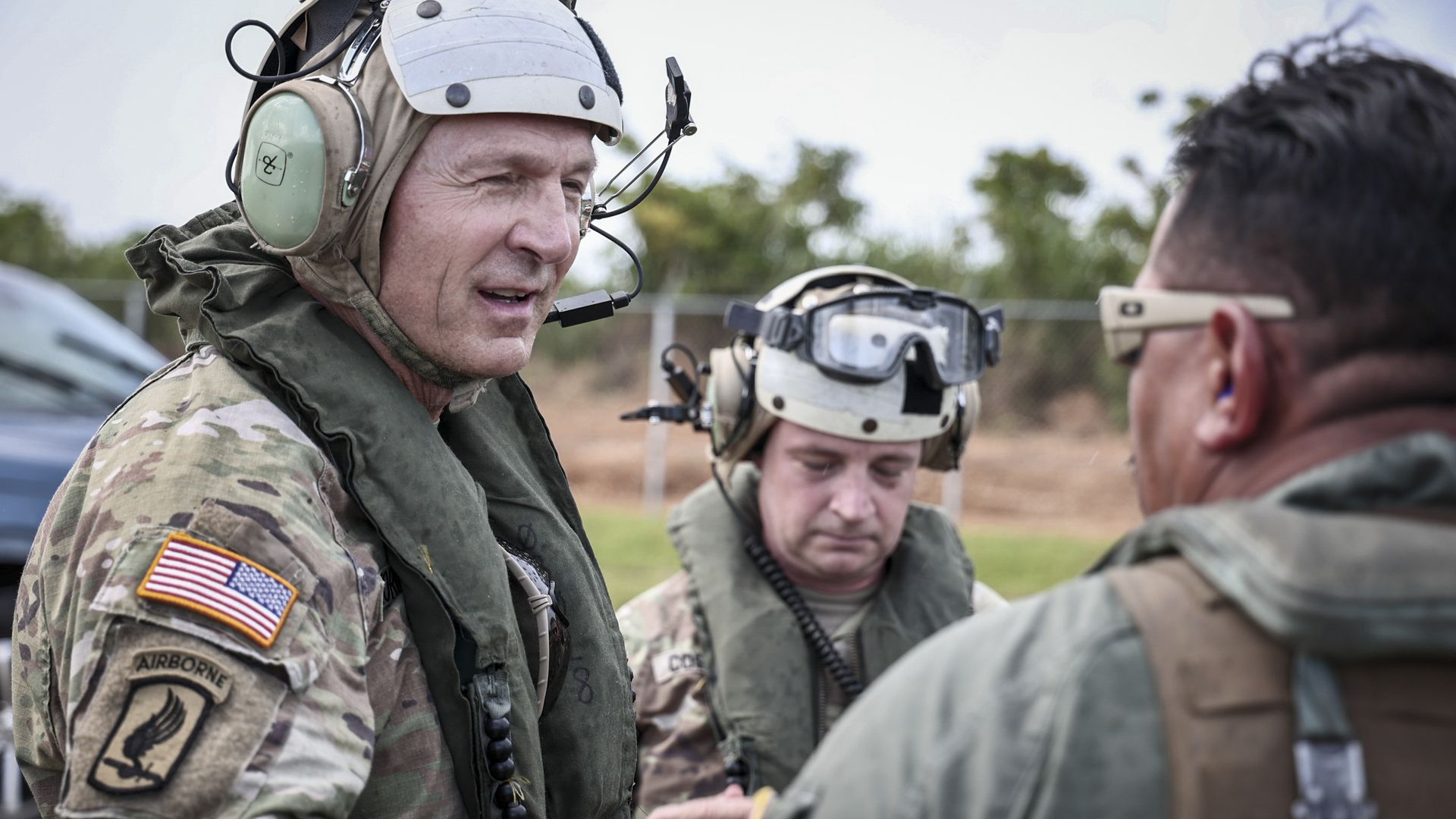
U.S. Army Gen. Randy George, left, readies for an aerial tour of Guam. Photo: Mark Scott/DVIDS
The U.S. Army chief of staff, Gen. Randy George, is sick of stagnation.
Why it matters: For too long, things have taken too long, George told Axios in an interview in his Pentagon office, ahead of the land-power bonanza that is the annual Association of the U.S. Army conference.
- The world, its wars and the weapons winning them are evolving at a blistering pace. Meanwhile, the U.S. military is largely at the mercy of trying-and-buying habits that make Blockbuster look newfangled.
- Places like the Defense Innovation Unit are touted for their flexibility but are system workarounds.
Driving the news: George months ago unveiled the "transforming in contact" initiative, meant to quickly arm soldiers and test commercially available kit the service thinks will define future warfare.
- That effort is now mushrooming beyond its original units and focus areas, namely communications, jamming and spoofing, and drone warfare.
- Future experimentation will include two divisions, two armored brigade combat teams and two Stryker brigade combat teams.
- "What are war-winning capabilities? That's what we're focused on," George said. "We're going to have to make tough decisions on where do we not spend our money."
- The chief dubbed the expansion "2.0" in a speech at AUSA.
The intrigue: George is scheduled to sit on a panel today alongside Govini, Palantir Technologies and Anduril Industries executives.
- That's not the Lockheed Martins of the world. Instead, it's the newer crop of contractors Axios previously wrote about.
- George said he planned to meet this week with "a bunch of these companies that understand how to spin stuff quickly."
Zoom in: If transforming in contact is declared a success, it will be a tacit admission that Pentagon orthodoxy is broken.
- It, too, is a sign of the times. Different gear is needed at different times in different regions for different fighting styles. And the U.S. is staring down a Russia-China double-barrel shotgun.
- "To actually do something different inside your formations, you have to change how you train and you operate," George said. "You have to change how you are organized, and you have to change how you buy things."
- "We're trying to get the mindset of the world is changing all the time," he added, "so we can't wait years to make change."
- Army Undersecretary Gabe Camarillo in an earlier interview told Axios the Army can't afford to "wait for a 10-year cycle for everyone to be uniform."
Friction point: Transforming in contact has taken blows from the old guard, according to George, who didn't name names. (Defense Department inertia is infamously stubborn.) But feedback on the ground, from troops who are working through the changes, has been positive.
- "Bottom line, I'm biased," Col. James Stultz, with the 101st Airborne Division, told me in an email. "I think it's going well."
What's next: "We need to push ourselves to build a stronger culture of innovation inside the Army. We need to adopt a greater sense of urgency and accept greater risk," Army Secretary Christine Wormuth said in an AUSA speech.
- "There is risk in testing new systems in challenging environments," she added. "But we do not have the luxury of time to wait for perfection."
