Axios Future of Defense
July 24, 2024

Welcome back to the Future of Defense. Hope y'all are well.
- I'm home from Colorado after spending 14 hours traveling amid the CrowdStrike meltdown.
- What news flew under the radar during this chaotic week? Let me know!
In this edition, insights from Aspen, a first look at a record-setting drone flight, and some interesting loose ends.
Today's newsletter is 1,172 words, a 4½-minute read.
1 big thing: China and Russia, two sides of a vise

The complementary scheming of Russia and China dominated discussions among some of the world's highest-ranking military and political officials at the Aspen Security Forum.
Why it matters: To hear the national security brain trust tell it in Colorado, Western primacy is in a vise, with Moscow and Beijing together applying the pressure.
Here are a few examples, laid bare at last week's conference, where the U.S. and its allies are being challenged:
- In space, China aims to "displace the United States as the global leader" and exploit it "in a way that is to our detriment," said Lt. Gen. Jeffrey Kruse, the Defense Intelligence Agency director.
- When China blew up a satellite in 2007, "they put us on notice," and "we have only seen their development of counter-space weapons just rapidly, breathtakingly, increase," said U.S. Space Command boss Gen. Stephen Whiting.
- Online, Russia peddles disinformation that influences elections. China absconds with sensitive information that springboards its weapons development and broader economy.
- "If Xi Jinping were sitting on this stage, he would say, 'Thank you very much for allowing us to cherry-pick, to pick your pocket, of leading technologies and IP,'" said Jon Huntsman Jr., a former U.S. ambassador to China and Russia.
- On the ground and at sea, Russia and China use their troops to muddle borders. Those nearby document the belligerence, but denunciations have done little to stop them.
- "If we allow it to become the norm, that a larger state can change its smaller neighbors' borders with force, then which border remains secure?" said Jonatan Vseviov, the secretary general of Estonia's Ministry of Foreign Affairs.
Yes, but: A wide range of governments have noted the hazards and are moving with greater urgency, officials said.
- "I think it's underappreciated in our country, in the United States, just how much our European allies have awakened to the fact that the house is on fire," said Gen. Christopher Cavoli, the head of U.S. European Command.
- "This is not a show, and this is not just rhetoric. This is true concern about the stability of their continent and the survival of their states."
- Twenty-three NATO countries meet the 2% defense spending mark, up from years past. Poland "stands out as the biggest spender," according to the Atlantic Council.
- The U.S. and others have sanctioned China for its aid to Russia. The former provides a vast majority of the latter's imported machine tools and microelectronics.
Bottom line: "If there's one vibe, it's great powers are acting badly," Anja Manuel, the Aspen Strategy Group executive director, told Axios before the summit.
- "This is a very dangerous world."
2. Exclusive: An ULTRA marathon
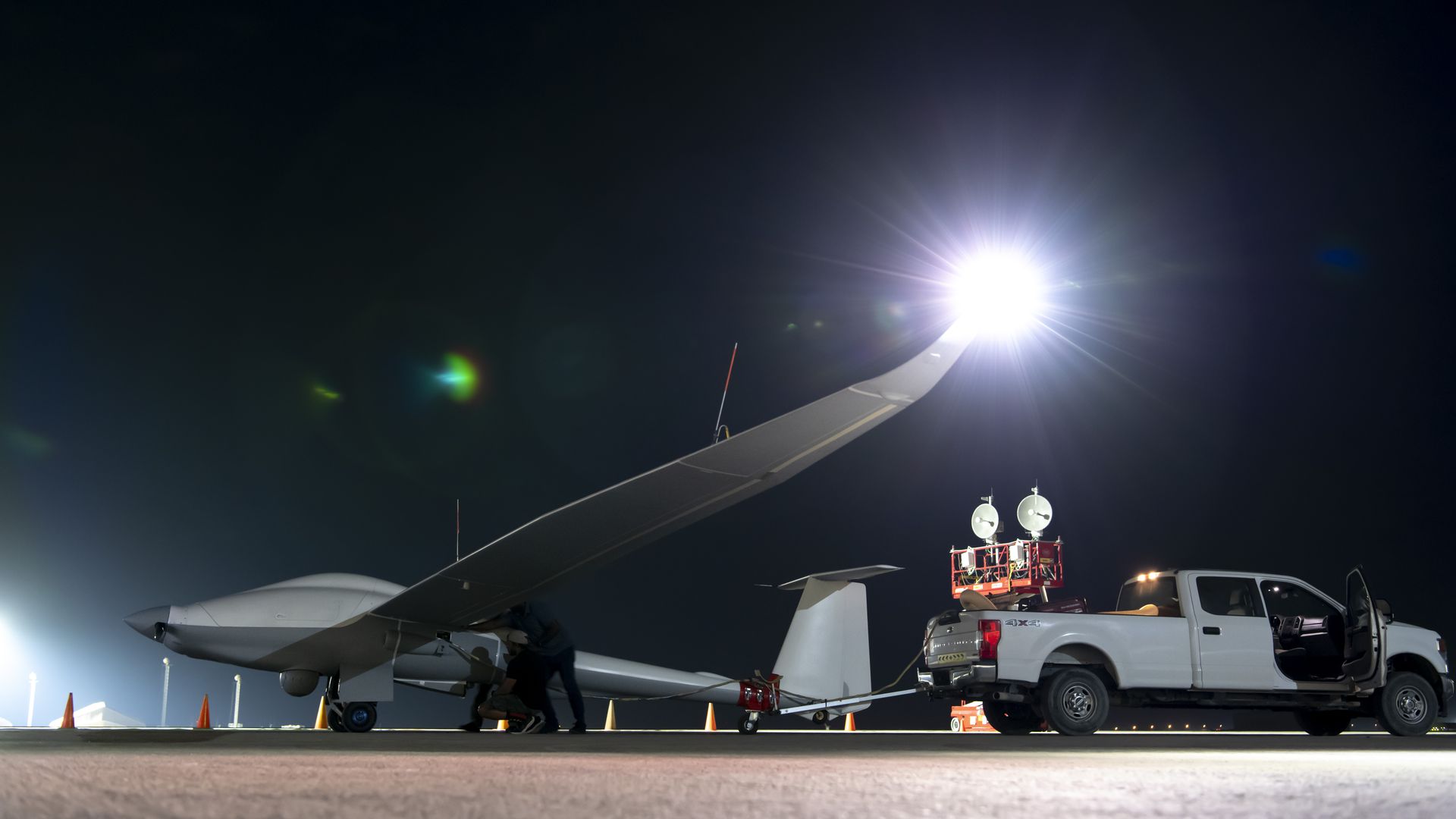
A secretive drone designed to reap intelligence from faraway targets flew for at least three days straight in recent testing, a feat its maker shared first with Axios.
Why it matters: The marathon flight — possibly twice as long as other drones' — could shake up how the U.S. military approaches overhead surveillance, for which there is an insatiable appetite.
Zoom in: The Dzyne-made Unmanned Long-endurance Tactical Reconnaissance Aircraft was put to the test at Dugway Proving Ground, Utah.
- The glider-like ULTRA has a wingspan longer than 80 feet and can carry payloads weighing hundreds of pounds.
- Launched from the greater Middle East, the drone can reach and linger over portions of Africa, Asia and Europe.
- The Air Force's fiscal 2025 budget blueprint allocated roughly $35 million for four of them.
The intrigue: ULTRA was photographed this year at Al Dhafra Air Base in the United Arab Emirates, home to MQ-9 Reapers.
What they're saying: Off-the-shelf components help cut the cost of ULTRA, according to Chris Miller, Dzyne's chief strategy officer and former acting secretary of defense.
Be smart: Bill Barr, the former U.S. attorney general, is a paid adviser to Dzyne.
- Barr previously told Axios that he saw the world enter "the age of drones" while he was the nation's top law enforcement official.
3. The Ukrainian "lift" lobby
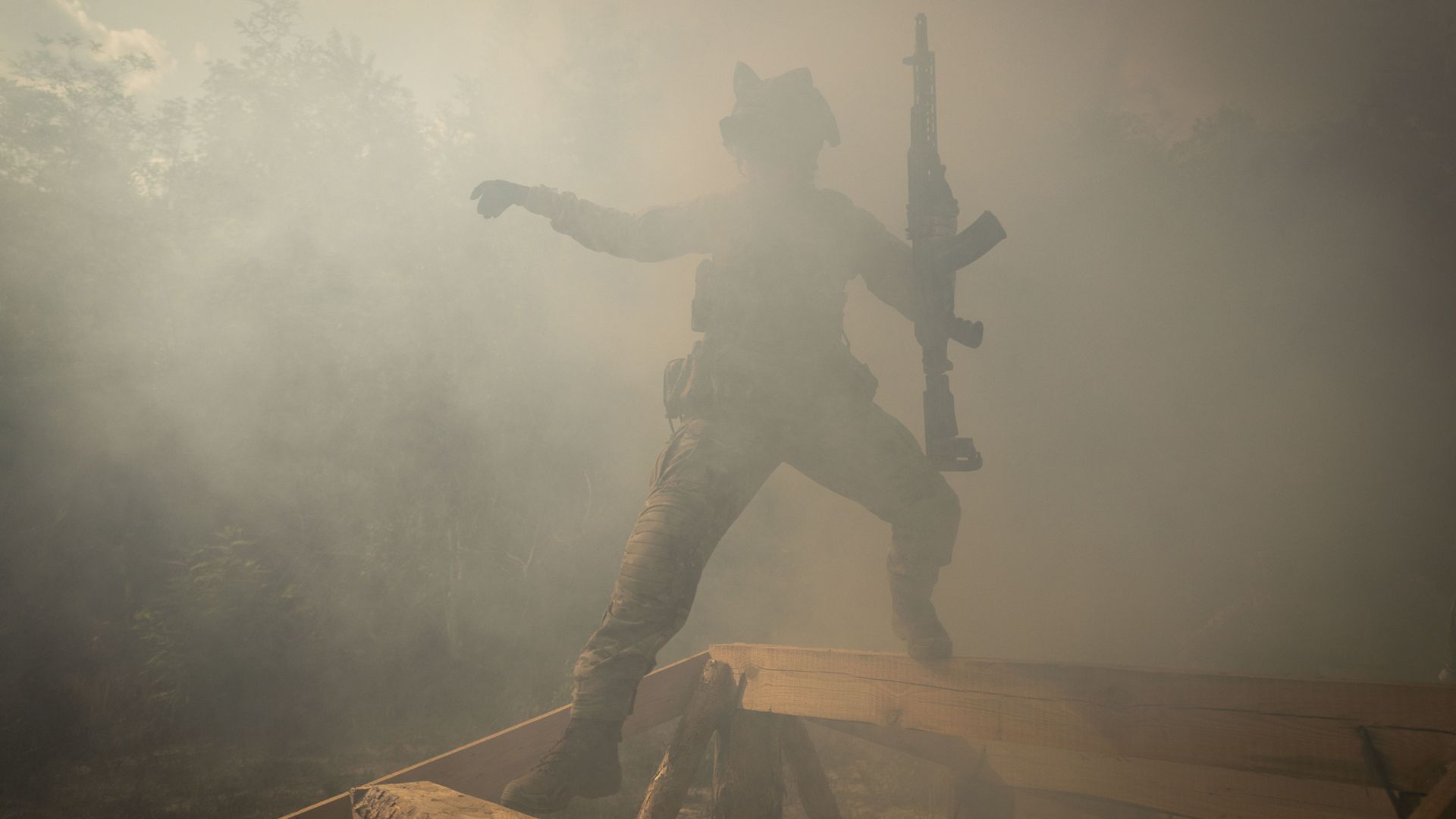
A Ukrainian campaign to persuade its weapons benefactors to "lift all bans" on hitting military targets inside Russia is underway, the besieged country's defense minister told the Aspen Security Forum.
Why it matters: Domestic political plays and worries of reprisal abroad influence how and when the American arsenal is tapped for sales and security aid.
What they're saying: "To make sure they don't come to our borders, we wanted to use long-range missiles against the enemy," said Rustem Umerov, who beamed into last week's forum via video.
- Russian air bases are of particular interest. Umerov sidestepped when asked about striking Moscow.
- "We had some discussions with partners. Some made some announcements publicly," he added. "Some had discrete discussions. But we're continuing."
Friction point: Limits on how Western arms can be used have been hotly debated. Critics argue the restrictions leave Ukrainian troops and civilians open to attack.
- Ukrainian President Volodymyr Zelensky described restrictions on donated arms as "crazy."
- U.S.-made bombs have killed civilians in Gaza, drawing condemnation from watchdogs.
What's next: F-16 fighter jets are on the way to Ukraine, where they are expected to fly this summer.
4. Quick hits
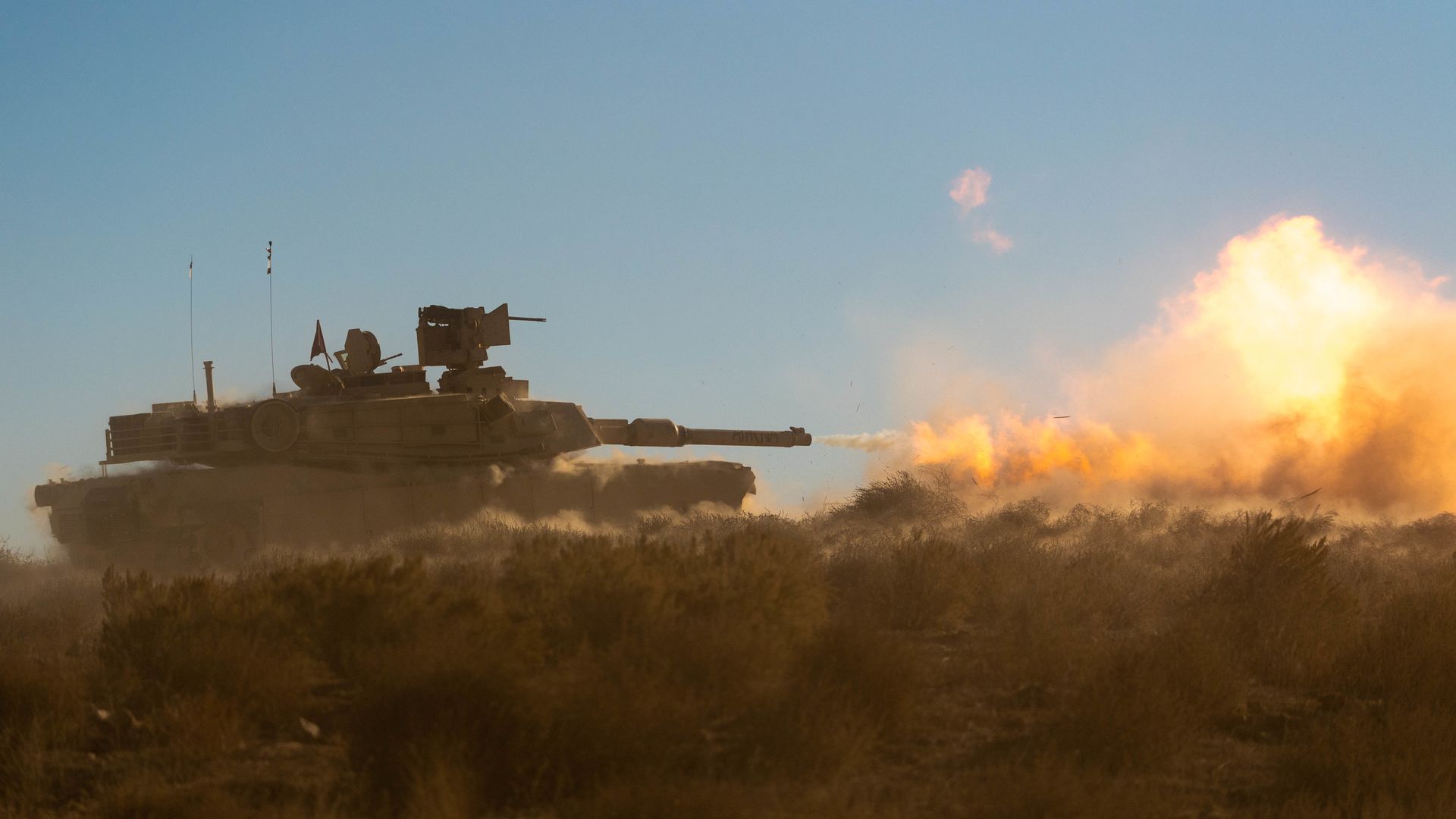
🛡️ The U.S. Army's next Abrams tank will "have to address drones," a defense official tells me. The future tank must be lighter, more mobile and operable by a smaller crew augmented by cutting-edge software.
- Why it matters: Ukraine sidelined its fleet of older Abrams tanks in response to being spotted and targeted by Russian unmanned aerial systems, the Associated Press reported.
- 💭 My thought bubble: This is yet another instance of drones, no matter their sophistication, upending venerated military equipment.
📻 L3Harris Technologies and Epirus are working together to build radios with extended range and battery life and improved heat management.
- Why it matters: Secure, intuitive communication devices are foundational to the Pentagon's vision of seamless battlefield connectivity. Do not shrug off radios.
- 💭 My thought bubble: The collaboration is between one of the world's largest defense contractors — earning nearly $14 billion in defense-related revenue in 2022 — and one of the smallest.
💰 Saronic, a Texas company building sea drones, raised $175 million in new venture capital funding at a $1 billion valuation.
- Why it matters: This is a big-money reminder that autonomous tech isn't just for the sky, Pro Rata author Dan Primack and I wrote.
- 💭 My thought bubble: The money can only help bring the Navy's sought-after hybrid fleet one step closer to reality.
5. Check this out
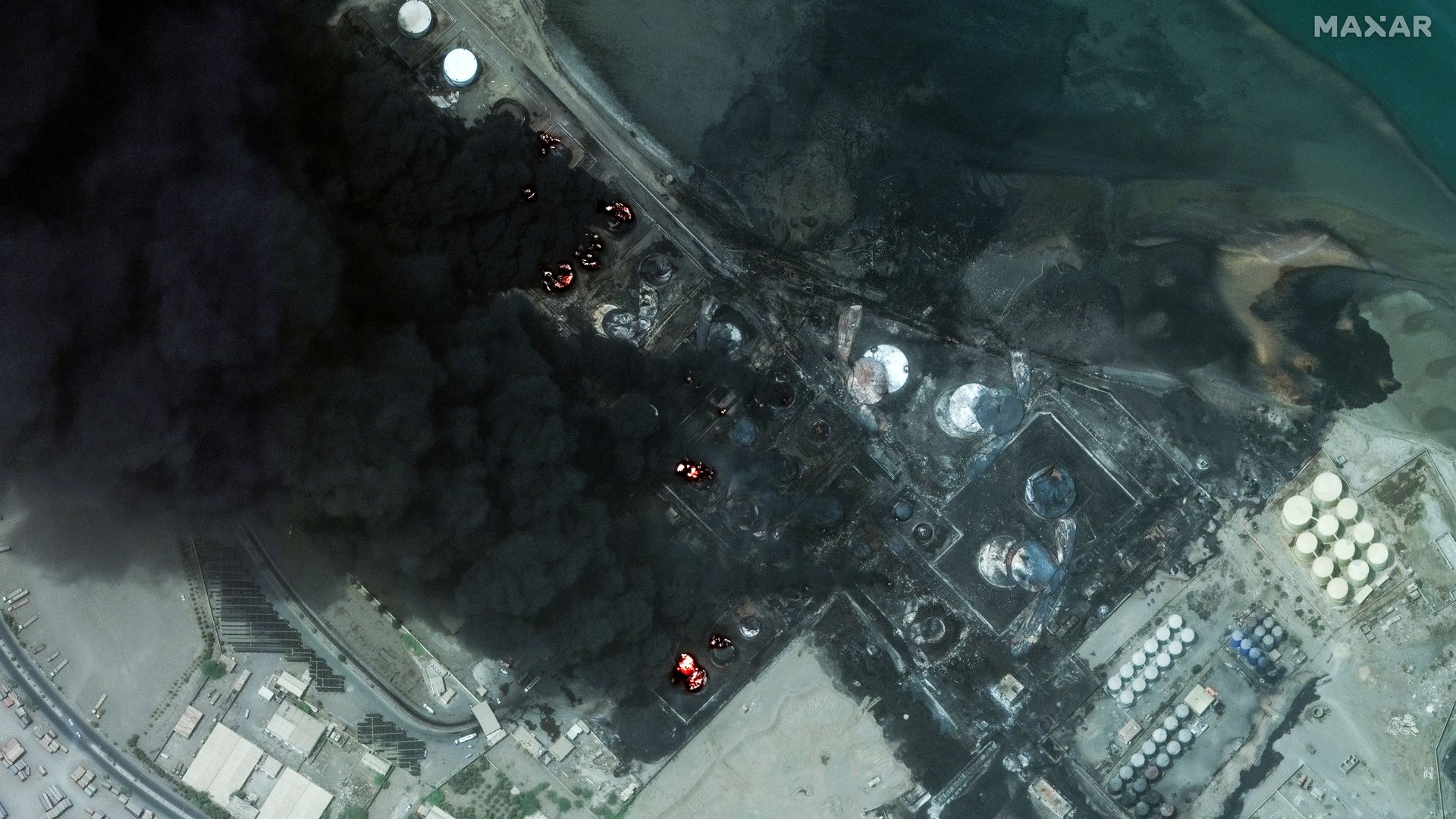
Maxar, a major provider of geospatial intelligence, documented the aftermath of Israel's bombardment of the Yemeni port city Al Hudaydah.
- The attack was in response to a deadly drone strike last week. Houthi rebels used a souped-up Iranian Samad-3 to hit Tel Aviv.
- It flew toward Sudan and Egypt, cut over the Mediterranean Sea and then swung south to the city, the Jerusalem Post reported.
The big picture: This is the first time Israel has directly attacked Yemen.
- Large oil tanks are seen burning as black smoke chokes the air.
Be smart: Israel's response serves a warning to those plotting additional attacks and shows just how seriously it is taking ratcheting hostilities in the region.
Shoutout to Nicholas Johnston for editing and Brad Bonhall for copy editing.
Did I miss something? What did you like or dislike? Shoot me a message by replying to this email.
Sign up for Axios Future of Defense