Axios Future of Defense
August 28, 2024

Another Wednesday. Another edition!
✈️ Situational awareness: The U.S. Air Force revealed it worked with Denmark and Norway to fine-tune electronic-warfare systems aboard Ukraine-bound F-16s.
- Be smart: This means Ukrainians will pass back combat data — digital gold — that will sharpen the West's understanding of Russian defenses.
What's below: A rendezvous with Undersecretary Gabe Camarillo, another news roundup and Pentagon purists.
Today's newsletter is 1,499 words, a 5.5-minute read.
1 big thing: Exclusive … Weapons talk with Army's Camarillo
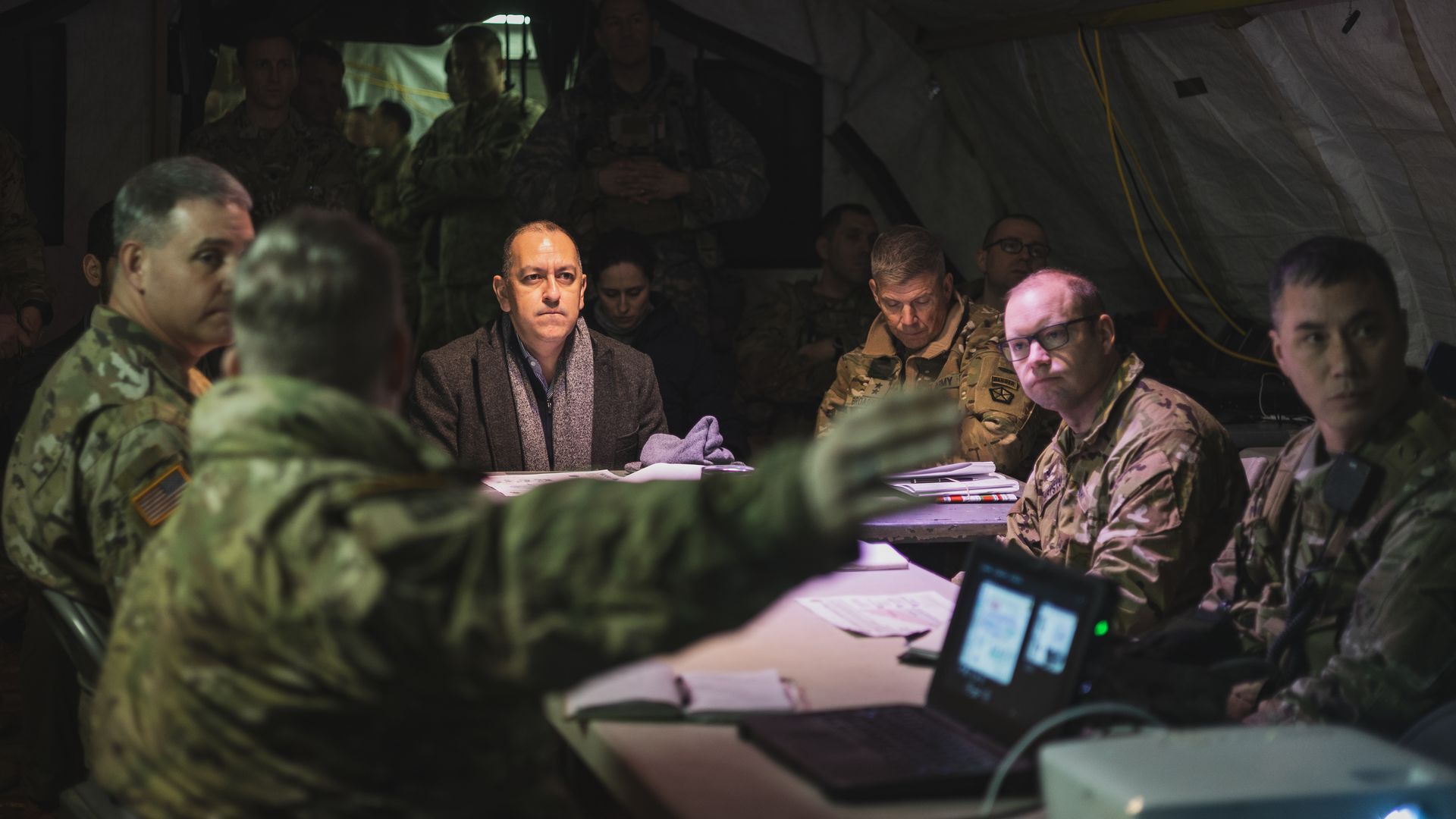
U.S. Army Undersecretary Gabe Camarillo envisions a future battlefield swarming with sensors and electronics, swollen with digital chatter and interference, and starving for overhead defenses.
Why it matters: The Army is putting a premium on drone and counter-drone equipment in light of the Russia-Ukraine war and is scoping out sci-fi-style energy weapons to combat aerial threats.
Why he matters: Camarillo has for years served as the service's No. 2 civilian, working as its chief operating officer and keeping abreast of its weapon developments.
- We spoke for 40 minutes in his Pentagon office, where windows let in just enough light to grow a houseplant or two.
The intrigue: A directed-energy proving ground is emerging in the greater Middle East, where laser and microwave weapons face real-world, punishing conditions.
- The Army this year dispatched to Iraq several laser weapons mounted on Stryker combat vehicles.
- It plans to send Epirus-made high-power microwave prototypes to the region in the coming months.
- Army Gen. Michael Kurilla, the U.S. Central Command boss, told Congress he would "love" to have additional directed-energy weapons in the area, especially as the Navy snipes Houthi drones launched from Yemen.
What they're saying: "We're going to learn quite a bit about the effectiveness and the maturity of these two directed-energy technologies against the range of unmanned aerial vehicle threats that exist in that area of responsibility," Camarillo said.
- Also under consideration: lasers mounted to Joint Light Tactical and Infantry Squad vehicles, and launched effects (drones catapulted from larger aircraft and vehicles) strapped with electronic-sizzling payloads.
- "I expect the maturity of those laser and high-power microwave systems to continue to evolve, to give us more solutions over time," he said.
How it works: High-energy lasers and high-power microwaves promise to zap incoming ordnance for pennies on the dollar.
- Lasers fire at the speed of light and can burn through their targets. Microwaves can fry electronics en masse.
- They boast unlimited magazines, so to speak, but efficacy can be stunted by atmospheric conditions and extreme distance. They also require power, which can be disrupted.
- "This is another example where, I think, we need to be thinking about continuously innovating, continuously upgrading technology, and our adoption of it, so that we can always stay ahead of the threat," Camarillo said.
What we're watching: Epirus chief executive Andy Lowery is bullish that his company's rig will perform well overseas.
- "We're going to put out this very elegant microwave energy field, and the bad guys are just going to be scratching their heads. 'What the hell is going on?'"
Be smart: Widespread adoption of directed-energy has yet to happen, despite years of experimentation and roughly $1 billion in yearly Pentagon spending.
2. Bonus: Camarillo speed round
Here's what else caught my attention during our conversation:
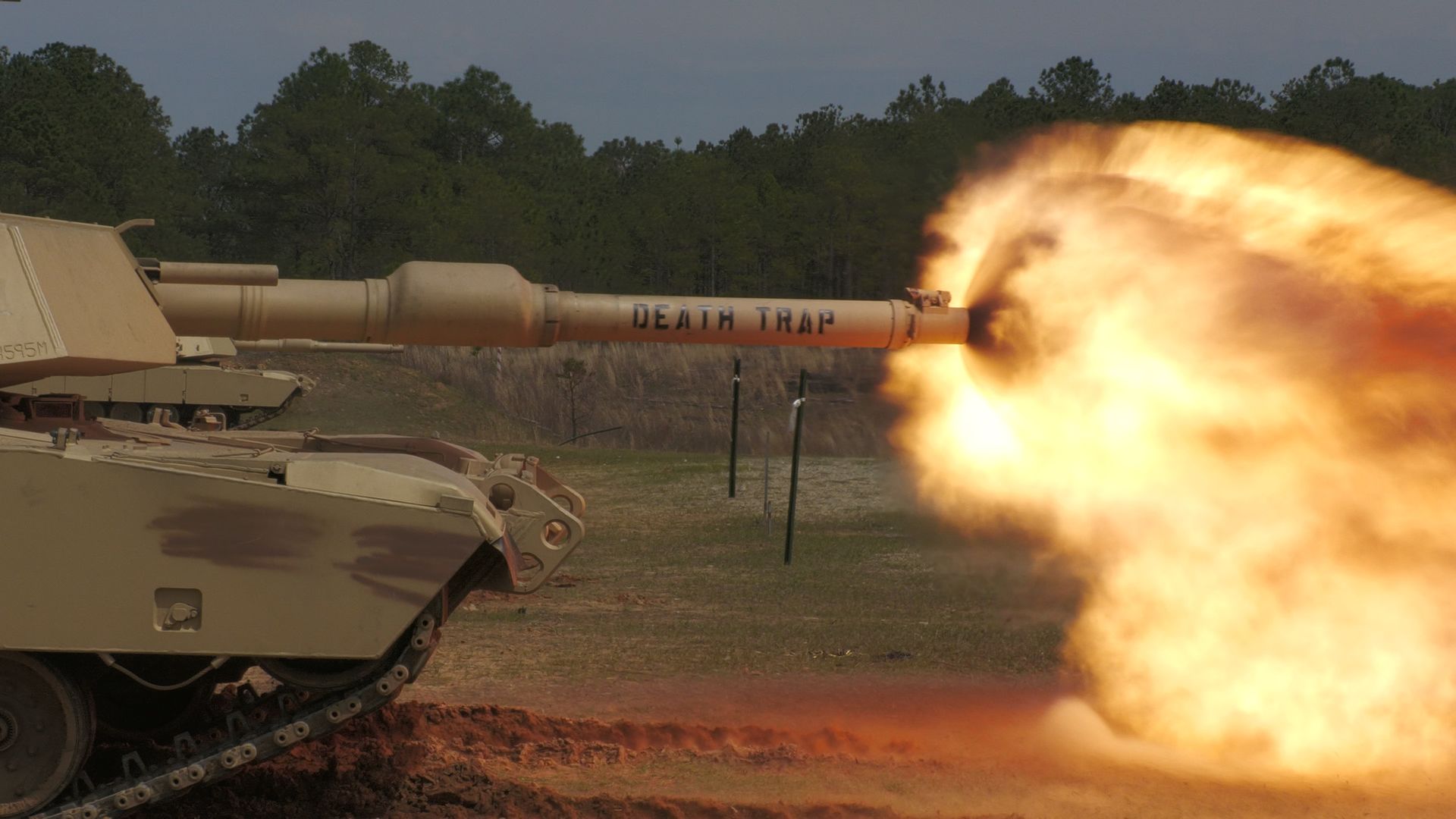
- The next Abrams tank, dubbed M1E3, "will be lighter weight than almost any tank we've ever seen before in the Army," according to Camarillo.
- The service "has to be prepared for every imaginable type of conflict, to include tank-on-tank, as we've seen in Ukraine."
- Taking a decade to try and buy equipment, then dish it out to soldiers, isn't palatable. "Certain capabilities that were relevant five years ago, four years ago, even two years ago might not be as germane as they once were," the undersecretary said.
- The Army wants novel drone killers.
- "We've looked at a potential competition, in the near term, for a low-cost, next-generation interceptor," he said.
3. Quick hits
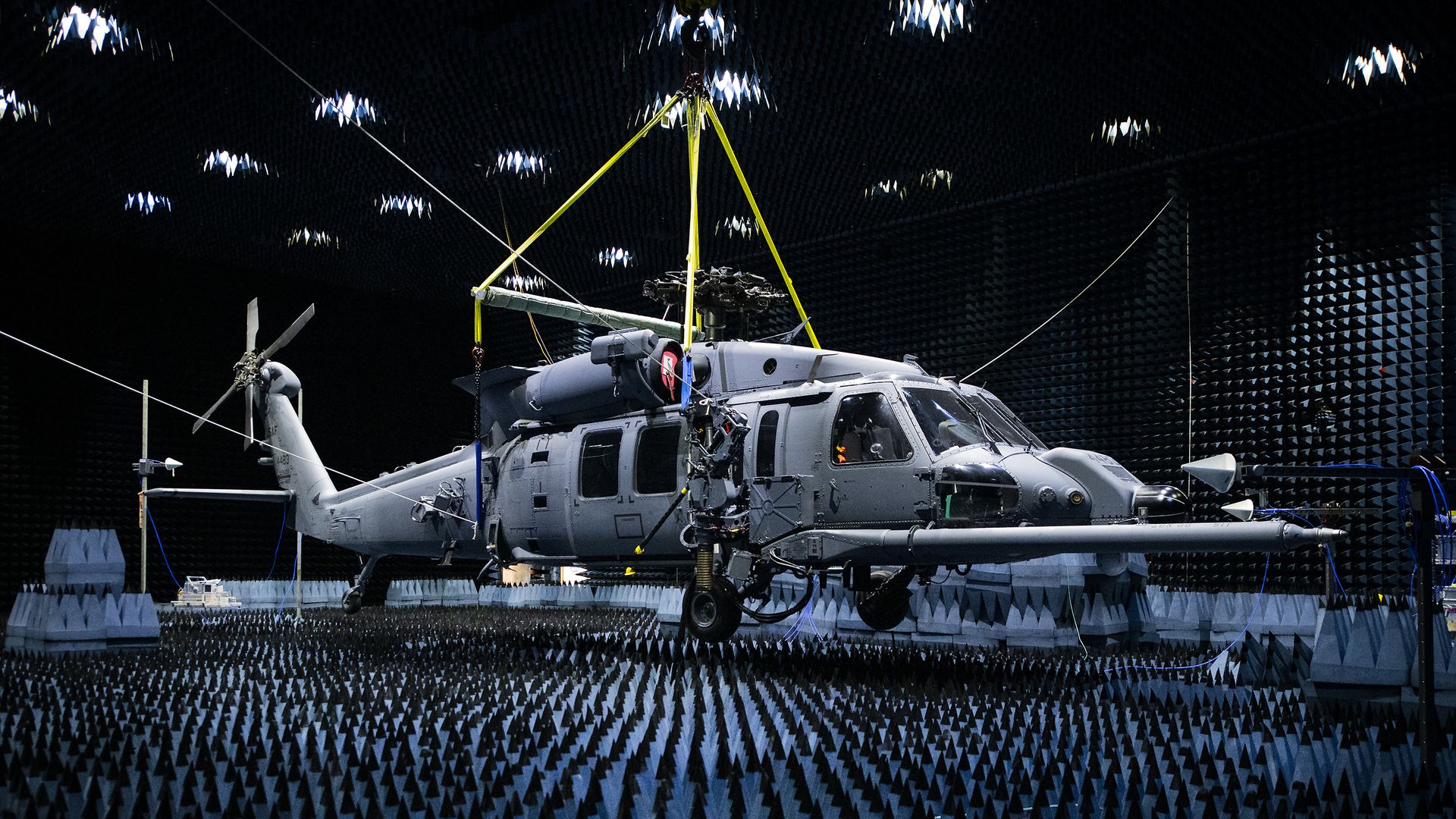
🚁 The U.K. Ministry of Defense wants to erect one of the largest silent hangars — aka anechoic chambers — in Europe. QinetiQ won a related $26 million contract.
- Why it matters: A supersized facility means extra-large unmanned tech, helicopters and fighter jets can be put to the test against jamming, spoofing and other electronic harassment.
- 💭 My thought bubble: The post-global war on terror era will be defined by electromagnetic-spectrum prowess.
💥 North Korean leader Kim Jong Un called for additional development and production of exploding drones following a successful demonstration, state media reported.
- Why it matters: Pyongyang is no stranger to the drone game. Last year it rolled out bootleg versions of the American MQ-9 Reaper and RQ-4 Global Hawk.
- 💭 My thought bubble: South Korea has vowed to fry its neighbor's drones with lasers. There's a cat-and-mouse game afoot.
💵 Defense-tech company Parry Labs has raised $80 million, Axios has learned. Capitol Meridian Partners was the lead investor, with True Ventures, 3Wire Partners and Teamworthy Ventures participating.
- Why it matters: Parry Labs collaborates with big-name defense contractors such as Shield AI, AeroVironment and General Atomics Aeronautical Systems.
- 💭 My thought bubble: More money and attention are flowing to software, and rightly so. "Software-defined hardware" is more than a catchphrase.
4. Axios interview: Jason Brown

This week's conversation is with Jason Brown, general manager of Applied Intuition Defense.
- We met at the company's offices in Rosslyn, Virginia. Coffee was served black and piping hot.
- An Italian Air Force flyover sent us scrambling to the windows mid-interview. Worth it!
Why he matters: Brown was instrumental in establishing the Pentagon's Joint AI Center and is now an executive at a software and autonomy provider the military keeps consulting.
Q: When you hear "future of defense," what comes to mind?
A: Software and data are the weapons that matter most. I actually said that five years ago to a room full of generals and admirals, and I got a look that was interesting and inquisitive by most, and then one admiral actually said, "Well, they're not weapons."
- When we consider ransomware and cyberattacks and, fundamentally, where AI is going, the idea that software and data aren't weapons themselves, I think, is shortsighted.
Q: When will wars be waged solely by robots?
A: The answer is either never or when humans are no longer around and robots are fighting themselves. Humans leverage technology as tools, and sometimes technology drives human behavior, but war is still very much a human endeavor.
- Robots and autonomous systems are clearly, however, becoming more prevalent and more relevant to competitive advantage.
Q: What region of the world should we be watching? Why?
A: If you ever take your eye off the Middle East, you're going to pay for it.
- In my long career in national security, every time we've wanted to take our eye off the Middle East, every time we thought we were doing something that would allow us to take our eye off the Middle East, maybe even in the long term, it's been foolish or shortsighted or just out of touch with the reality of that region and the fact that many long-standing issues are nowhere close to being resolved.
Q: How many emails do you get a day, and how do you deal with them?
A: Very few, because our company is obsessed with Slack.
- There are more Slack messages in my system than there are atoms in the universe.
Q: What's your secret to a successful overnight flight?
A: Don't take it. I'm in California between two and four times a month, and unless I absolutely have to, I avoid red eyes and I get on a daytime flight.
- I take Alaska Airlines because the internet works. It's a direct five-hour flight back and forth, and I get into such a state of flow. This happened to me yesterday, actually — I didn't want the flight to end.
Q: What's a piece of gear or tech you can't go without?
A: Gemini. You could say the same about ChatGPT. I'm using large language models mostly for understanding technology in detail and understanding terms and concepts I may not have before.
- Even if it's not right, even if it's off base, it sparks new ideas. I'm using it constantly, all the time. I rarely ever use it to write.
Q: What advice would you give your younger self?
A: Write more, because you do your best thinking when you're writing. I did a lot of writing in the early part of my career.
- Now, most of my intellectual capacity is focused on teaching as an adjunct at Georgetown University, where that is my outlet, where putting that content together for those students really forces me to think about things in new and different ways.
- There's no downside to trying to regularly put out quality content, whether it's blogs, whether it's actual articles that you publish. Write more, for sure.
5. Check this out
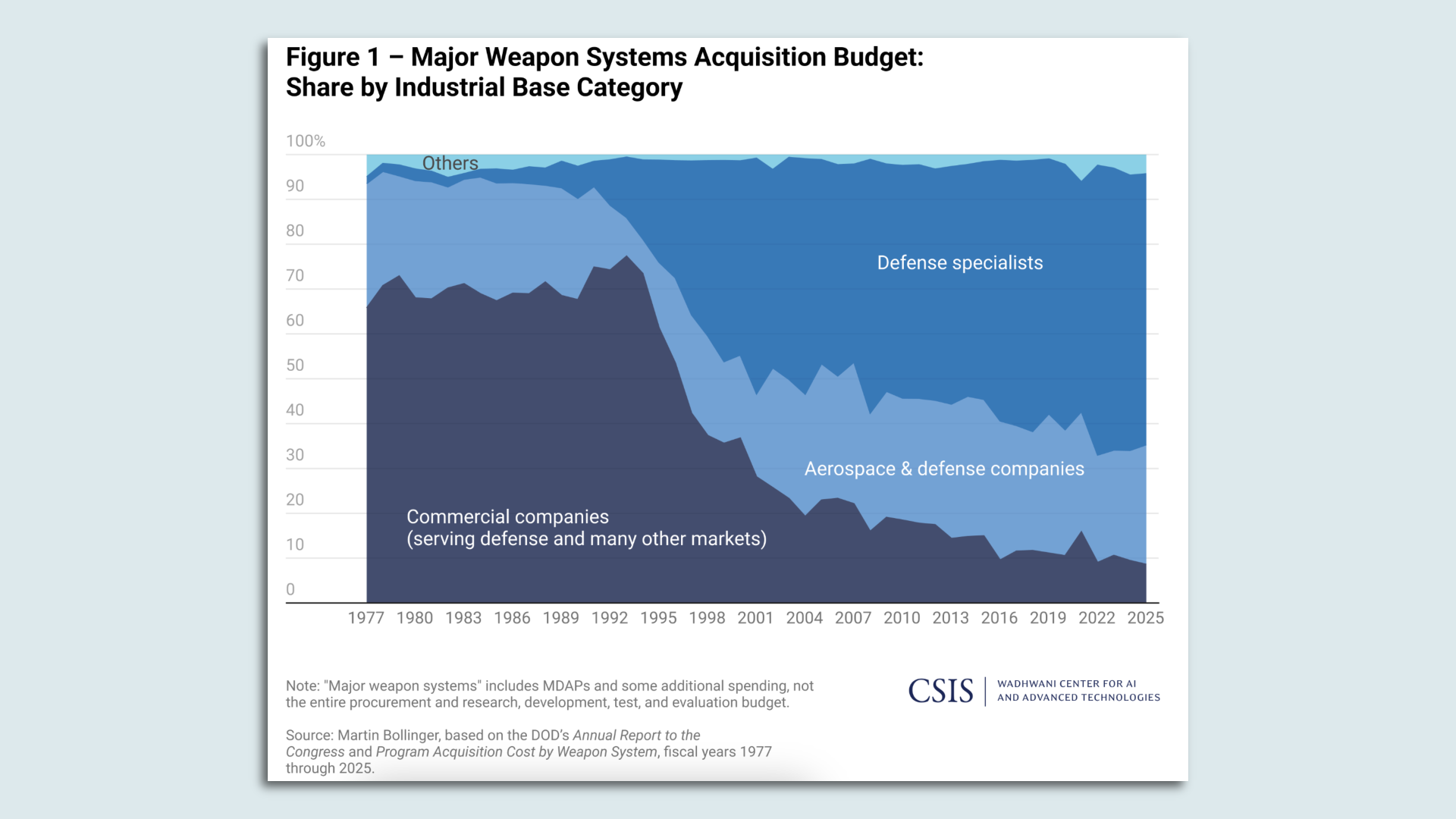
The companies crafting America's arsenal are increasingly isolated from the broader economy, as they specialize into selling to the Pentagon and few others, according to new analysis from the CSIS think tank.
Why it matters: As the chart shows, this moment is an outlier. But exclusivity could become the norm.
The bottom line: "The defense industrial base that we have today is not the same defense industrial base that won the Cold War," Gregory Allen, one of the authors, told me.
- "The worst form of this would be where the incumbent companies actually like really onerous regulations and management requirements on defense contracts, even if those regulations are not actually helpful in national security."
Shoutout to Nicholas Johnston for editing and Brad Bonhall for copy editing.
Did I miss something? What did you like or dislike? Shoot me a message by replying to this email.
Sign up for Axios Future of Defense