U.S. Army eyes drone-soaked Middle East to refine energy weapons

Add Axios as your preferred source to
see more of our stories on Google.
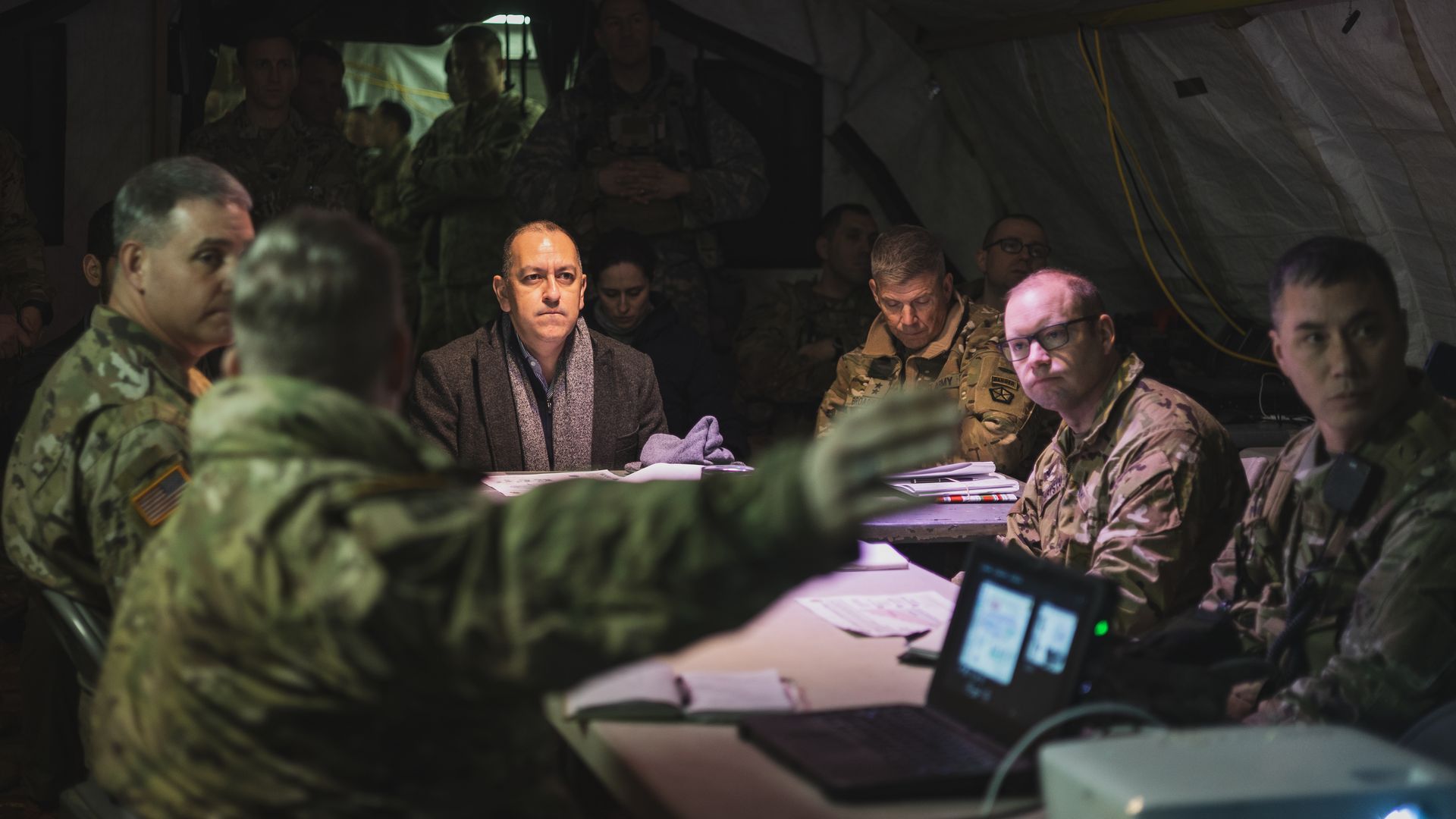
Army Undersecretary Gabe Camarillo, center, visits soldiers during the Dragoon Ready 23 exercise. Photo: Christian Carrillo/DVIDS
U.S. Army Undersecretary Gabe Camarillo envisions a future battlefield swarming with sensors and electronics, swollen with digital chatter and interference, and starving for overhead defenses.
Why it matters: The Army is putting a premium on drone and counter-drone equipment in light of the Russia-Ukraine war and is scoping out sci-fi-style energy weapons to combat aerial threats.
Why he matters: Camarillo has for years served as the service's No. 2 civilian, working as its chief operating officer and keeping abreast of its weapon developments.
- He sat down with Axios for a 40-minute interview at the Pentagon.
The intrigue: A directed-energy proving ground is emerging in the greater Middle East, where laser and microwave weapons face real-world, punishing conditions.
- The Army this year dispatched to Iraq several laser weapons mounted on Stryker combat vehicles.
- It plans to send Epirus-made high-power microwave prototypes to the region in the coming months.
- Army Gen. Michael Kurilla, the U.S. Central Command boss, told Congress he would "love" to have additional directed-energy weapons in the area, especially as the Navy snipes Houthi drones launched from Yemen.
What they're saying: "We're going to learn quite a bit about the effectiveness and the maturity of these two directed-energy technologies against the range of unmanned aerial vehicle threats that exist in that area of responsibility," Camarillo said.
- Also under consideration: lasers mounted to Joint Light Tactical and Infantry Squad vehicles, and launched effects (drones catapulted from larger aircraft and vehicles) strapped with electronic-sizzling payloads.
- "I expect the maturity of those laser and high-power microwave systems to continue to evolve, to give us more solutions over time," he said.
How it works: High-energy lasers and high-power microwaves promise to zap incoming ordnance for pennies on the dollar.
- Lasers fire at the speed of light and can burn through their targets. Microwaves can fry electronics en masse.
- They boast unlimited magazines, so to speak, but efficacy can be stunted by atmospheric conditions and extreme distance. They also require power, which can be disrupted.
- "This is another example where, I think, we need to be thinking about continuously innovating, continuously upgrading technology, and our adoption of it, so that we can always stay ahead of the threat," Camarillo said.
What we're watching: Epirus chief executive Andy Lowery is bullish that his company's rig will perform well overseas.
- "We're going to put out this very elegant microwave energy field, and the bad guys are just going to be scratching their heads. 'What the hell is going on?'"
Be smart: Widespread adoption of directed-energy has yet to happen, despite years of experimentation and roughly $1 billion in yearly Pentagon spending.
