Exclusive: U.S. trails China and Russia on hypersonic weapons, task force finds

Add Axios as your preferred source to
see more of our stories on Google.
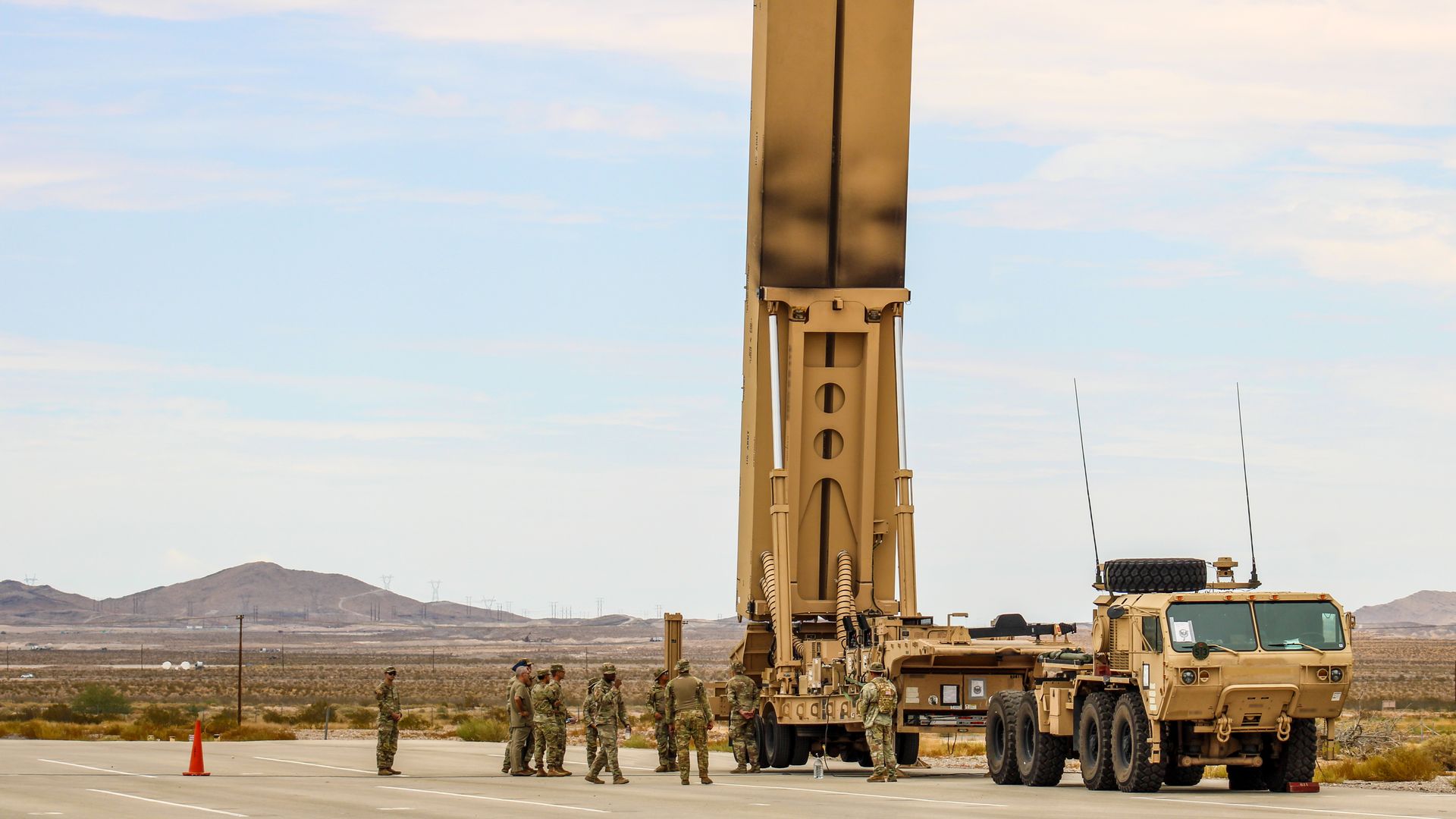
U.S. Army soldiers demonstrate the Long Range Hypersonic Weapon transporter erector launchers at Nellis Air Force Base, Nevada. Photo: David Kim/DVIDS
American sluggishness to develop and deploy hypersonic weapons, coupled with Russian and Chinese determination to field their own arsenals, is fostering a "battlefield asymmetry" that threatens Western potency, according to an Atlantic Council study first shared with Axios.
Why it matters: This warning isn't coming from knee-jerk alarmists.
- Instead, it's the product of months of debate and research from the Hypersonic Capabilities Task Force, featuring former U.S. Army, Air Force, Pentagon and National Nuclear Security Administration leaders, among others.
The intrigue: The document lands as the Trump administration begins cobbling together the Golden Dome, a $175 billion hemispheric missile shield.
What's inside: Here are some of the task force's key takeaways and recommendations:
- Speedy and nimble weapons represent "a paradigm shift in modern warfare" that "we cannot afford to ignore." (Hypersonic armaments zip along at speeds greater than Mach 5, traveling miles in seconds.)
- Post-launch missile interception alone is not enough. Terminal High-Altitude Area Defense and Patriot countermeasures can be overwhelmed by barrage after barrage and are expensive to replenish.
- The U.S. needs a line of lower-cost, higher-capacity missiles as well as reusable hypersonic aircraft for intelligence-gathering and other tasks.
- Codevelopment and coproduction should be embraced. Think AUKUS Pillar 2, the emerging-tech angle of the Washington-London-Canberra security pact.
- The Defense Department should pursue hypersonic delivery options for nuclear weaponry. The nuke-toting F-35A is "not likely to remain sufficiently survivable in the 2030s," it reads.
Threat level: "The current gap in high-speed and hypersonic capability is significant and growing rapidly," the report cautions.
- The report evaluates the Russian Kinzhal (used against Ukraine) as well as the Tsirkon and Avangard missile systems.
- China's hypersonics include the DF-17 and DF-26 ballistic missiles.
- The U.S. also has hypersonic systems in various stages of development. They include the Long Range Hypersonic Weapon, Conventional Prompt Strike, Air-Launched Rapid Response Weapon and Hypersonic Attack Cruise Missile.
The bottom line: Incremental improvements are "not enough," task force director Stephen Rodriguez told Axios. "We need to act decisively now."
- "That means aggressively fielding the first generation of U.S. hypersonic systems while fundamentally rethinking how we foster an industrial base that can deliver affordable capacity for the next generation."
More from Axios:
Stratolaunch goes hypersonic with reusable Talon-A vehicle
