Consider these factors as the Pentagon dissects AUKUS

Add Axios as your preferred source to
see more of our stories on Google.
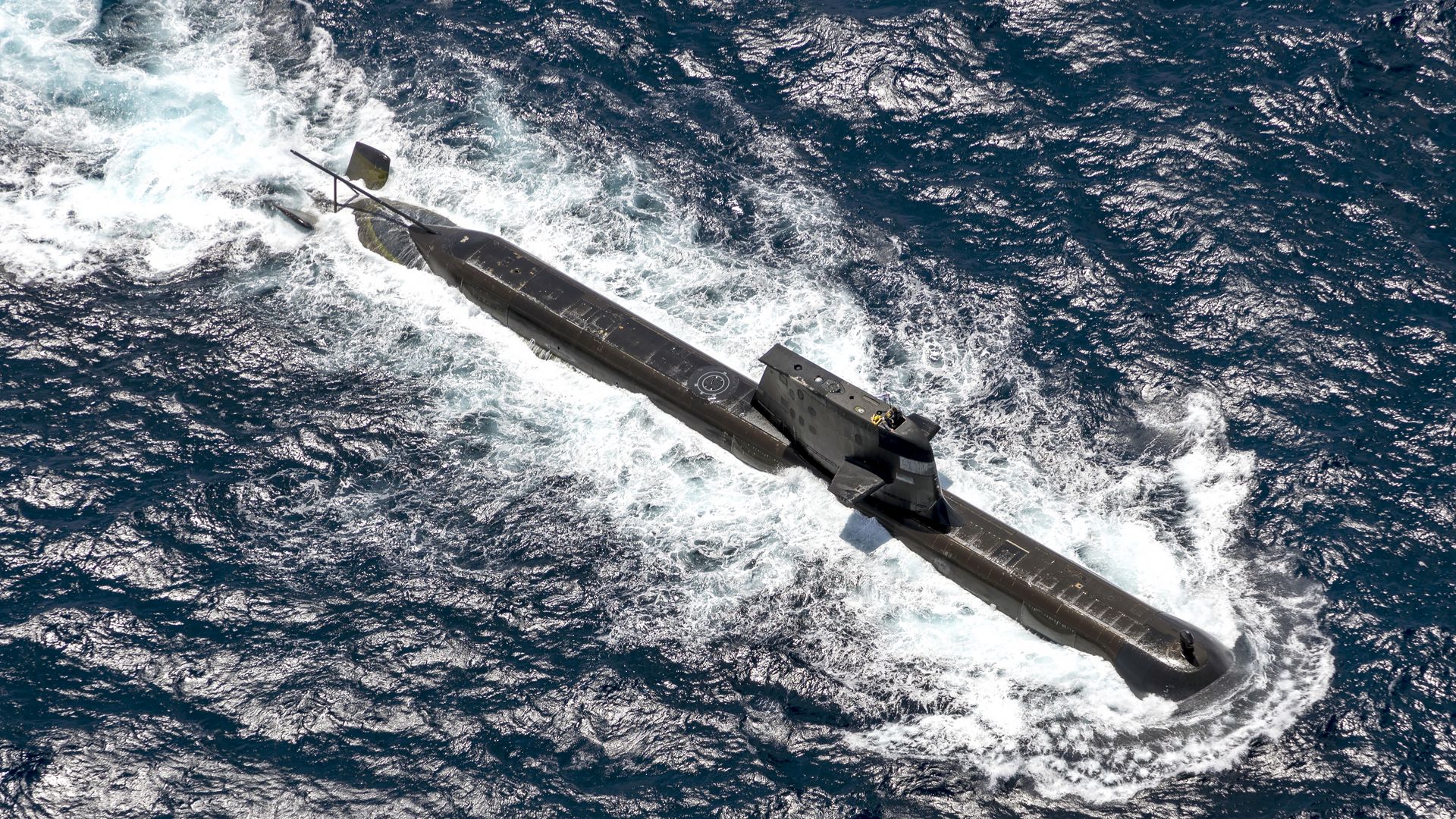
Royal Australian Navy submarine HMAS Rankin, spotted during AUSINDEX 21. Photo: Yuri Ramsey/Australian Defence Force via Getty Images
Everyone has an AUKUS take.
Why it matters: The landmark defense pact — designed to arm Australia, the U.K. and the U.S. with nuclear-powered submarines and cutting-edge tech, including hypersonic weapons and electronic jammers — is today navigating choppy waters.
Driving the news: The Pentagon's policy office, led by Elbridge Colby, last week announced that by fall it would conclude its "America First" examination of the initiative, which rolled out during the Biden administration.
- Colby has expressed AUKUS skepticism in the past, namely over resource allocation, but in March said Washington should "do everything we can to make this work."
The big picture: As the review proceeds, consider these factors:
Shipbuilding shortfalls. The U.S. struggles to construct, maintain and retrofit warships. The Government Accountability Office catalogues it. The Navy cops to it, too.
- Adm. Daryl Caudle, a career submariner turned chief of naval operations, last month told Congress the "delivery pace is not where it needs to be to make good on Pillar I of the AUKUS agreement."
- Pumping out the requisite two-plus Virginia-class subs per year, he added, demands "transformational improvement. Not a 10% improvement. Not 20%. A 100% improvement."
Actual application. How the Trump administration perceives Australia's commitment to using the subs, and to countering China, could make or break a ruling.
- "They've been very coy about how they would actually employ the submarines, other than to say, 'Well, it's a deterrent, it could be employed to defend Australia,'" Bryan Clark, a senior fellow at the Hudson Institute, told Axios.
- "You've got to be willing to say that you would use it offensively if you want to gain the deterrent value out of it," he said, "because China could come away thinking Australia is going to buy these submarines, but they don't have the resolve to use them."
Odds Down Under. Almost two-thirds of Australians surveyed in a recent Guardian poll thought it was unlikely the U.S. would deliver subs.
- And 41% of the voters thought the deal would not affect the country's security.
- Canberra in July cut a $525 million AUKUS check. Prime Minister Anthony Albanese denied in a television interview that it was an "extra" fee, insisting it was part of the "schedule of payments to be made."
- "It's about increasing their industrial capacity," he said.
Pillar II obscurity. Sub construction — or lack thereof — dominates headlines. Comparably less ink has been spilled on the co-development of defense tech like AI, autonomy and hypersonic countermeasures.
- Articles published by War on the Rocks in June and the Australian Strategic Policy Institute last year put it succinctly: Pillar II has a public relations problem.
- Policy and export reform isn't as attractive as novel weapons and their delivery.
- "The matter at hand — sophisticated, trilaterally supported innovation — seems to be unfurling lethargically," Peter Dean and Alice Nason argued in their War on the Rocks piece.
Common ground. A U.K. government spokesperson told Axios it "is understandable that a new administration would want to review its approach to such a major partnership, just as the U.K. did last year."
- Prime Minister Keir Starmer and President Trump have recently traded compliments, which could bode well for AUKUS.
What we're hearing: The trilateral agreement will survive, but perhaps in a somewhat different form and with a less optimistic timetable.
- "I infer that the administration is pro-AUKUS," one defense industry executive told Axios. "I think, internally, 'the Blob' is trying to portray it to Trump as a big, beautiful trade deal."
- "Everyone knows the sub industrial base is stressed, though."
The bottom line: The AUKUS anxiety is legit. The ongoing review is additional evidence nothing is sacred under Trump 2.0.
Go deeper: The Pentagon's dramatic divorce from D.C. orthodoxy
