Exclusive: Defense industry must collaborate more in Middle East, says Dunford

Add Axios as your preferred source to
see more of our stories on Google.
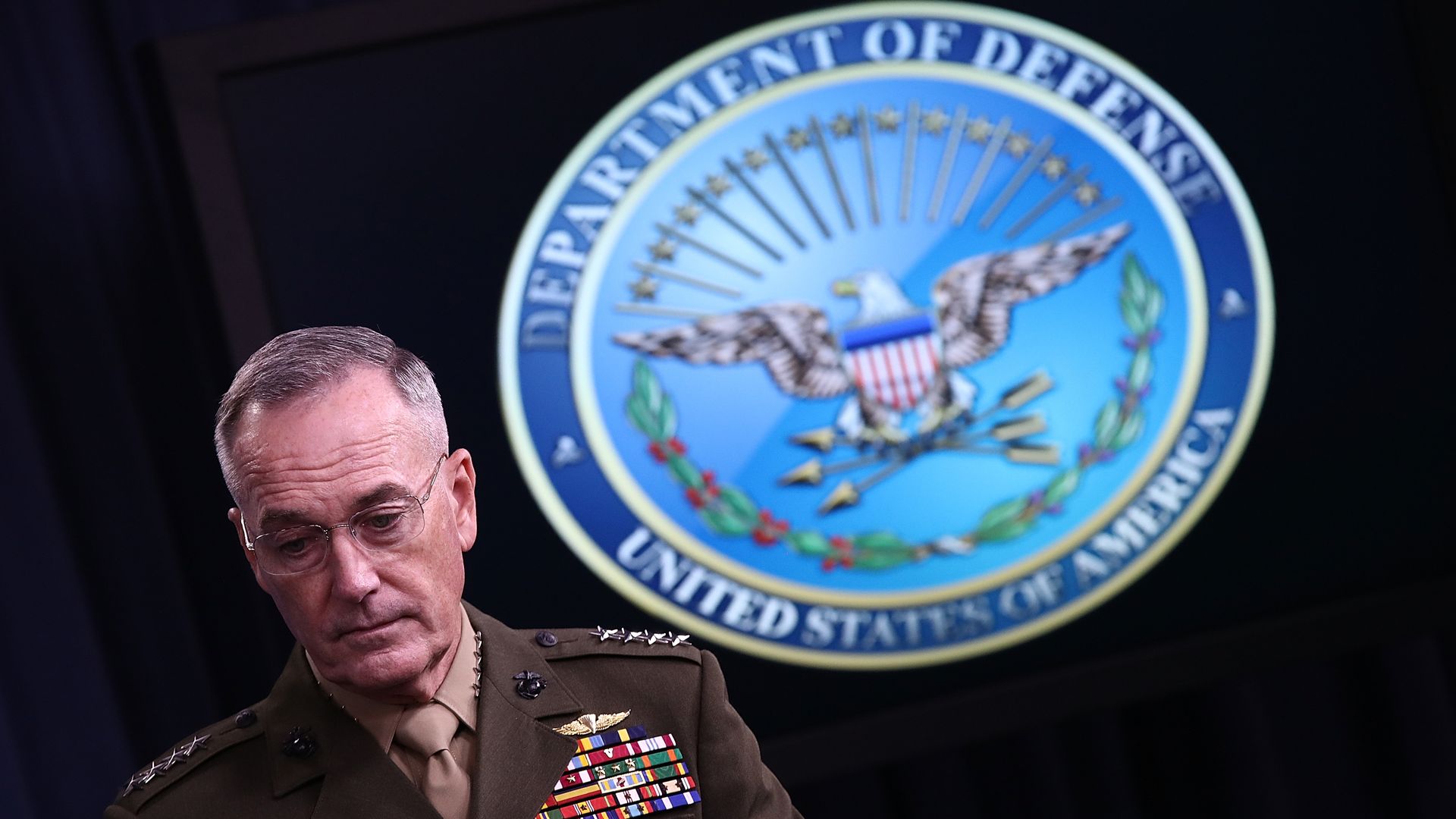
Joseph Dunford, pictured during his time as chairman of the Joint Chiefs of Staff. Photo: Win McNamee/Getty Images
The U.S. must collaborate with friendly Middle Eastern governments to strengthen a global industrial base and prepare for large-scale wars that will chew through raw materials and high-end munitions alike, according to a new study from Joseph Dunford, a former Joint Chiefs chairman, and Eric Edelman, a former undersecretary of defense for policy.
Why it matters: Conflicts are no longer regional. They are worldwide.
- Supply chains crisscross borders. Fights transcend singular domains. And countries long considered national security threats in Washington are growing intimate.
Driving the news: "Partners in Production: U.S.-Middle East Cooperation to Enhance Our Collective Defense Industrial Base" was published Wednesday by the Jewish Institute for National Security of America.
- Axios got an early look.
What they're saying: "I'm one who buys into the fact that our center of gravity was — and continues to be — the network of allies and partners that we have around the world," Dunford said in an interview.
- "The natural thing to do would be to look for ways to make our partners more capable and increase ... the aggregate defense industrial base of like-minded nations."
Zoom in: Cooperation could be as simple as procuring raw materials and as complex as codevelopment and coproduction of missile interceptors and clean-sheet weaponry, the authors argue.
Between the lines: The foundation is already built.
- The U.S. engages in defense-tech diplomacy overseas, mainly in Europe and the Indo-Pacific.
- U.S. defense contractors have fruitful relationships with Israeli counterparts, including Rafael and IAI.
- The Trump administration is courting Gulf states. It's also advocating for foreign military sales reform.
The bottom line: "The alignment of Russia, China, Iran, North Korea and other like-minded states — that's problem No. 1," Dunford said.
- "Problem two is the inadequacy of the defense industrial base," he added. "That's been exposed with operations in Ukraine, operations in Israel, planning to support Taiwan, and then U.S. requirements for U.S. military forces."
