Messy messaging on Ukraine underscores D.C. dysfunction

Add Axios as your preferred source to
see more of our stories on Google.
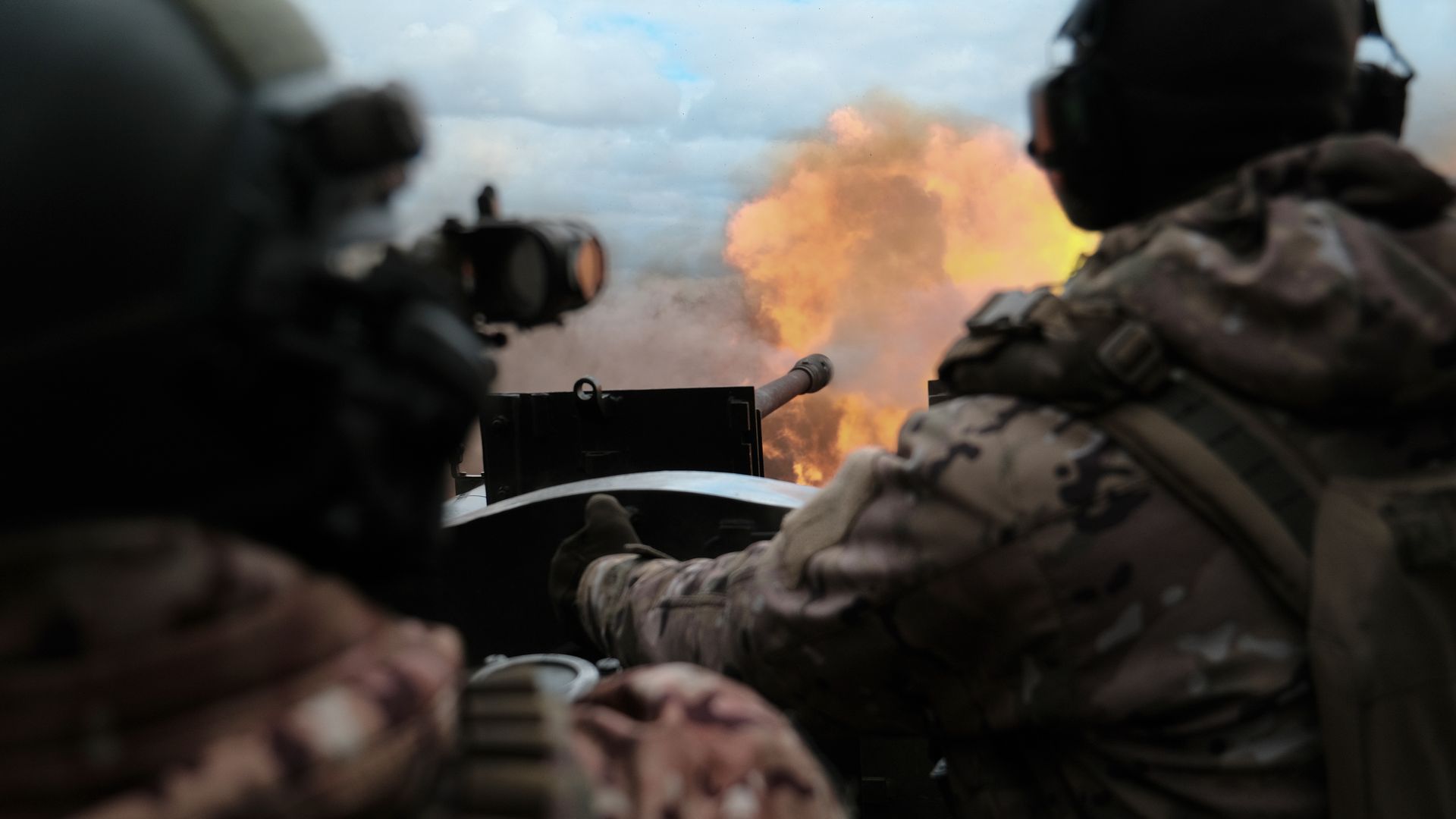
Ukrainian artillery fires in the Bakhmut direction in October 2023. Photo: Oleh Arkhanhorodsky/Global Images Ukraine via Getty Images
Recent U.S. messaging regarding Ukraine has been a cluster.
The big picture: Jumbled narratives and dismissive answers raise questions about what an "America First" foreign policy looks like, and who really holds the levers of power in Washington.
Driving the news: President Trump on Monday reversed a hold on weapons shipments to Ukraine. He told his counterpart, President Volodymyr Zelensky, in the intervening days he hadn't actually ordered the freeze, according to the Wall Street Journal.
- The suspension came after Trump asked Defense Secretary Pete Hegseth to take stock of Patriot air defenses and other key U.S. supplies, an adviser told Axios.
- It was Hegseth and Undersecretary of Defense for Policy Elbridge Colby who pushed for the pause, NBC News and Politico reported.
Zoom in: It's a breakout moment for Colby, who has argued for "strategic prioritization," aka elevating the Indo-Pacific and Taiwan's defense at the expense of other regions.
- In his March confirmation hearing, Colby warned senators the U.S. lacks a "multi-war military."
- He was also hesitant to name Russia as Ukraine's invader, citing a delicate diplomatic situation.
The intrigue: Trump has been reluctant to both blame Russia and equip Ukraine, telling aides that if he sends weapons to Kyiv it could become "my war," Axios' Marc Caputo and Barak Ravid reported.
- But Trump has grown increasingly frustrated with Russian leader Vladimir Putin, and German Chancellor Friedrich Merz has personally advocated for Ukraine's overhead defense.
- "We get a lot of bullshit thrown at us by Putin, if you want to know the truth," Trump said at a Cabinet meeting this week. "He's very nice all the time, but it turns out to be meaningless."
Zoom out: The Pentagon on July 2 blamed the arms holdup on a broader review of American support to militaries worldwide.
- "For a long time — four years under the Biden administration — we were giving away weapons and munitions without really thinking about how many we have," spokesperson Sean Parnell told reporters. (Former national security adviser Jake Sullivan rejected that thinking in an essay published in the New York Times.)
- Some Ukrainian needs overlap with those of U.S. troops abroad, including in the Middle East, where the largest Patriot engagement ever occurred last month at Al Udeid Air Base in Qatar.
What we're watching: It remains unclear which other countries fall under the administration's review, and where the line is drawn.
- The State Department, for example, authorized a potential $510 million sale to Israel at the end of June.
- Washington's also been working to beef up Taiwan.
The bottom line: "It is absolutely vital that security assistance continues to flow to force Putin to the negotiating table," Sen. Jeanne Shaheen (D-N.H.), the ranking member of the Foreign Relations Committee, said in a statement.
- "Unfortunately, last week's decision sent exactly the wrong message."
Go deeper: Changes to U.S. weapons sales mustn't be "haphazard," says Rep. Dean
