Axios Future of Defense
February 25, 2026

Good morning, and welcome back.
- Headed to the American Dynamism Summit next week? I am! Let's link.
💻 Situational awareness: Defense Secretary Pete Hegseth gave Anthropic CEO Dario Amodei a Friday evening deadline to provide the U.S. military unfettered access to the company's AI model or face harsh penalties, my colleagues reported yesterday.
Out with it: The Ford's ongoing odyssey, Lockheed Martin's plans for Legion-ES and oodles of defense-tech cash.
Today's newsletter is 1,942 words, a 7.5-minute read.
1 big thing: Canada "sends a message"

Canada's first-ever defense-industrial strategy, published this month, suggests it, like Europe, can no longer count on the U.S. to be a security backstop, economically or militarily.
- "Long-held assumptions have been upended — about the end of imperial conquest, the durability of peace in Europe, and the resilience of old alliances," the plan reads.
- "In this uncertain world, it is more important than ever that Canada possess the capacity to sustain its own defense and safeguard its own sovereignty."
Why it matters: It's a major break for Canada, which has not taken President Trump's 51st state remarks lightly.
- Canadians today view the U.S. as more of a risk than a partner, according to a Globe and Mail poll conducted by Nanos Research. (Only 9% agreed that the "U.S. is a trustworthy ally of Canada.")
Driving the news: Prime Minister Mark Carney in a press conference promised to "double our defense expenditures by the end of this decade," prioritize business with Canadian defense contractors and pour resources into the Arctic.
- "The truth is, over the last few decades, Canada has neither spent enough on our defense nor invested enough in our defense industries," he said.
- "We have relied too heavily on our geography and others to protect us."
By the numbers: The strategy pledges to increase the share of defense acquisitions awarded to Canadian firms to 70%, boost defense exports by 50% and create 125,000 new jobs across the country's economy.
- That will take years.
- Small and mid-size businesses make up the vast majority of Canada's defense industry.
What they're saying: The blueprint and posturing around it send "a message to the defense primes, that they are not going to rely on American firms anymore," Jana Nelson, a former deputy assistant secretary of defense for western hemisphere affairs, told me.
- While "they're not arming against the United States," she said, they are "arming toward their own defense."
- "It's not an aggressive move — but it is a smart de-risking move."
Zoom out: This increased Canadian autonomy was foreshadowed by two recent events:
- A breakout decision to move ahead with Australia on an over-the-horizon radar project worth billions of dollars;
- And heated debate over American F-35 and Swedish Gripen acquisitions.
Reality check: Canadian security will remain inextricably linked to the U.S. into the future.
- Trump's Golden Dome ambitions stretch well beyond America's borders.
- North American Aerospace Defense Command is a shared endeavor.
- And Canada is a member of NATO and the Five Eyes intelligence partnership.
The bottom line: "Canada is finally aligning with Europe on a hard truth: sovereignty isn't declared, it's manufactured," Eliot Pence, the CEO of Dominion Dynamics, told me.
- The Canadian company announced a $15 million seed round in January.
Go deeper: Trump's Greenland gambit thrusts Arctic security into mainstream politics
2. Ford's wild ride
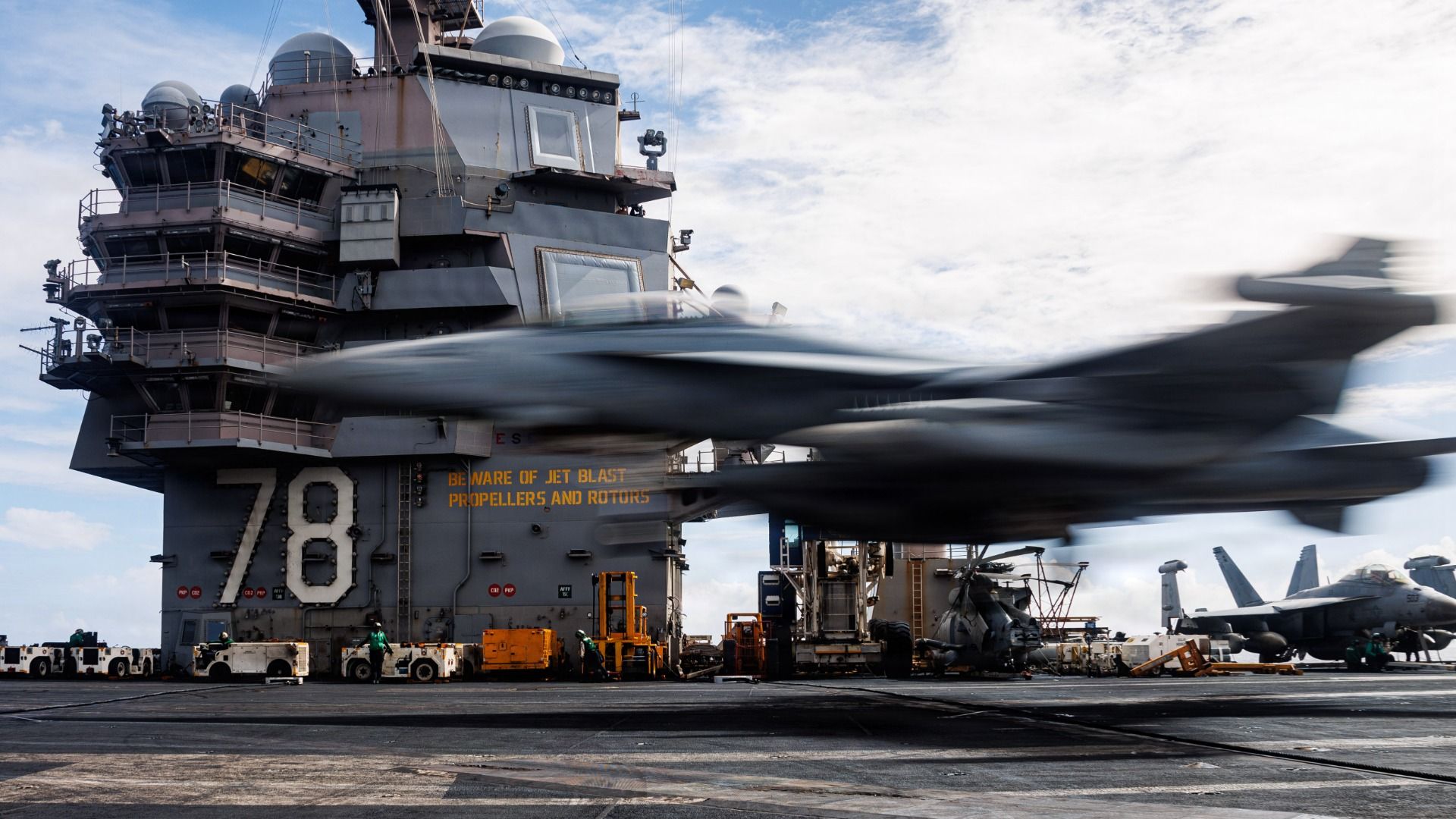
The U.S. Navy's Gerald R. Ford aircraft carrier left Virginia in June. It has since traveled to the Mediterranean and the Caribbean and is now arriving in the greater Middle East as President Trump threatens to pummel Iran.
Why it matters: The world's largest warship has been deployed for some eight months. That raises maintenance and morale concerns.
- Should it stay out until mid-April, it will break a post-Vietnam record, according to USNI News and its internal database.
Friction point: Chief of Naval Operations Adm. Daryl Caudle in January told reporters he would push back on further extensions of the Ford "because they do have significant impact."
- "People want to have some type of certainty they're going to do a seven-month deployment," he said.
- "When it goes past that? That disrupts lives. It disrupts things: funerals that were planned, marriages that were planned, babies that were planned."
- The CNO's office did not immediately respond to my questions regarding how Caudle is advising Trump.
The other side: The president this month said the Ford was needed "in case we don't make a deal" with Tehran.
Zoom out: An enormous amount of American firepower is coalescing in the Middle East. (It's the largest buildup inside Central Command in years.)
- Included are A-10, F-15, F-16, F-22 and F-35 warplanes, plus surveillance, communications, refueling and transport aircraft.
- Warships in the area are also equipped with hundreds of Tomahawk missiles, a Trump 2.0 favorite.
Flashback: Both the Harry S. Truman and Carl Vinson aircraft carriers were in the Middle East last year, dealing with Houthi rebels in Yemen.
More from Axios:
U.S. slashing military presence in Syria
3. Exclusive: Ready or not

Today's metrics don't give the U.S. military an accurate sense of its own readiness, as the Pentagon battles outdated procurement procedures and other countries quickly up-gun their troops, according to a General Catalyst Institute report first shared with me.
Why it matters: Misunderstandings about what works where and who is available when can be deadly. The report warns, for example, that flying a jet off Virginia is different than over a far-flung battlefield.
- "We need, in order to be survivable and lethal in that space, true, honest feedback of how our units are going to amass capability and execute the orders" of the president and defense secretary, GCI's Jonathan Clifford told me.
- "You can think about readiness as being binary, being zero or one. But in reality it is gray, just like the battlespace."
Driving the news: The report advocates for a composite readiness index. It would prioritize commander feedback, including on materiel performance downrange, the numbers on hand and ability to integrate with other services.
- Weapons or vehicles that regularly score low, the report states, should be scheduled for modernization — or sent to the scrap heap.
- "What is survivable in one theater may not be in another, and that will help commanders make more-informed decisions, or make more-informed decisions on their budgeting and capabilities," said Clifford, who previously worked on the Hill and in the Pentagon.
Zoom out: The report also suggests:
- Mandating adversarial testing, including for electronic and cyber vulnerabilities;
- Formalizing a "venture-capital-as-a-prime" model and better educating contracting officers about private markets and money;
- And investing equally in American production and innovation.
The bottom line: "Readiness is thrown around quite often as a buzzword," Clifford said.
- "A system that was born out of the 1980s, post-Goldwater-Nichols, is just as ripe for reform as the technology the Pentagon is buying."
Go deeper: Paul Kwan: VCs are overlooking biodefense
4. Sensors for Taiwan
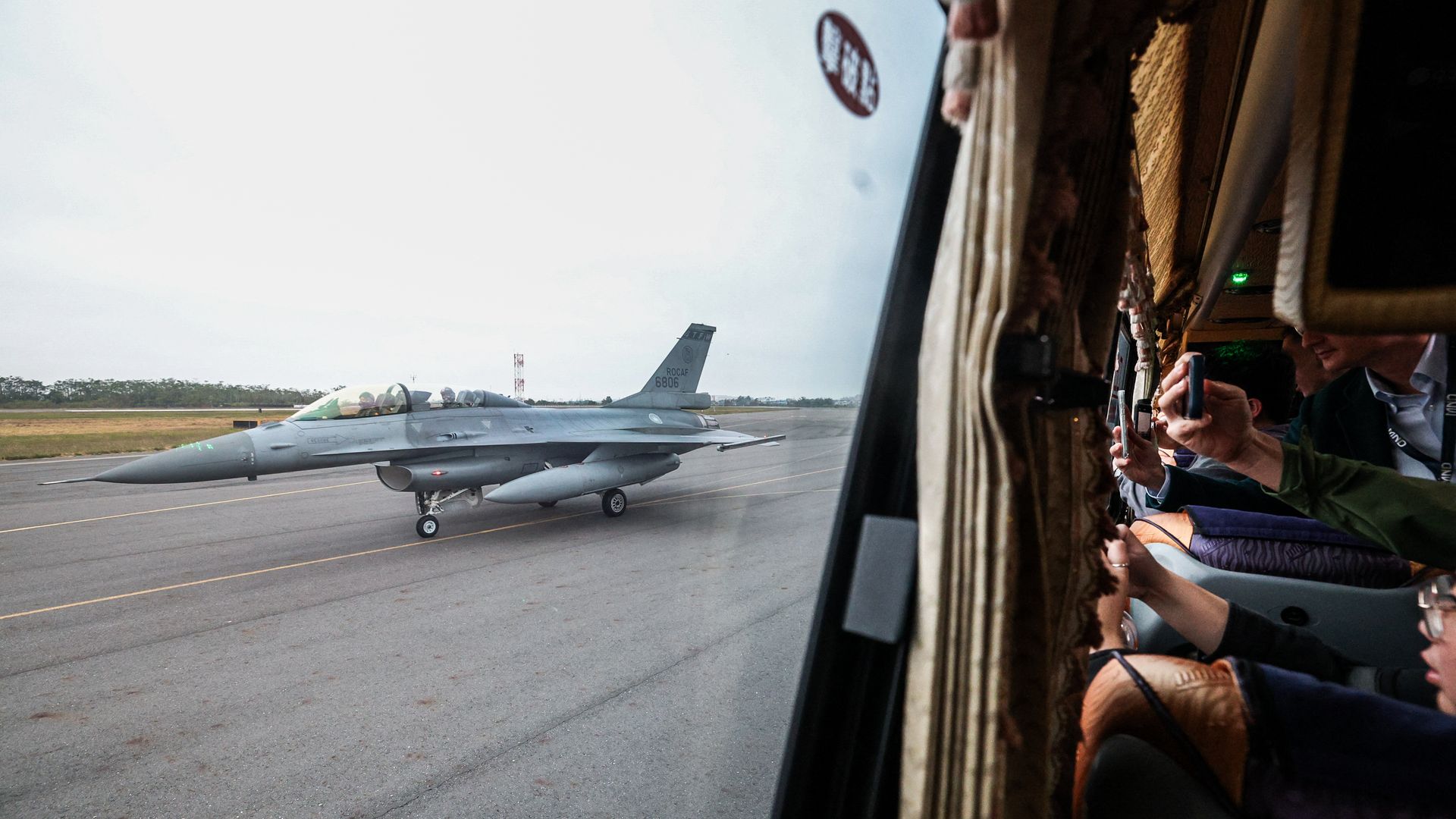
Lockheed Martin will provide Taiwan IRST21 Legion-ES sensors for their F-16s in a U.S. government deal worth $329 million.
Why it matters: The arrangement could improve Taiwan's ability to keep tabs on Chinese aircraft.
Driving the news: Lockheed's Patrick McKenzie discussed the contract and technology Monday at the Warfare Symposium in Colorado, weeks after word of the deal emerged.
- "If you are flying through the air, you're creating heat through skin friction, and this sensor will detect and be able to track that heat," he told reporters.
- "It'll improve some situational awareness, increase reaction time and then support survivability in those contested environments."
Zoom out: The People's Liberation Army entered Taiwan's air defense identification zone 3,075 times in 2024, according to the U.S.-China Economic and Security Review Commission.
What we're watching: The Davidson window.
Go deeper: Secretive Lockheed RQ-170 drones used in Maduro raid
5. ICYMI: The KC-390's future
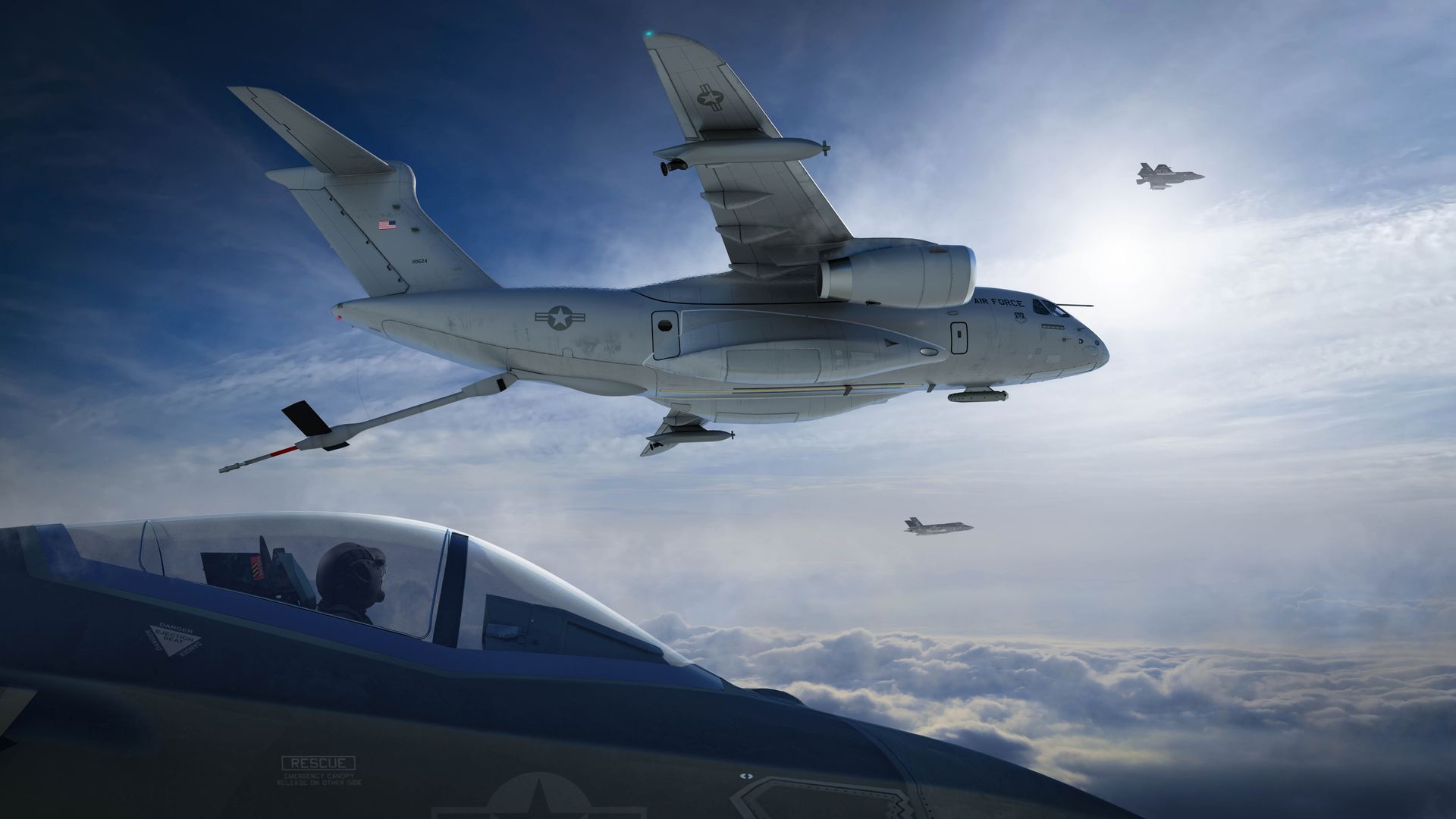
MELBOURNE, Fla. — Northrop Grumman and Embraer are exploring the development of an autonomous refueling device for the KC-390 Millennium that executives say could be demonstrated in a few years.
Why it matters: It's a play that returns Northrop to the tanker game while also potentially securing Embraer, a Brazilian company, the stronger stateside foothold it's been seeking.
- Air-to-air refueling is critical to military operations around the world.
Driving the news: Axios and other news outlets on Feb. 19 flew aboard a KC-390 and visited Northrop's facilities southeast of Orlando.
- That aircraft departed Brazil about a month ago and has been zipping around the world. It previously stopped in Singapore and is now headed to Europe.
- The KC-390 is flown by a handful of militaries including Brazil's, with several others in talks to acquire it. Embraer is marketing it to the Pentagon.
Zoom in: The KC-390 refuels via probe-and-drogue. That is largely incompatible with the U.S. Air Force.
- A refueling boom like the one Embraer and Northrop are discussing might pique the service's interest.
- "As I look at the marketplace ... really the next logical step for growth, for modernization, for recapitalization is the mobility market," Tom Jones, Northrop's president of aeronautics systems, told reporters.
- Conceptual art published by Northrop shows a boom extending from the back of the Millennium. The probe-and-drogue systems are still visible. The aircraft is flanked by F-35s, fifth-generation fighters used by more than a dozen countries.
Flashback: Embraer previously worked with L3Harris Technologies on a potential boom, among other things. That relationship fell apart in 2024, according to Breaking Defense.
The bottom line: "Air mobility operations are changing," Frederico Lemos, the Embraer Defense chief commercial officer, told reporters.
- "At the same time, the legacy tanker fleet faces a lot of challenges: numbers and availability and the ability they have to operate from dispersed locations," he said.
- "We need to bring something new."
Go deeper: Embraer teases counter-drone missions for Super Tucano
6. Quick hits

🪙 Chariot Defense, Aalyria and Code Metal raised millions of dollars, respectively. Chariot's Series A? $34 million. Aalyria's Series B? $100 million. And Code Metal's Series B? $125 million.
- Why it matters: The defense-tech spectrum is as wide as the investor wallets are deep.
- 💭 My thought bubble: Chariot exited stealth last summer. I broke that news, here.
🚀 The U.S. Navy is seeking a new anti-radiation missile with a longer range than existing options, according to a sources-sought notice.
- Why it matters: The service anticipates buying up to 300 of the so-called Advanced Emission Suppression Missiles annually. The munition must be compatible with existing aircraft, such as the F-18 and F-35.
- 💭 My thought bubble: Will a missile-making startup throw its hat into the ring?
🪽 General Atomics Aeronautical Systems said it's eyeing Joint Air-to-Surface Standoff, Long-Range Anti-Ship and Joint Strike missiles for use aboard its MQ-9B drone.
- Why it matters: "We want to continue to build value in the aircraft by expanding into more missions," GA-ASI president David Alexander said in a statement.
- 💭 My thought bubble: Start the clock. The company teased a flight as soon as this year.
🚧 Work on a prototype Sentinel launch silo at Northrop Grumman's Promontory, Utah, site kicks off this month, according to the U.S. Air Force.
- Why it matters: Infrastructure has been a major headache for the over-budget Sentinel nuclear missile, which is expected to replace the Minuteman III.
- 💭 My thought bubble: I'm moderating a nuke panel at a conference in Washington next month. Stay tuned.
7. Check this out
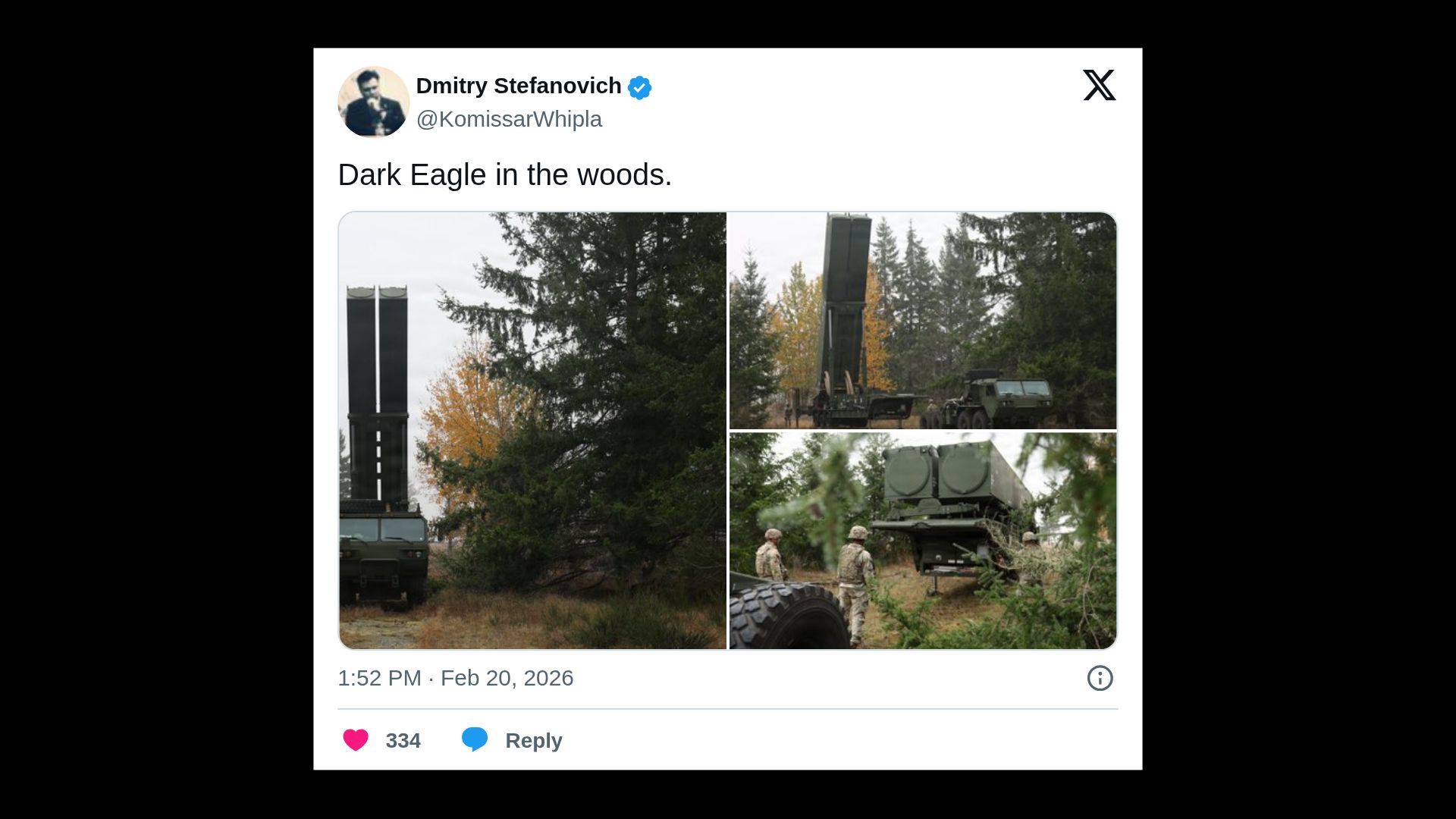
Photos of the U.S. Army's Dark Eagle hypersonic weapon appeared on DVIDS a few days ago. They were quickly scrubbed.
Why it matters: Conspiracies, man.
Driving the news: A few quick-fingered folks saved the images and are now debating their disappearance online.
- Was it the climate-control tubes? The wooded location? Or simply a PAO slip-up?
Go deeper: Army seeks "65-year change" in weapons trying and buying
Shoutout to Dave Lawler for editing and Matt Piper for copy editing.
👋🏼 Thanks, as always, for reading and sharing. Tell your friends to subscribe here.
Sign up for Axios Future of Defense