Trump-Xi meeting is high stakes for Taiwan

Add Axios as your preferred source to
see more of our stories on Google.
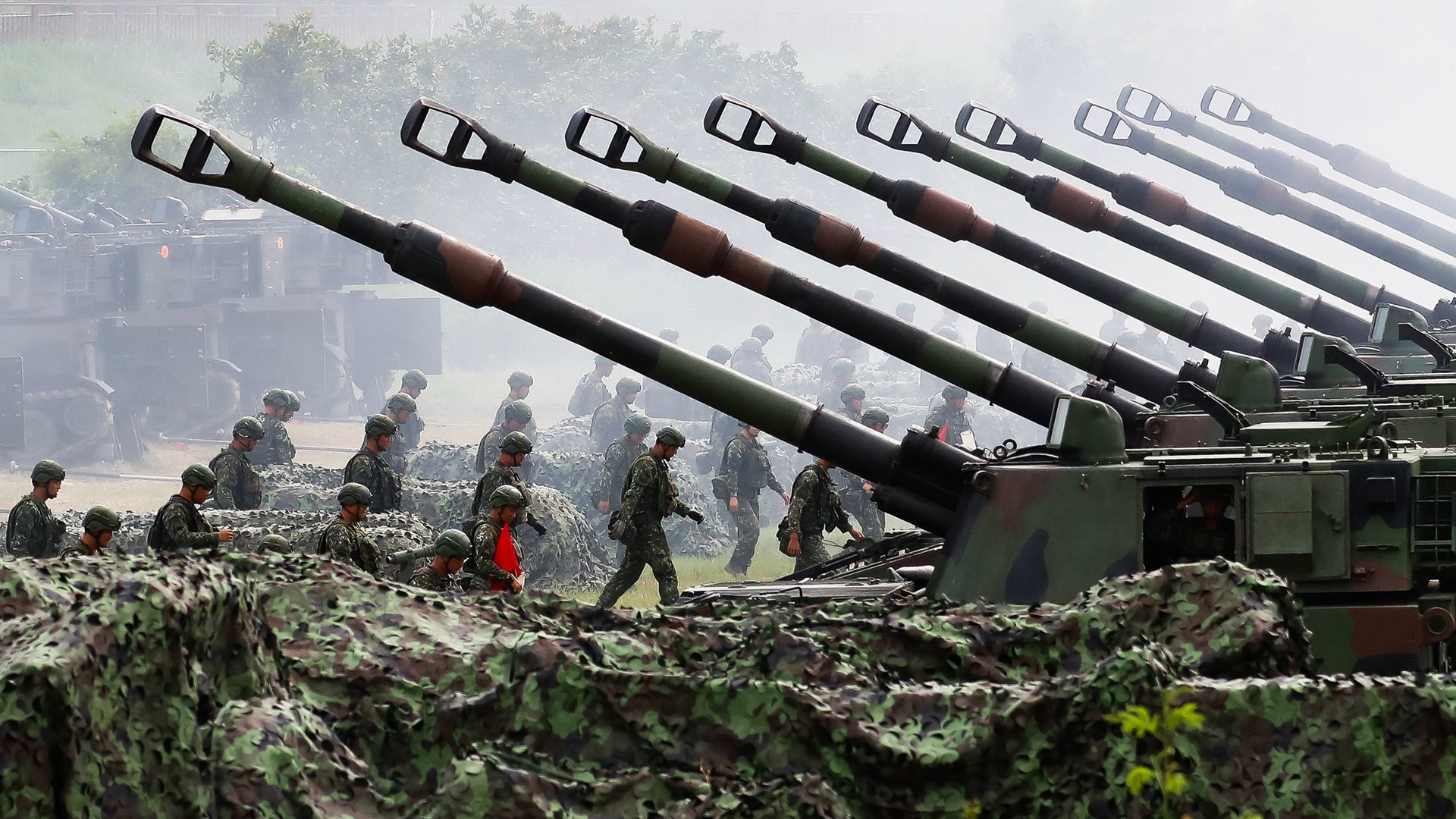
Taiwanese troops during artillery training, featuring M109 American self-propelled howitzers, in August 2024. Photo: Daniel Ceng/Anadolu via Getty Images
Eyes and ears are fixed to the Indo-Pacific this week, as President Trump leapfrogs across Malaysia, Japan and South Korea and prepares for a high-profile rendezvous with Chinese President Xi Jinping.
Why it matters: Trade is at the top of Trump's agenda, with the markets bracing for news on tariffs and export controls. But the two are also expected to discuss Taiwan, which remains a focal point of fears over potential great-power conflict.
- After all, the Davidson window — or the idea that Beijing could make a move by 2027 — is drawing near.
- Trump has sporadically cast doubt on America's willingness to defend the self-governing island, including by claiming Taiwan "stole our chip business." But he's also claimed Xi won't actually invade, at least while he's president.
- Any remarks Trump makes in South Korea will be parsed in Taipei.
Breaking it down: Axios discussed the state of play with Ambassador Alexander Yui, Taiwan's representative to the U.S., during last week's Future of Defense Summit. Here are some of the standout moments:
On invasions: "We are doing what we can to prop up our self-defense capabilities," Yui said.
- If Xi "calculates he can't do it quickly, I don't think he'll do it. I don't think the Chinese people have the stomach for a protracted war," he added.
- Russia's failure to achieve a speedy victory in Ukraine — coupled with a staggering number of recorded casualties — could factor into Xi's thinking.
On navigating Trump 2.0: The new administration is "obviously" different from its predecessors, but "we respect that because every country has its own way of managing things," Yui said. "Every day is still a surprise. It's been, what, nine, 10 months? There's been a lot going on."
- Taiwan is hardly alone in contending with Trump's surprises, including on security issues. Consider the experiences of NATO boss Mark Rutte or Ukrainian President Volodymyr Zelensky.
- But for Taiwan, where even a stray word in a presidential statement can spark concern at home or stoke tensions with Beijing, it's a particular challenge.
- "The communications — the relations — between Taiwan and the United States, it's very fluid, very close and very open," Yui stressed. "You are our most important partner."
On arms deliveries: "The F-16Vs that we purchased during President Trump's first term, the first plane rolled out in March. And the 66 we bought are supposed to be delivered all by next year," Yui said.
- "It's going to be a little challenging. But they're doing what they can to try to speed up. Same with other weapon systems."
- A delivery ceremony was held earlier this year in Greenville, South Carolina, where Lockheed Martin has a factory. But there remains a $21.5 billion backlog in U.S. arms deliveries as of September, according to the Taiwan Security Monitor.
On China's military: "The Chinese in the last decade or so have expanded their military prowess considerably. Look at the Sept. 3 parade — quite an impressive display of armaments. But their forces are not tested, and they have a pretty interesting situation with their military command," Yui said.
- Nine top generals were expelled this month, officially for financial crimes.
- Previous ousters included former Defense Minister Li Shangfu.
Zoom out: The Pentagon last year assessed that Taiwan continues "to improve defensive resilience through a whole-of-society approach."
- That includes "building its war reserve stocks, growing its defense-industrial base, improving joint operations and crisis response and strengthening its officer and noncommissioned officer corps," according to the latest China Military Power Report.
What we're watching: Trump's social media feeds as the talks wind down.
Go deeper: Crash in South China Sea underscores "incredibly tense" situation
