Exclusive: Inside Apex as it readies a Golden Dome demo

Add Axios as your preferred source to
see more of our stories on Google.
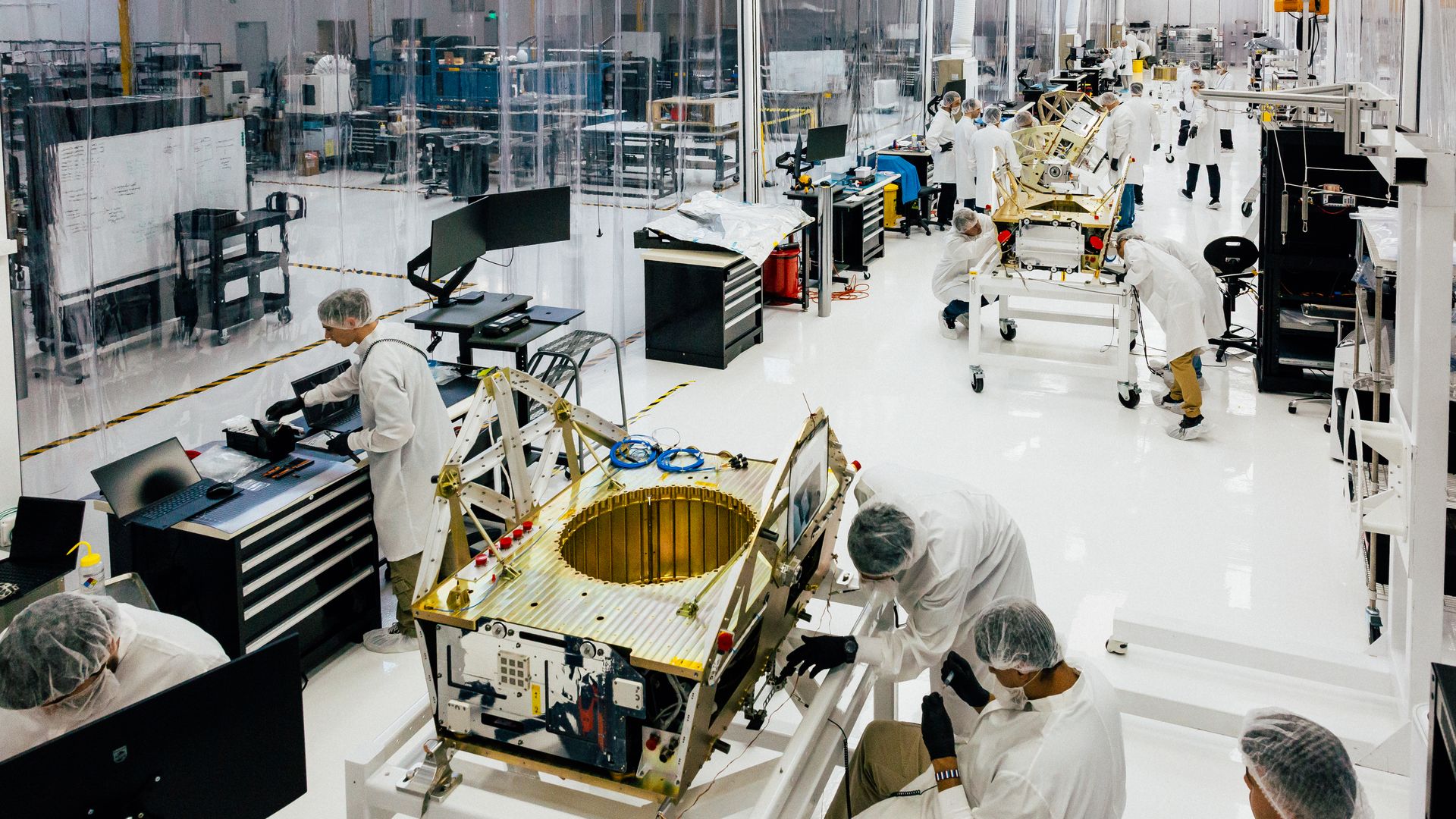
The Apex assembly line in Los Angeles. Photo: Courtesy of Apex
Apex wants to be the Toyota or Ford of space, according to chief executive Ian Cinnamon. President Trump's hemispheric missile shield could be its golden ticket.
The big picture: Ask around and you'll hear it repeated: The next war will be fought in space.
- That's one reason for the surge of speeches, spending and startups focusing on the domain.
- "When I was at Palantir, I was noticing: OK, the government is asking for people to launch not one satellite, but dozens or hundreds," Cinnamon told Axios. "Nobody's able to deliver on time and on schedule. Why is that?"
State of play: Apex builds satellite buses, or the platforms that star-bound payloads sit atop. Seven were on the production line when Axios toured the company's facilities just north of LAX airport. The company makes its own avionics, batteries and solar panels, as well.
- "We try to keep it really simple," Cinnamon said. "The key is a straight line all the way through. That's something that is, again, very much from the automotive mentality."
- The buses are popular: "The reality is we've been selling them faster than we can make them." The next "available one," he added, "is in March."
Zoom in: The buses come in three sizes. While the smallest works for electro-optical and hyperspectral sensors and the largest is good for communications and radar configurations, Cinnamon thinks the medium variant is ripe for Golden Dome.
- That's "really for missile tracking, missile warning, space-based interceptors, that kind of stuff," Cinnamon said.
- "When we saw the executive order, saw the line about space-based interceptors, the immediate reaction was this is the first time in history that we could actually have the pieces to pull this off."
Flashback: A similar feat was attempted during the Reagan era. It foundered.
The intrigue: Apex in October announced Project Shadow.
- Formally, it's an effort to validate what the company is calling "orbital magazines," or spacecraft that host and support interceptors. The upcoming demonstration includes two test fires; Cinnamon promised not to create additional space debris.
- Informally, it's a make-or-break moment powered by private capital.
- "The whole point of Shadow is ... to basically say, 'Hey, we actually know how to integrate all your pieces together,'" he said, without disclosing potential collaborators. "Think of us like a Tier 1 supplier."
By the numbers: Apex was founded in 2022. It now employs more than 230 people. Cinnamon wants to double that.
- The company raised $200 million in September, pushing its valuation above $1 billion. That Series D was led by Interlagos.
- Its $95 million Series B included support from Toyota Ventures.
Zoom out: Trump has set a 2028 target for Golden Dome. Defense Secretary Pete Hegseth has said the endeavor will create "tangible protection for this country" before he leaves the White House.
- That's a tight timeline — or an impossible one, according to critics, unless it's just a rehash of existing countermeasures. And cost estimates are scattershot. Billions? Yes. Trillions? Maybe.
- "This is not something that is going to be an overnight success by any means. And I think we have to be realistic about that," Cinnamon said.
- "There is a lot of work that needs to come together," he added. "Having one space-based interceptor does nothing for us."
What we're watching: How the Missile Defense Agency's Scalable Homeland Innovative Enterprise Layered Defense contract — worth as much as $151 billion — plays out, and who buddies up with Apex.
Go deeper: Ursa eyes space defense with $35 million Draper engine deal
