Eight takeaways from the Pentagon's Donroe-inspired defense strategy

Add Axios as your preferred source to
see more of our stories on Google.
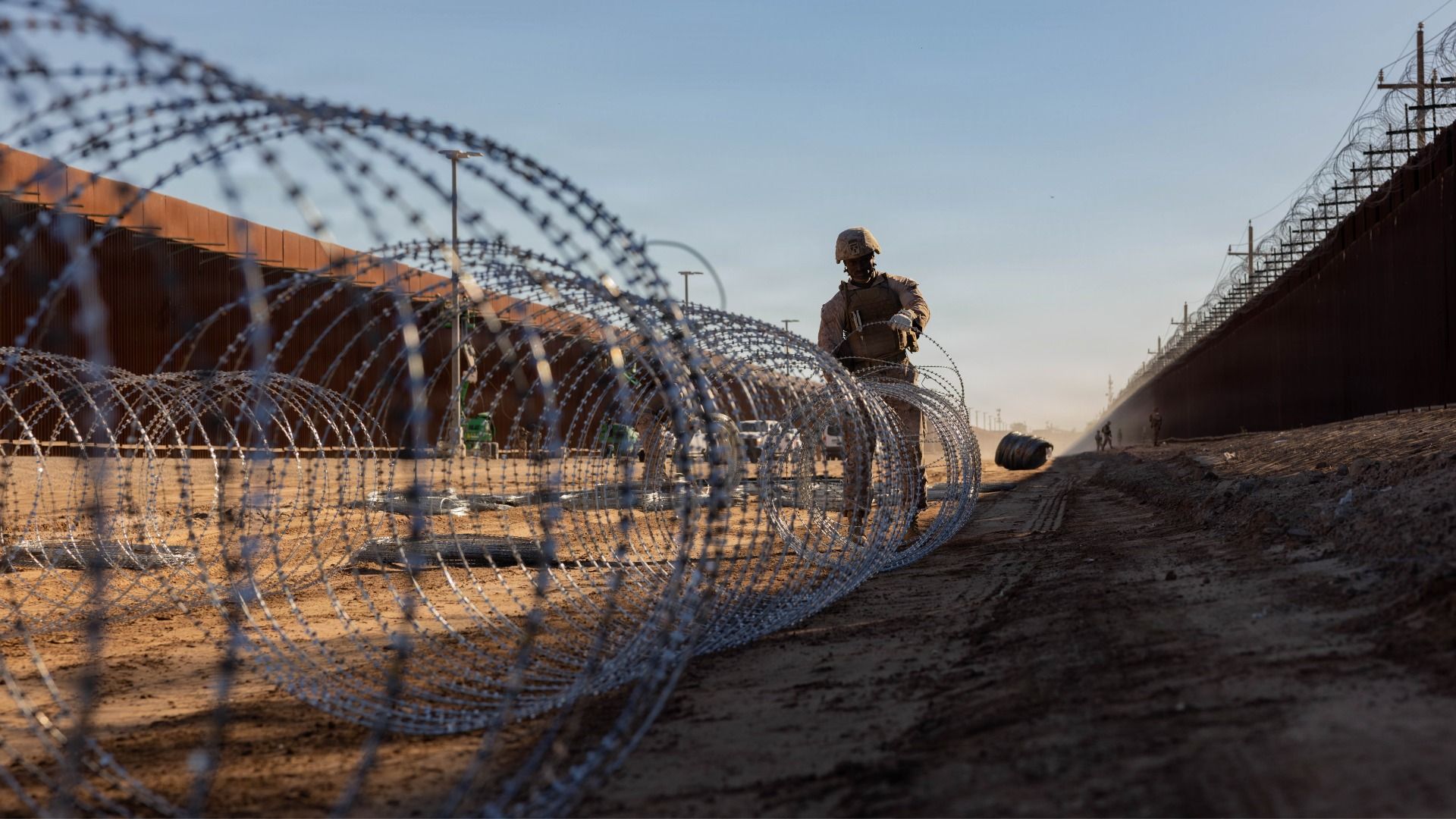
A Marine assigned to Joint Task Force-Southern Border prepares concertina wire in Yuma, Arizona, in December 2025. Photo: Stella Tedesco
The Pentagon published its premier national-security blueprint on Friday night with little warning or fanfare, ahead of the heftiest snowstorm Washington had seen in years.
The big picture: The unclassified National Defense Strategy, some two dozen pages, is the Donroe Doctrine made manifest. The "rules-based international order" is dismissed as an "abstraction," and the emphasis is on hard power close to home.
- Inside the document, homeland defense is often perched above or before China and Russia, typically considered top threats.
- "For too long, the U.S. government neglected — even rejected — putting Americans and their concrete interests first," it begins.
- "This strategy is fundamentally different from the grandiose strategies of the past post–Cold War administrations, untethered as they were from a concrete focus on Americans' practical interests."
Here are some of the most eyebrow-raising takes in the strategy:
It denies isolationism while also promising that the military will no longer be "distracted by interventionism, endless wars, regime change and nation building."
- It's similar to the pledge Defense Secretary Pete Hegseth made at the Reagan National Defense Forum in December.
It cites in one sentence the "speed, scale and quality of China's historic military buildup" and in the next notes the goal is "not to dominate China; nor is it to strangle or humiliate them." Another promises robust defenses along the first island chain, including Japan, Taiwan and the Philippines.
- Beijing is pressuring Taipei as 2027 nears. Its Justice Mission drills, involving warships, warplanes and more, followed news of an $11.1 billion arms package.
It warns that Russia, despite its demographic and economic struggles, retains "deep reservoirs" of military and industrial power.
- Moscow's invasion of Eastern Europe grinds on, buttressed by China, Iran and North Korea. European officials are rightfully worried Vladimir Putin will not stop at the edges of Ukraine.
It alludes to a change in posture on the Korean Peninsula, on the heels of multiple reports that the U.S. would withdraw some of its forces there.
- South Korea, it states, "is capable of taking primary responsibility for deterring North Korea with critical but more limited U.S. support." Expect change.
It makes clear that American access to the Panama Canal and Greenland is paramount.
- Canada, it adds, can play a vital role in overhead and undersea defense. President Trump at Davos this month said the country gets "a lot of freebies" from Washington and should show more gratitude.
It warns of a potential war across multiple theaters against multiple aggressors. It dubs it the "simultaneity problem."
- The bipartisan Commission on the National Defense Strategy in July 2024 warned the U.S. is unprepared for such a bloody, widespread fight.
It pins Islamic terrorism and its tendrils as the top concern in Africa.
- American troops have repeatedly bombed the Horn of Africa, targeting ISIS-Somalia and al-Shabab. However, U.S. presence in the Sahel has decreased significantly in recent years.
It praises President Trump for avoiding "a world war just a year ago" and for leading the country into a "new golden age."
- Everything is golden in Trump 2.0. The domes. The fleets. The visas.
Between the lines: Past administrations have front-run such strategy documents with background briefings for reporters and think tankers to shape the debate.
- Quietly publishing it when D.C.'s attention was elsewhere is typical of this Pentagon's bunker mentality.
Go deeper: Trump challenges where America fights and how it arms itself
