Axios Future of Defense

December 10, 2025

I'm officially back on the East (best) Coast. I've traded sun for snow.
- Got plans Thursday? I'm chatting with the CEO of USA Rare Earth at an Axios event in Washington. Doors open at 5pm.
⚓️ Situational awareness: The U.S. Navy and Palantir Technologies yesterday announced "ShipOS," software they said will initially help build and maintain American submarines but could soon be used for aircraft carriers and jets.
Keep an eye out: Night vision gains, missile-making factories and F/A-XX pressures.
Today's newsletter is 2,122 words, an 8-minute read.
1 big thing: The presidents' precedent

To better understand Trump 2.0, perhaps it's best to consult past presidents.
The big picture: President Trump wants a big-spending but smaller-footprint military, focused on the Americas, with deterrence for adversaries and some distance from allies. His team is turning to history to justify that outlook.
Driving the news: In a speech given to the Reagan National Defense Forum in California this weekend, Defense Secretary Pete Hegseth invoked four commanders in chief and sought to separate Trump from a fifth.
- Trump, he said, is the "true and rightful heir of Ronald Reagan."
- The Monroe Doctrine, articulated by President James Monroe, "is in effect and is stronger than ever under the Trump corollary," he said.
- The U.S. "will be strong" but not "unnecessarily confrontational," he said. "To quote another great Republican president, we will speak softly and carry a big stick." (Note: Speaking softly is not exactly Trump's trademark.)
- Trump "restored freedom of navigation," he said, referencing fights in Yemen and the Red Sea. "Somewhere, Thomas Jefferson is smiling."
- And in stark contrast, he said, the Biden administration was "more concerned about Ukraine's borders than our own."
State of play: Hegseth's rhetoric adds color to the White House's national security strategy, which arrived this month. The document prioritizes the Western Hemisphere while chiding past administrations for overreaching. It generated alarm in Europe, plus praise from Moscow.
- "Out with utopian idealism, in with hard-nosed realism," Hegseth said at the conference.
- "The War Department will not be distracted by democracy building, interventionism, undefined wars, regime change, climate change, woke moralizing and feckless nation building," he added.
- "We will instead put our nation's practical, concrete interests first."
Zoom in: Bits of the presidents' precedent schtick are already in play.
- Golden Dome is seen as the successor to the Reagan-era Strategic Defense Initiative, which ultimately foundered.
- And Trump is deploying the military closer to and at home more frequently, including in major U.S. cities, the southern border and the Caribbean.
Reality check: Words may not always match reality. While blasting past presidents for nation-building and vowing to extricate the U.S. from the Middle East, Trump is also about to name himself chair of a governing board for Gaza.
- The four presidents Hegseth mentioned also had contrasting foreign policies, though all took interventionist or expansionist approaches within the hemisphere.
Between the lines: While attempting to define Trumpism in the present, Hegseth and company are also litigating the past — placing Trump in the tradition of Teddy Roosevelt and Ronald Reagan, while his critics contend the contrast could hardly be starker.
- "Folks in Washington like to invoke President Reagan's name, often when they criticize President Trump. They say, or at least insinuate, that Donald Trump is nothing like Ronald Reagan," Hegseth said.
- "But those folks are wrong. They are dead wrong."
Go deeper: Trump 2.0 refashions U.S. military muscle
2. Exclusive: Palantir in New Hampshire

A partnership between L3Harris Technologies and Palantir Technologies is producing "significant improvement" in night-vision goggle production, among other payoffs, according to the companies.
Why it matters: American manufacturing is under the microscope.
- That's especially true for military contractors, amid calls for additional capacity and reindustrialization.
Driving the news: L3Harris' Samir Mehta and Palantir's Kevin Kawasaki described to me at the Reagan National Defense Forum how collating and modeling the right data pulled from the right systems has refined results at facilities in Londonderry, New Hampshire.
- "If we get an order for 500 goggles, and it's a drop-in order, and Special Operations Command says it's the most important thing that we should be working on ... we can simulate that very quickly and say: 'In order to accommodate that, here's what we need to do: We need more labor here, we need to divert some supply chain there, we're six parts short that we have to go expedite,'" Mehta said.
- In some cases, decisions that previously took days or weeks are now taking hours.
State of play: L3Harris and Palantir revealed partnership plans in October 2024. The two were already working together on the Army's Tactical Intelligence Targeting Access Nodes, futuristic command-and-control trucks.
- Their collaboration has since netted advances in situational awareness and target identification as well as in using radios as sensors.
- "There's information and data everywhere," Mehta said. "There's oodles of it."
Follow the money: L3Harris announced a $263 million deal for continued Enhanced Night Vision Goggle-Binocular production in January.
The bottom line: "We see bringing artificial intelligence to U.S. manufacturing as a national security issue," Kawasaki told me.
- "If you need to increase capacity in the United States, we can't just double our labor force. It doesn't exist," he said.
- "I need the person standing and sitting on the manufacturing line to have the best technology. And I need the warfighter to have the best technology, as well."
Go deeper: Ukrainian feedback is fueling L3Harris radio updates
3. Castelion wants "a lot of munitions"

Hypersonic missile-maker Castelion anticipates pumping out Blackbeard munitions at its to-be-built New Mexico factory as soon as 2026, with the ultimate goal of producing thousands per year, according to CEO Bryon Hargis.
Why it matters: "If you want to achieve deterrence, you have to make a lot of munitions," he told me on the sidelines of the Reagan National Defense Forum.
- "It's not suitable to just have high-capability munitions, which is what the country's done a very good job of to date."
Driving the news: The young company has made two splashy announcements in the span of weeks:
- A $350 million Series B, led by Altimeter Capital and Lightspeed Venture Partners. (Other backers include Lavrock Ventures, Andreessen Horowitz and General Catalyst.)
- Project Ranger, a 1,000-acre plant in Rio Rancho, outside of Albuquerque. A second footprint is also under consideration elsewhere.
"Project Ranger is all about scaling out an enormous production capacity," Hargis, a former SpaceX national security executive, said. "We ordered the steel buildings for the site — like 20-plus buildings — six months before we even had the site. We're going as fast as possible to make it happen."
Zoom in: The Blackbeard missile has undergone more than 20 developmental test flights; Castelion conducted a trial just days ago. And the company earlier this year won contracts for Army and Navy integration.
- "If you're going to field, if you're going to have that deterrent effect, you have to be integrated into what the rest of the U.S. has," Hargis said.
- "It has to launch from something to get there. It has to be in the supply chain."
Threat level: The U.S. hypersonic arsenal trails those of China and Russia. And much has been said about woefully small weapons stockpiles — and just how quickly they'd be expended in a real fight in the Indo-Pacific or Europe.
- "For Blackbeard, being a medium-range hypersonic weapon, the country has never built anything like this at any kind of scale," Hargis said.
What we're watching: If the Pentagon's hunger (read: budget) matches Castelion's aggression.
4. "Five more Andurils"
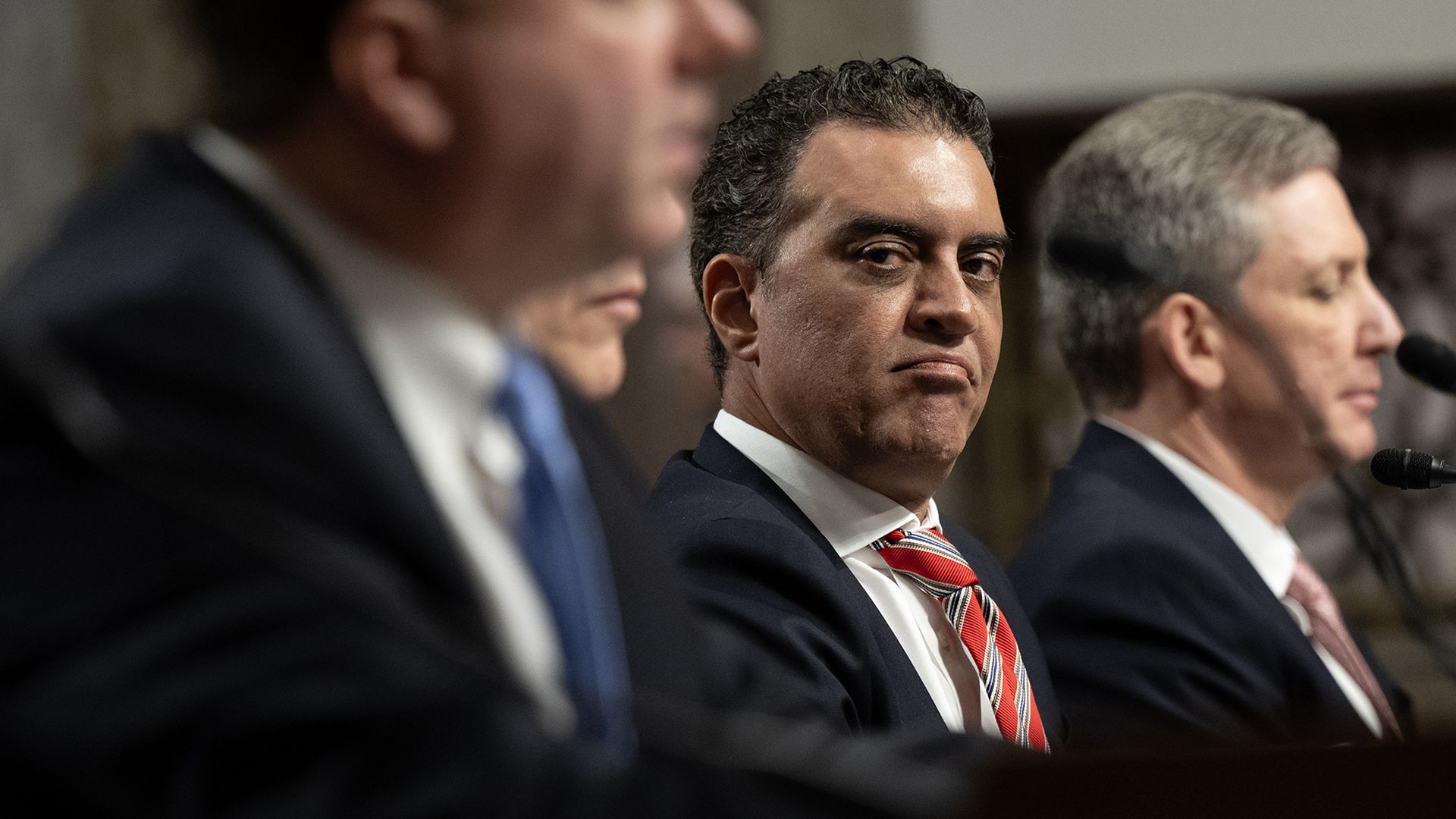
Pentagon chief technology officer Emil Michael would like to see "five more Andurils and Palantirs and SpaceXs" flourish, he told reporters Monday.
Why it matters: His remarks reflect the growing momentum of neo-prime contractors, the influx of private capital into the defense world and the U.S. military's growing affection for dual-use equipment.
What they're saying: "The enthusiasm, the amount of dollars going into this from a national security standpoint is, frankly, amazing," Michael said at a Defense Writers Group lunch in Georgetown.
- "If we bring five more of those in, then you're going to have a much more robust, competitive environment, vis-a-vis the primes, and I think everyone goes faster and gets cheaper."
Context: Michael previously served on the Defense Business Board. He was also Uber's chief business officer.
The intrigue: Each company referenced has a different role in the defense pool: hardware, including drones and missiles; digital transformation, namely artificial intelligence; and space.
Flashback: Palantir successfully sued the Army in 2016.
- It has since inked significant contracts, including a potential $10 billion software-and-data arrangement. Prior to that, it won a $178 million competition for Tactical Intelligence Targeting Access Nodes.
Go deeper: Defense industry heaps praise on Hegseth's weapons-buying reformation
5. F/A-XX's fate

A decision concerning the fate of the U.S. Navy's futuristic fighter must be "made quickly," considering how long it will take to build, test and get familiar with such a sophisticated warplane, the chief of U.S. naval operations said.
Why it matters: The service's F/A-XX endeavor has been, at least publicly, stuck in limbo.
- Rumors of an imminent contract award have come and gone, as opinions of Trump 2.0 officials clash with those of military leadership.
What they're saying: "As far as next-generation tactical aircraft for the Navy, I'm a huge fan of that. That's an imperative for any air wing of the future," Adm. Daryl Caudle told reporters huddled with him at the Reagan National Defense Forum.
- "High-end warfare can be enabled with unmanned, can be enabled with space and cyber effects, of course, but at the end of the day, you've got to bring the lead, and the mass has to be delivered."
- "Every day you do a decision delay is one day later I'm already not getting something."
Catch up quick: F/A-XX has been in the works for years. Boeing and Northrop Grumman are competing for the secretive multibillion-dollar deal; neither has divulged much about their approach or design.
- Boeing earlier this year won the Air Force's Next Generation Air Dominance competition, earning it the right to build the F-47. The Trump administration has since said it does not think industry can handle both jets at the same time — a point contractors reject.
- Northrop CEO Kathy Warden in November told me she was confident in her company's abilities. Steve Parker, the CEO of Boeing's defense business, told reporters in Paris this summer that his company's "capital investment was for both programs."
The intrigue: Navy Secretary John Phelan told me he is discussing F/A-XX with Defense Secretary Pete Hegseth and his deputy, Steve Feinberg.
- Asked if he considers the project alive, he said: "As far as I'm concerned, yes."
Go deeper: Navy nominee wants futuristic fighter despite White House doubts
6. Quick hits

🐝 Beehive Industries said its 3D-printed engine, Frenzy, is now validated for flight. The company shipped two engines to Ohio for high-altitude tests in October.
- Why it matters: "Frenzy is now flight-ready, and our production system is ready to scale alongside it," David Kimball, Beehive's chief technology officer, said in a statement.
- 💭 My thought bubble: Another engine competitor is always welcome.
☑️ Boeing completed its acquisition of Spirit AeroSystems.
- Why it matters: It's a multibillion-dollar deal. Plus, Spirit Defense "will continue to support its customers as an independent supplier to the defense industry to ensure uninterrupted support for its customers," Boeing said in a statement.
- 💭 My thought bubble: Breaking Defense's Valerie Insinna has a punchy rundown of the deal, here.
💥 Teledyne FLIR Defense will deliver more than 600 Rogue 1 attack drones to the U.S. Marine Corps, following word of a $42.5 million contract.
- Why it matters: The deal "represents our first production rate contract in the loitering munition market, following the initial test and evaluation contract in 2024," George Bobb, CEO of Teledyne Technologies, said in a statement.
- 💭 My thought bubble: I've been monitoring Rogue 1 since May 2024, and took one of the first public images. No, seriously.
🇹🇭 Israel Aerospace Industries will arm the Royal Thai Air Force with its Barak MX air defense systems, capable of tackling missiles, drones and aircraft.
- Why it matters: CEO Boaz Levy described the deal as "a significant milestone for IAI in East Asia, with Thailand being a key and influential country in the region."
- 💭 My thought bubble: For what it's worth, Asian Military Review pegged the value at $108 million.
7. Check this out

A quartet of Chinese ships sailed through the Philippine Sea last week.
- Vantor captured them in transit.
My thought bubble: There's wild detail in this satellite imagery. If you squint, you can even see a helicopter mid-flight.
- What does this level of commercially available specificity and speed mean for maritime domain awareness? Targeting? What about surface fleets, more broadly?
Go deeper: China is "eating our lunch in space," U.S. defense threat expert says
Shoutout to Dave Lawler for editing and Matt Piper for copy editing.
👋🏼 Thanks, as always, for reading and sharing. Tell your friends to subscribe here.
Sign up for Axios Future of Defense