Uber wants drivers to train AI in their free time

Add Axios as your preferred source to
see more of our stories on Google.
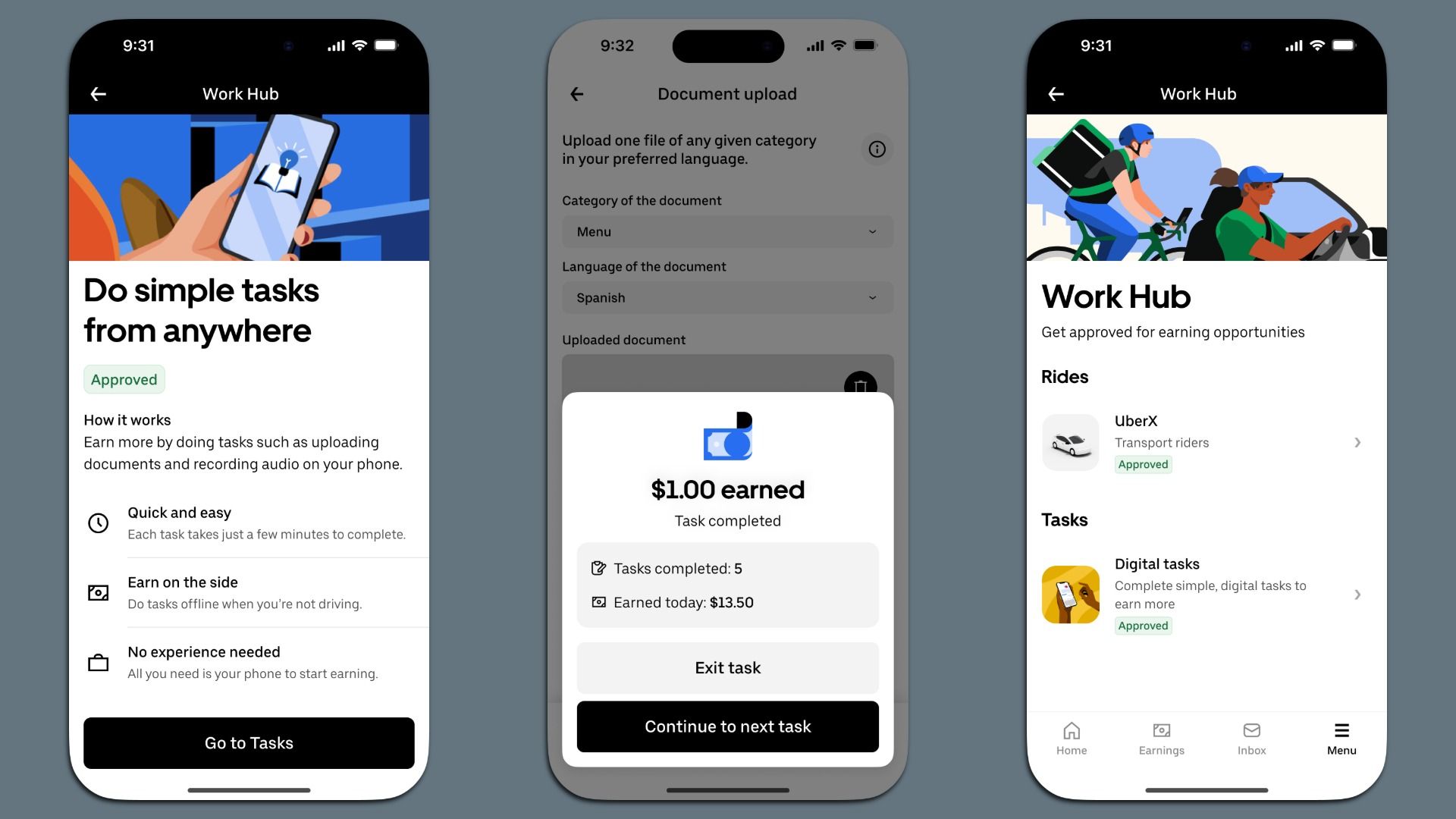
Credit: Uber
Uber's new "digital tasks" program lets drivers get paid for small jobs that help train AI models when they're not driving.
Why it matters: As driverless robotaxis begin to fill streets in scattered cities across the U.S., Uber is enlisting its gig workforce to help train the technology that could replace them.
The big picture: The pilot program, unveiled at an event for Uber drivers on Thursday, lets some U.S. drivers and couriers opt in to perform simple online jobs — like recording short voice clips, uploading photos, or submitting documents used to train AI — directly in the Uber Driver app.
- Uber says the success of a beta test in India convinced it to expand the trial, which it plans to do by the end of 2025.
- The program is a way to give drivers flexibility to earn while their electric cars are charging, or while they're at home on the couch watching sports.
Between the lines: Each task takes only a few minutes, pays a set amount, and appears in drivers' balances within 24 hours, per Uber.
- A presentation from the launch event showed screenshots of the app paying $0.50 for a 2-3 minute task and $1 for a task that takes 1-3 minutes, but Uber says that the screenshots aren't representative of real tasks because the pilot isn't live yet.
- "Pay will be determined at the task level based on its complexity and the time required," per Uber.
- The company says task availability depends on "client needs," suggesting these are crowd-sourced data jobs that may fluctuate in volume.
Reality check: The digital tasks will not be related to any of Uber's autonomous partnerships for rides, like the one they have with Waymo, according to the company.
- The tasks will come from Uber AI Solutions, a nearly year-old platform that provides audio, video, images and text data sets to customers training their own AI models.
- The Uber AI Solutions website shows that some of those clients include self-driving tech companies Aurora and Tier IV.
- Helping those companies refine their algorithms for autonomous vehicles means drivers are effectively helping train robots to drive.
Catch up quick: Most modern generative AI systems have been trained, in part, by humans labeling the data. The pay is often low and the work can be inconsistent, but the payout for big labeling companies is lucrative.
- Earlier this year Meta paid around $15 billion in cash for a stake in labeling giant Scale AI and also poached its star CEO Alexandr Wang.
- In 2018 researchers estimated that by 2023 the global market for data labeling would reach more than a billion dollars. In 2024 the market size was valued at nearly $4 billion, and it's expected to reach over $17 billion by 2030.
- In 2019 Axios called these data labelers "AI sharecroppers," making anywhere from $2.50 to $15 an hour, depending on the work and where the workers lived.
- Amazon's Mechanical Turk project, for example, has been outsourcing digital tasks for pennies since 2005.
What they're saying: In the presentation announcing the digital tasks program, Uber CEO Dara Khosrowshahi said Uber's drivers were doing more rides than ever and earning more tips.
- In Phoenix, Austin and Atlanta — the cities where Uber has partnered with Waymo to provide self-driving rides in the Uber app — earnings per hour have been consistent with cities without autonomous vehicles on the road.
- In the era of the infinite workday when every moment can be monetized, an Uber spokesperson told Axios that in an effort to keep drivers' eyes on the road, new tasks won't appear in a drivers' hub if they are online and actively accepting trips.
The bottom line: Whether you're a knowledge worker or a gig worker or somewhere in between, it's hard not to think that with every key you press or file you upload you're training your digital replacement.
