Allies and analysts sweat Saudi F-35s

Add Axios as your preferred source to
see more of our stories on Google.
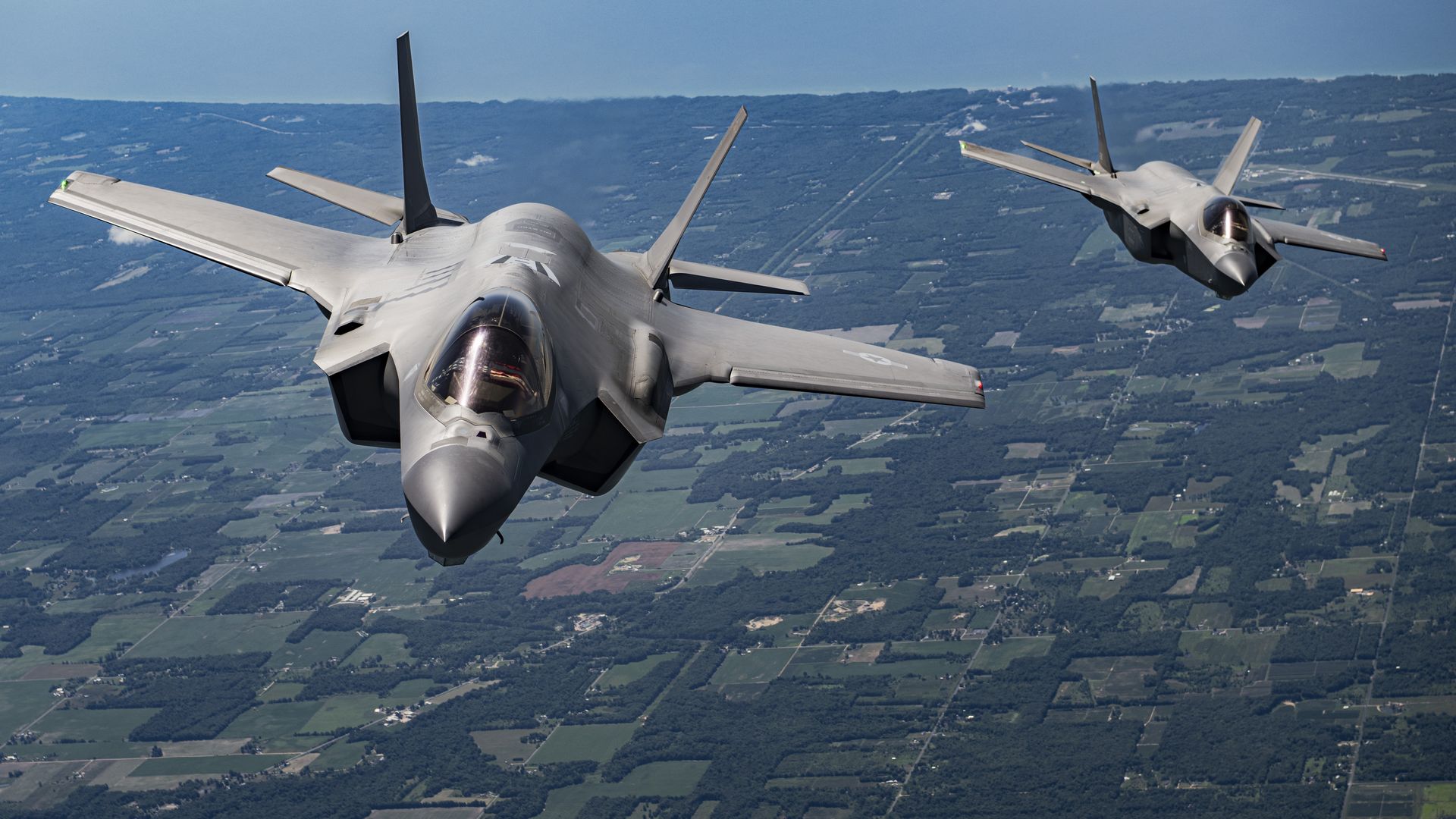
Two U.S. Air Force F-35As fly over Utah in July. Photo: Zachary Rufus/DVIDS
The potential sale of F-35s to Saudi Arabia has almost everybody worked up. Rightfully so.
Why it matters: Such a consequential deal — long whispered about, worth billions of dollars and to be fulfilled over many, many years — touches every corner of today's geopolitical and defense-tech zeitgeist.
- President Trump's growing affection for the Gulf states, plus his unpredictability? Check.
- Relations with Israel and rules governing its firepower, or qualitative military edge? Affirmative.
- China's influence abroad and its IP thievery? Yup.
- F-35 exclusivity and scrutiny of card-carrying members? Mhmm.
- Soft power, foreign military sales and congressional oversight? Absolutely.
Driving the news: Trump on Tuesday met with Saudi Crown Prince Mohammed bin Salman, who brought with him a security wishlist. The president told reporters in the Oval Office the country deserved "top of the line" F-35s, on par with what Israel receives, because both have been "great allies."
- "They're buying them from Lockheed," he said. "We make the best planes, the best missiles."
- Lockheed praised Trump's announcement in a statement to Axios, saying it was "honored" to work with Saudi Arabia. "We look forward to working with the Trump administration, Congress and the Saudi government as this process moves forward."
Friction point: China and Saudi Arabia are inching closer. The two recently concluded the Blue Sword naval exercise, building upon an earlier iteration in 2023.
- The Saudis said the drills were meant to "strengthen military cooperation between the two sides and to exchange expertise to raise combat readiness."
- That's raised hackles here. China's spies and hackers often target U.S. defense contractors and abscond with sensitive data; critics of Beijing have derided its arsenal as a copycat.
What they're saying: "My bottom line is, before providing Riyadh the F-35, I think we need to address concerns related to China ... and demand that Saudi Arabia normalize relations with Israel," Bradley Bowman, an expert at the Foundation for Defense of Democracies, told Axios.
- "You want our nation's best aircraft? Then you can't be doing military exercises with China. Sorry. And you probably shouldn't be working with them on ballistic missiles."
State of play: Lockheed Martin has delivered more than 1,250 F-35s worldwide. They are wielded only by select countries, including NATO allies, Japan and South Korea. Israel is the only Middle Eastern country currently equipped with the stealth jets, and used them against Iran in June.
- Turkey was booted from the club for its employment of Russian S-400 air defenses. Another arrangement with the United Arab Emirates was frozen by the Biden administration.
- An F-35 deal for Saudi Arabia would require congressional review.
The other side: Saudi air forces include F-15, Tornado and Typhoon warplanes. F-35s — one of the most costly, complex and in-demand weapons on Earth — would be a significant step up.
The bottom line: "I think it's fair to see the F-35 as an important card on the table, in this sort of very complex, multiparty negotiation, trying to figure out what the future security architecture of the Middle East is going to be," John Hannah, former Vice President Dick Cheney's national security adviser, told Axios.
Go deeper: U.S. security guarantee for Qatar sparks jealousy and confusion
