Axios Communicators

May 30, 2024

1 big thing: More U.S. businesses viewed as left-leaning
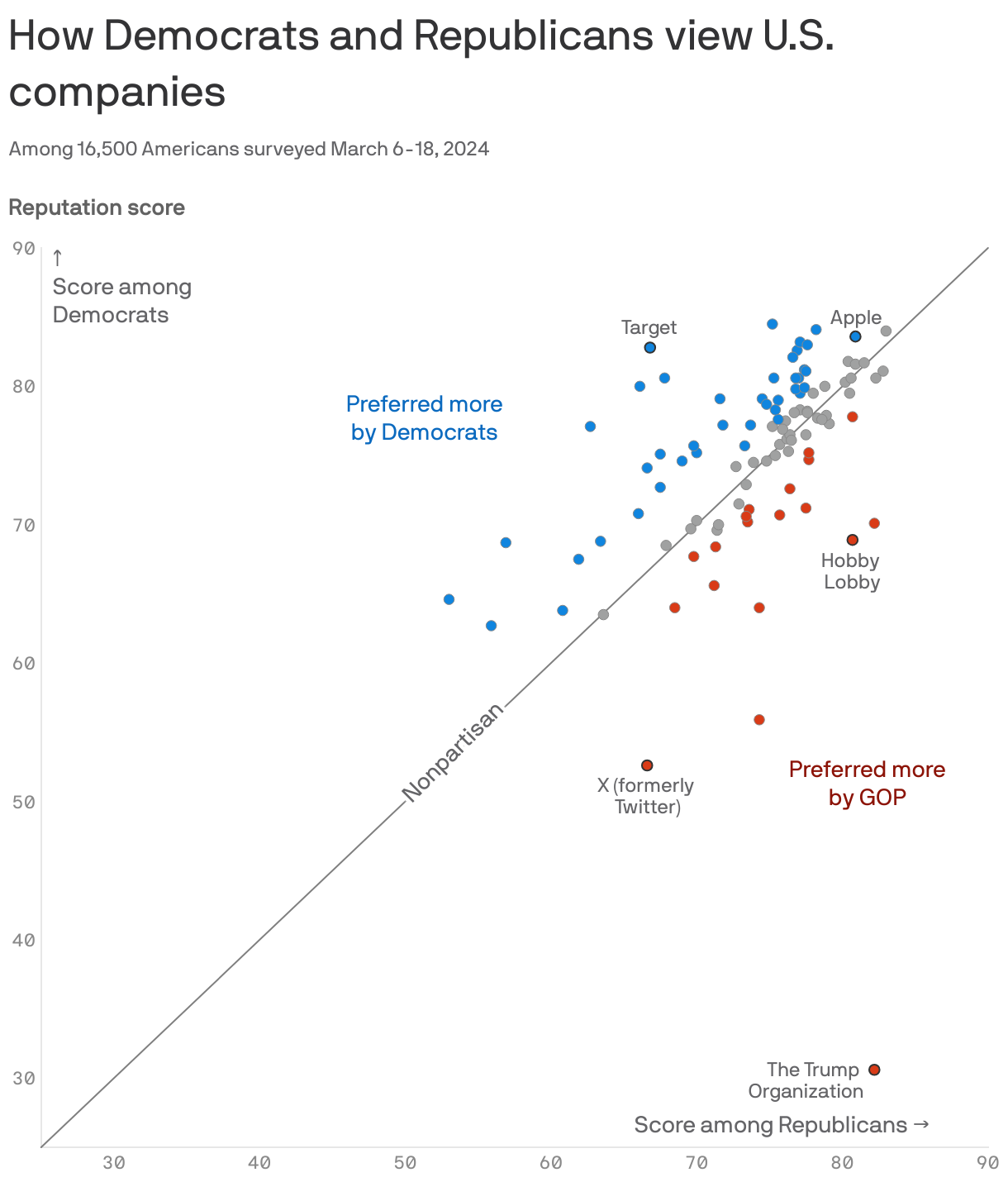
Consumers see twice as many brands as left-leaning as they do right-leaning, according to this year's Axios Harris Poll 100.
The big picture: Corporate America, long seen as aligned around capitalism and lowercase-c conservative behaviors, is increasingly viewed by consumers as catering to progressive ideals.
- 41 companies on this year's 100 list were viewed as left-leaning, while just 19 were seen as right-leaning.
- Procter & Gamble, Aldi, Lululemon and Geico were deemed the least polarizing, with zero partisan divide reported.
Why it matters: Trending left has brought upsides to many companies, as the U.S. population has become more diverse and younger, and college-educated consumers have embraced more progressive causes.
- Companies perceived as more liberal-leaning tend to have higher reputation scores than the conservative-leaning companies.
- But appearing to lean left also has put some companies at risk of alienating consumers and spurred demand for a return to center, as a red wave in this year's data suggests.
- Republican consumers are five times more likely than Democrats to think less of a company for focusing on societal issues, according to the Axios Harris Poll.
State of play: Brands that have been vocal in recent years on social and geopolitical matters — including Target, Anheuser-Busch brewer AB InBev, Pfizer and the Walt Disney Company — were seen as skewing more to the left.
- Seven of the top 20 most Democratic-viewed companies — Google, Nike, Patagonia, Adidas, Honda, Microsoft and USAA — received a "very good" rating from survey respondents, compared to just two — Hobby Lobby and Chick-fil-a — on the Republican side.
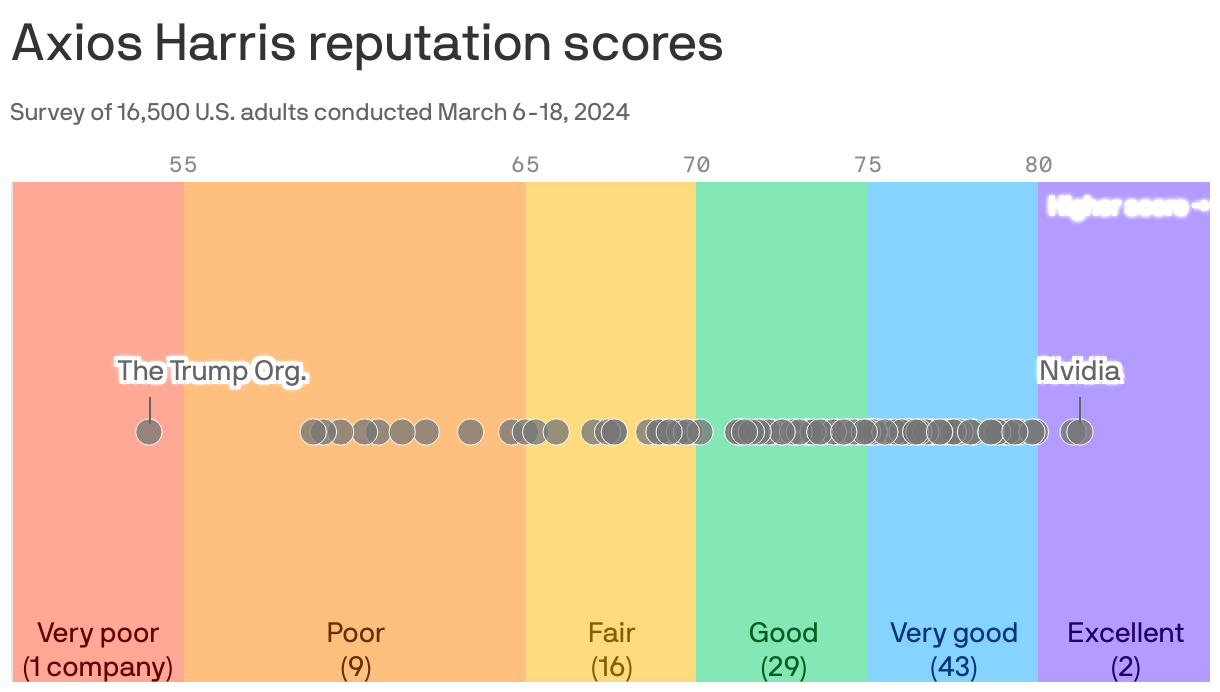
- On the other end, four of the more right-leaning companies — the Trump Organization, X, Fox and Dollar Tree — drew "poor" or "very poor" scores, compared to three — ByteDance, Wells Fargo and Spirit Airlines — on the left.
Between the lines: While fewer companies were perceived as skewing to the right, they saw the greatest partisan split.
- The Trump Organization is considered the most politically polarizing company, with a partisan split of 51.6, more than six times the average of 8.9.
- Fox is seen as the second-most polarizing brand, followed by Target, AB InBev and X.
What we're watching: Conservative lawmakers and activists are paying closer attention to how companies engage in diversity, equity and inclusion strategies and environmental efforts.
- Because of this, companies must be more clinical in how they communicate around these initiatives, says Paul Argenti, professor of management and corporate communications at the Tuck School of Business at Dartmouth.
What they're saying: "It is really important to understand the gap between the reality of what your organization is doing and the way your organization is perceived," Argenti said.
- "Whether it's related to purpose, sustainability or any kind of political matter, [the backlash] is typically more about rhetoric and public relations than it is about actions."
The bottom line: Perception can sometimes be reality, and the way a company or brand is perceived by Americans varies greatly depending on their political affiliation.
Editor's note: This story was corrected by removing a reference to Reddit as being in the "poor" or "very poor" category, when it is in the "fair" category.
2. Corporate reputations with staying power


The reputations of Amazon, Samsung and Patagonia have the most staying power, according to this year's Axios Harris Poll 100 rankings.
Why it matters: Each company continues to see high marks in areas of "vision," "growth" and "products and services."
- This implies that consumers are most concerned with the trajectory of a company and the services it provides when gauging corporate reputation.
Yes, but: Even the top-ranking companies have seen a slip in reputation scores over the past decade.
- Amazon has appeared within the top 10 of the reputation rankings the most, scoring the highest in 2017 with an "excellent" score of 86.3.
- Since then, the company's reputation score has dropped nine points, landing it at No. 16 on this year's list.
- Samsung's reputation peaked in 2015 with a score of 82, and it is currently ranked No. 10 with a score of 78.8.
- Patagonia held the No. 1 spot in 2023 and 2021 and came in at No. 8 this year with a "very good" score of 79.1.
Zoom out: Other mainstays include Sony, UPS and USAA, which have appeared within the top 10 at least three times.
The big picture: Sustaining a strong corporate reputation has become more challenging with each year, says John Gerzema, CEO of the Axios Harris poll.
- 17 companies had an "excellent" reputation score in 2017 and 10 in 2021, but this year there are only two — Nvidia and 3M.
- 71% of all companies in this year's rankings saw declines because of loss of trust, character and ethics.
What they're saying: "When asked why, people told us companies aren't doing enough to keep prices fair from inflation and are focusing too much on cultural issues," Gerzema said. "Ultimately, [the reputation decline] is based on what a company does rather than what it says."
3. Boeing isn't grounding airline reputations
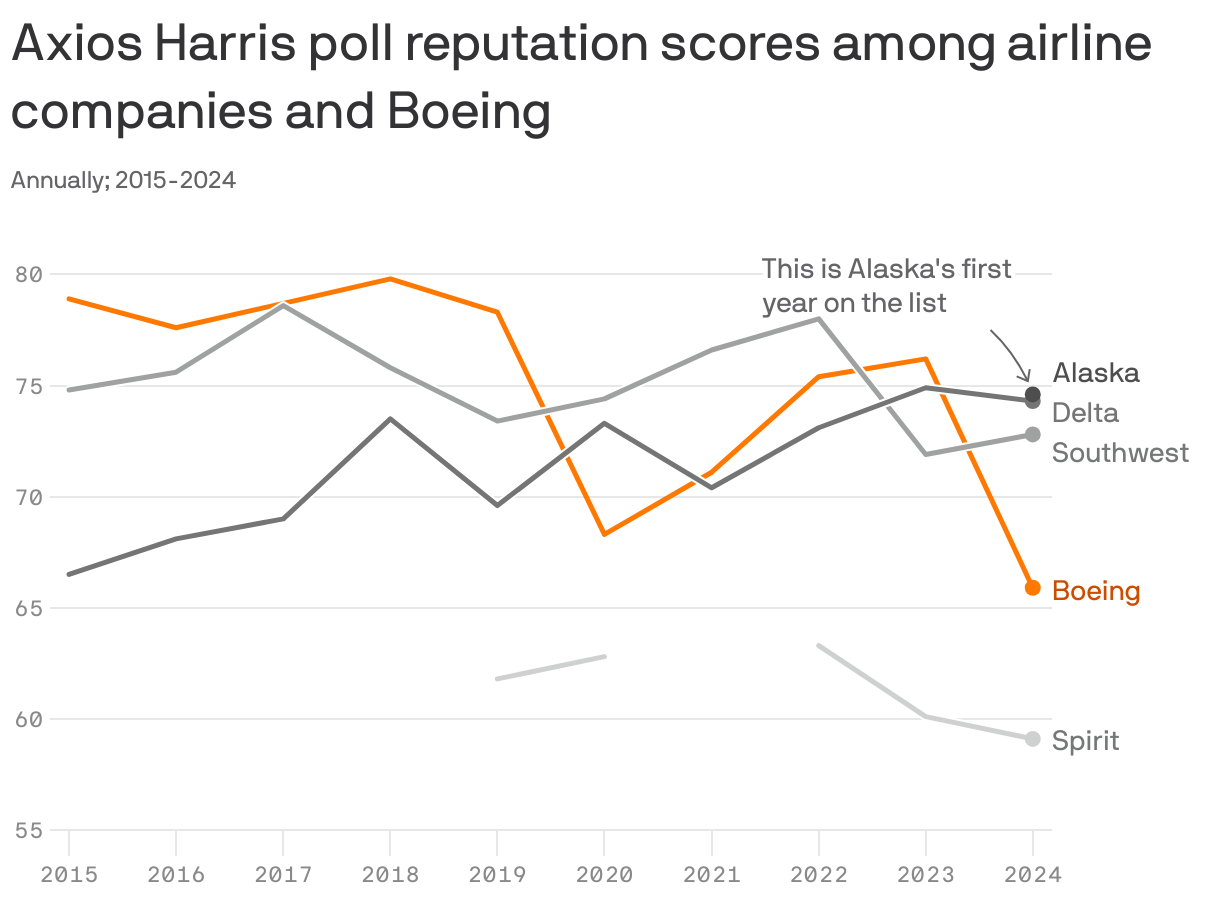
Boeing's corporate reputation took a huge hit this year, according to the Axios Harris Poll 100, falling 10 points since 2023.
- But its quality control issues have not brought down the reputations of major airlines that operate its jets, like Alaska, Delta and Southwest.
Driving the news: Alaska Airlines made the poll's top 100 list for the first time this year, likely in response to its deft handling of the Boeing crisis.
- The airline came in at No. 50 with a "good" rating overall, with the reputation dimensions of "trust," "vision" and "culture" scoring the highest.
Following its 2022 winter meltdown, Southwest's reputation score dropped seven points — from 78 to 71.
- It has since started to trend upward, making the most inroads on the reputation dimensions of "vision" and "ethics."
Delta's reputation continues to climb after taking a hit in 2021 when it faced criticism for its slow response and pivots on a restrictive voting rights bill in Georgia.
- The airline scored the highest on the dimensions of "culture," "products and services" and "trajectory."
Context: Missing from the list this year are American Airlines and United Airlines, meaning neither company was regarded as one of the 100 most-visible in 2024.
Between the lines: Boeing's reputation was beginning to improve following the 2018-19 737 Max crashes when the ongoing quality control issues took its reputation score to all-time lows.
- Notably, the manufacturer's "vision" scores highest, with Americans giving it a "good" rating.
4. TikTok’s reputation takes a hit amid ban talks

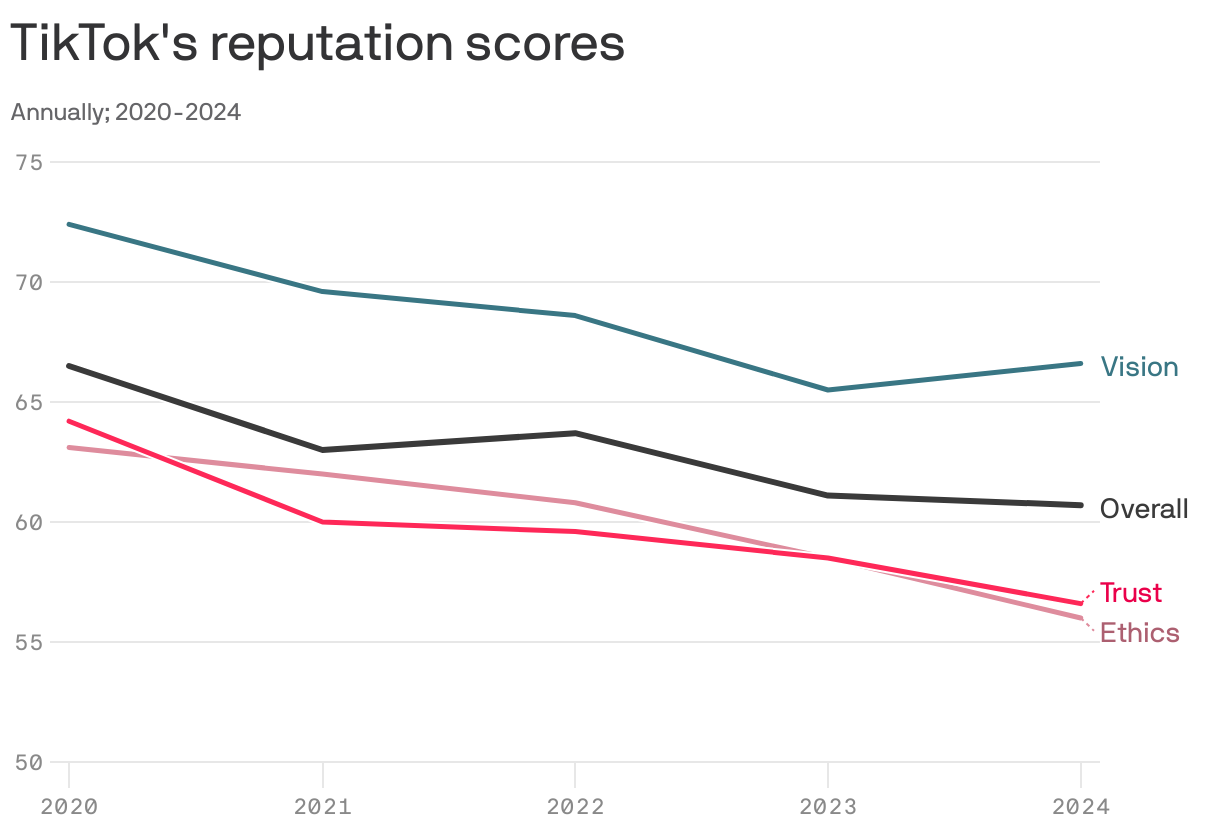
TikTok and its Chinese owner, ByteDance, continue to have one of the lowest reputation scores across all of the companies measured annually in the Axios Harris Poll 100.
The big picture: Social media companies overall have fallen behind the rest of Big Tech in their reputation scores over the past year due bipartisan concerns around social media safety and security.
By the numbers: TikTok and ByteDance's combined reputation score has plummeted from "fair" in 2020 to "poor" in 2024, according to the poll.
- Core attributes, such as trust and ethics, have declined further each year.
- Meanwhile, attributes more closely related to innovation, such as growth and products and services, have marginally improved and remained flat year-over-year, respectively.
Yes, but: TikTok has ramped up its public affairs push amid increased scrutiny from U.S. lawmakers.
- The platform has also started deploying more proactive communication tactics under the helm of political communicator and former Disney CCO Zenia Mucha, who joined the company in 2023 as chief brand and communications officer.
5. Reputation roundup
The latest Axios Harris Poll 100 coverage includes ...
- ⚖️ America's most nonpartisan companies: Procter & Gamble, UPS and BP have been able to stay top of mind for consumers, without wading into hot-button issues or cultural controversies.
- 📱 Social media companies overall have fallen behind the rest of Big Tech both in terms of their value to investors and public perception scores over the past year.
- 🎀 Consumers think highly of throwback companies: Sony and Mattel were highly ranked in the 2024 Axios Harris poll on corporate reputation.
- 🏰 Mouse House bounces back after reputation falters: In 2024, Disney's reputation score saw its first gain since 2017, thanks mostly to renewed favorability among Republicans.
6. Communicator Spotlight: Mixing Board founder Sean Garrett

Axios Communicators