Axios Communicators

June 06, 2024

🧲 Welcome back! Today we explore the gravitational pull between comms and marketing — because, let's face it, the lines are only getting blurrier. More below.
- 🤖 But first: Next week we will host a discussion on the state of AI and its impact on communications. Join by becoming an Axios Communicators Pro member today!
- 🇫🇷 And request an invite to join Axios Communicators in Cannes for conversations with American Express chief corporate affairs officer Jennifer Skyler and chief marketing officer Elizabeth Rutledge, plus Hinge CMO Jackie Jantos.
Today's newsletter is 1,411 words, a 5.3-minute read.
1 big thing: Airbnb's big comms bet
Airbnb's newest product, Icons, was created, managed and launched by the communications team.
Why it matters: It is an example of how communications can drive revenue by engaging with new audiences and piggybacking on cultural moments.
Driving the news: Airbnb CEO Brian Chesky recently announced the Icons category, which gives users the opportunity to have unique experiences — like spending the night in the Ferrari Museum, the home of Bollywood star Janhvi Kapoor or in a house modeled on the one featured in Pixar's "Up."
Flashback: The concept of Icons has already been tested, says Airbnb global head of policy and communications Jay Carney, and was inspired by previous viral Airbnb activations like the Barbie's Malibu DreamHouse, Shrek's Swamp and the "Home Alone" house.
- Of note, the Barbie DreamHouse received more press coverage last year than the company's IPO in 2020.
By the numbers: Since being introduced in May, Icons has garnered over 10,500 media stories and generated 15 million page views, a big success, according to Carney.
- "We look at the return on investment here as embedding brand awareness, and extending to target audiences. A very important piece of Icons for us is reaching audiences where we see growth potential, both inside the United States and in newer markets where we have a lot of potential in general for the business," he added.
Zoom in: By hijacking the interest of dedicated fan bases, the company is able to target and attract new customers based on age and location.
- For example, the Kapoor activation is a way for Airbnb to play in India — a key growth market for the rental platform — while Prince's "Purple Rain" house attracts Gen X and a game night experience with TikTok star Khaby Lame reaches Gen-Z, says Carney.
The big picture: Brands are increasingly looking for ways to authentically embed themselves into cultural moments.
Yes, but: Traditionally, major branding moments and partnerships have been spearheaded by marketing, with comms helping amplify them once campaigns were in place.
- However in the instance of Icons, the strategy was created and led by communications.
- And Chesky has long been bullish on the power of earned media, with Airbnb's marketing spend being lower than that of other travel companies.
What they're saying: "This is a way of showing how we're expanding beyond our core. Everyone knows we can offer a place to stay, but we also offer incredible, one-of-a-kind experiences," Carney added.
- When asked how he would describe Airbnb now, Carney said "a design-driven experiential company."
The bottom line: By owning brand campaigns and narratives, communicators can prove their value and show how their efforts impact the bottom line.
2. Molly Baz makes history with Special K
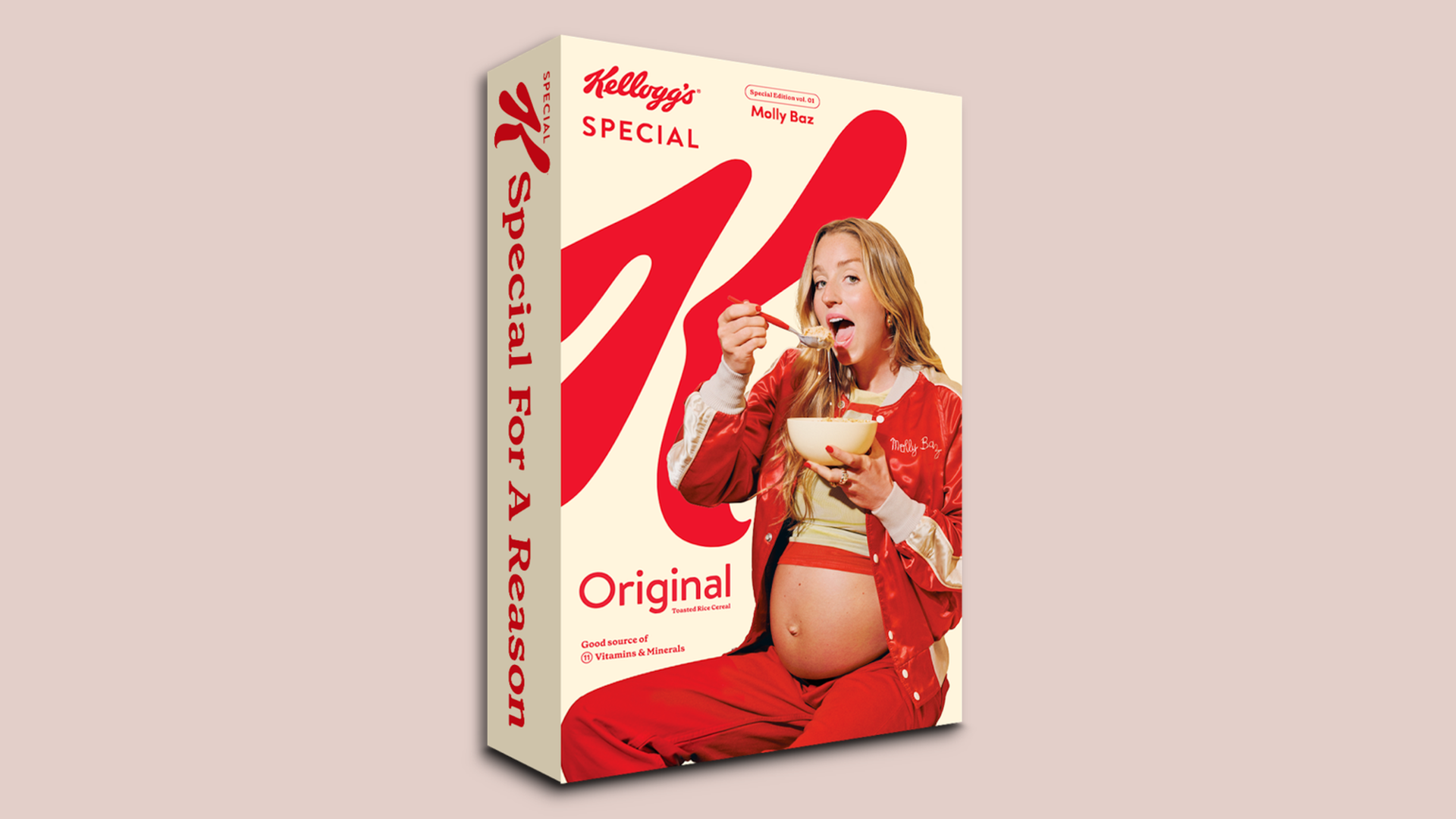
Best-selling cookbook author and chef Molly Baz will be the first pregnant woman to appear on a cereal box, as part of Special K's new marketing campaign.
- Why it matters: WK Kellogg is the latest company to appeal to mothers as the "she-conomy" continues to boom.
Catch up quick: Baz made headlines after a Times Square billboard from breastfeeding startup Swehl was flagged for review and removed by billboard operator Clear Channel.
- The removal of the original ad — which featured images of Baz's pregnant belly exposed and breasts covered only by cookies — sparked online conversation about the double standards within advertising.
- Special K reached out to Baz about a partnership "immediately following" the Times Square ad controversy, according to an agency spokesperson.
Between the lines: Baz's campaign also comes on the heels of a consumer boycott, ignited after WK Kellogg Co. CEO Gary Pilnick appeared on CNBC and encouraged cash-strapped families to consider eating cereal for dinner.
- The "cereal for dinner" ad campaign has been running since 2022, but after Pilnick positioned the name-brand cereal as a solution to rising food costs, parents across social media — specifically millennial moms — called for a boycott.
- By partnering with Baz, the brand is positioning itself to win back goodwill with this key audience.
The big picture: This partnership isn't just a way to insert the company into the cultural conversation and appeal to disgruntled consumers — it's also good business.
- Women predominantly control the purchasing decisions in their households, with 78% identifying as their family's primary shopper, according to a recent consumer report.
👀 Other major brands are taking note.
- Procter & Gamble brand Pampers will host the first-ever Olympic Village nursery for parent athletes and their babies during this summer's games in Paris.
- And Dove Chocolate launched the "Mom Experience Translator," an AI-powered tool that helps mothers returning to the workforce quickly identify and highlight their many transferable skills acquired during motherhood.
3. Campaign takes aim at brands for "Latino coating"

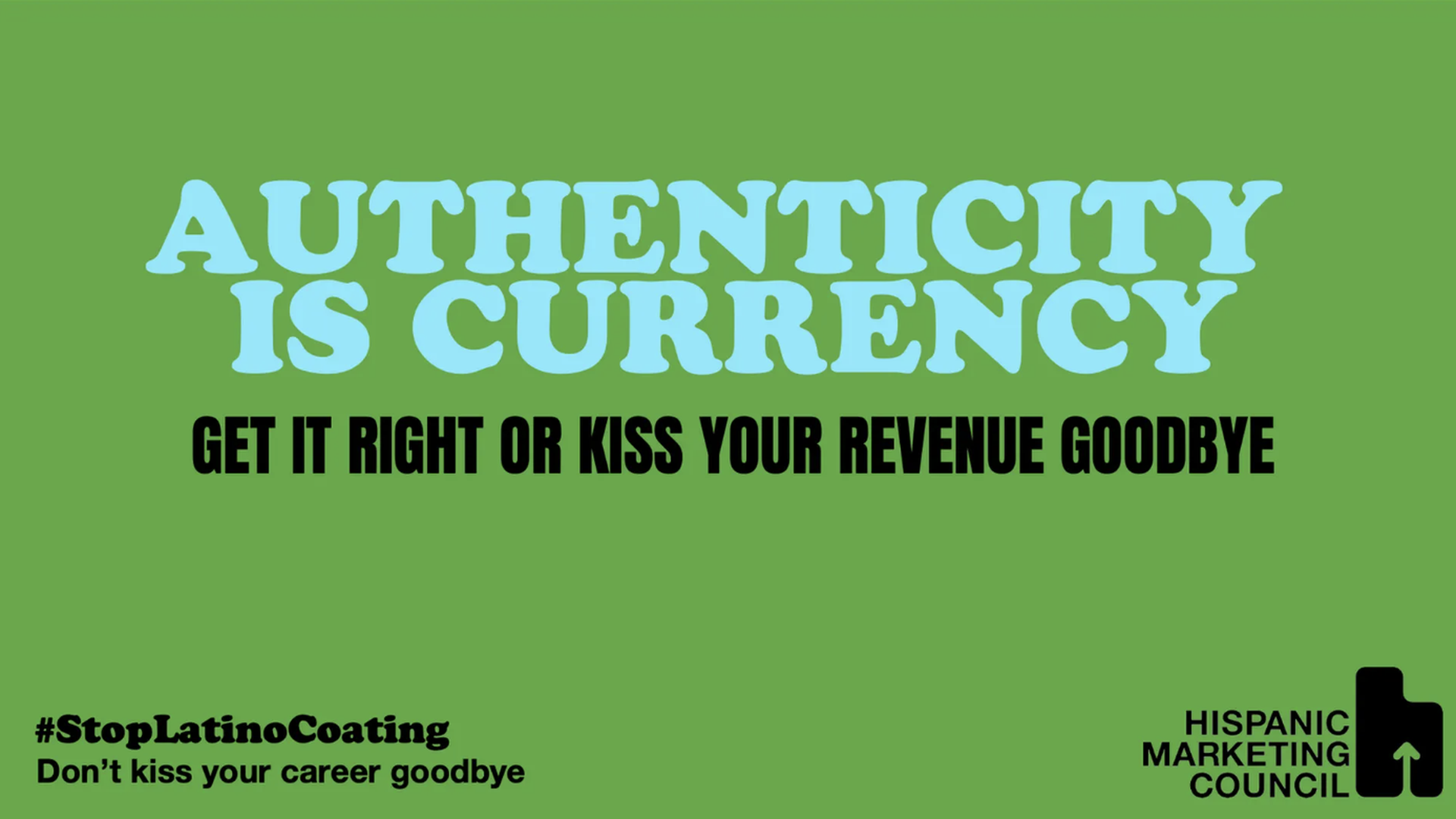
Advertisers and brands risk losing out when they use a superficial "Latino coating" approach to reaching Hispanic audiences, some industry leaders say.
State of play: Latino spending power is roughly $3 trillion a year, yet brands spend less than 4% of their advertising budgets on Latino outreach, per the Hispanic Marketing Council, which recently launched the "Stop Latino Coating" campaign.
- The term refers to the way marketers will add coat ads with some Latino elements "without genuine understanding or respect for Latino culture or communities."
Zoom in: Isabella Sánchez, vice president of media integration for Zubi and the chair of the Hispanic Marketing Council, says marketers are aware of how significant Latino buying power is, but they're "taking a bunch of shortcuts" instead of trying to reach the audience.
- One example: pharma. Sánchez says pharmaceutical companies are behind in tailoring their messaging to Hispanic consumers despite the fact that Latinos have high rates of diabetes and other health ailments.
Yes, but: Companies like Pepsi, Molson Coors, Kellogg's and Nestlé have all been recognized for putting Hispanics at the center of their advertising efforts, says Sánchez.
4. Scoop: Koch looks to the future
Koch Industries — one of America's largest and most influential privately held companies — is changing its name for the first time since 1968.
Why it matters: The conglomerate, owned by American billionaire Charles Koch, is dropping "Industries" from its name in an attempt to distance itself from the oil refining operation that brought it to prominence.
- Being known as Koch Inc. (or "Koch") is a "better fit for our current business and vision for the future," according to an email to employees obtained by Axios.
The big picture: While the change seems small, it speaks to a broader trend of legacy companies rebranding to explain the evolution of the business.
5. PR professionals abandon X

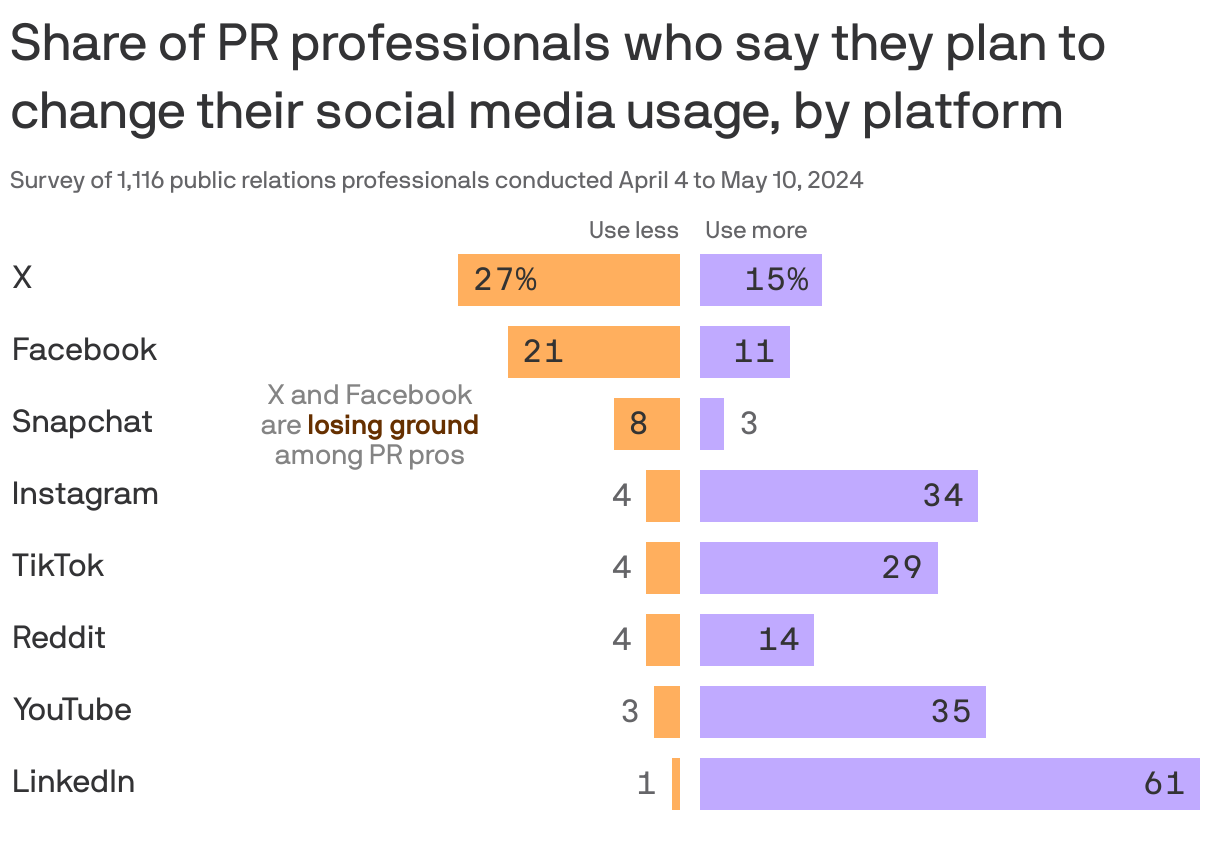
LinkedIn has toppled X (formerly Twitter) as the most useful social media platform for public relations professionals, according to Muck Rack's latest State of PR report.
Why it matters: Twitter historically served as a key resource for both journalists and communication professionals, but the usability of the platform has been questioned since Elon Musk took over in 2022.
By the numbers: Muck Rack surveyed 1,116 public relations professionals from April 4 to May 10, 2024, and found that most viewed LinkedIn as the social media platform they value most — more than X, Instagram, Facebook and TikTok combined.
- 61% planned to increase their LinkedIn use, while only 15% planned to focus more on X and 11% on Facebook.
Zoom in: X previously ws the second most used platform for pitching reporters, behind email, per the report.
- Now only 10% of PR professionals report using X for outreach, below even phone calls and text messages
Zoom out: With TikTok's fate in jeopardy, other social media platforms are moving in on short-form video.
- LinkedIn is testing a new TikTok-style video feature, with the hope of enticing more young creators.
- Meanwhile, Facebook has developed a professional mode, has put a greater emphasis on short-form video (with Reels) and has made it easier for users to share video content through direct messaging.
Yes, but: TikTok's influence remains. The platform has grown in importance among PR professionals by 8% year-over-year, per the report.
What they're saying: "Our research found that communicators are using social listening tools and prioritizing platforms like LinkedIn and Instagram to build comprehensive PR strategies," said Gregory Galant, cofounder and CEO of Muck Rack.
- "In order for brands to build trust and reach audiences where they are, integrating social media with earned media is necessary. Whether sharing news or thought leadership or tackling a crisis, we can no longer think of them as two separate channels with separate approaches."
✅ Thanks for reading! And thanks to editors Nicholas Johnston and Jay Bennett.
📇 And don't forget to share your job news. Monthly Moves will hit inboxes tomorrow.
Editor's note: The top story in last week's newsletter on how consumers view brands was corrected by removing a reference to Reddit as being in the "poor" or "very poor" category, when it is in the "fair" category.
Sign up for Axios Communicators