Why Utahns should care about the downstream effects of Colorado River collapse

Add Axios as your preferred source to
see more of our stories on Google.
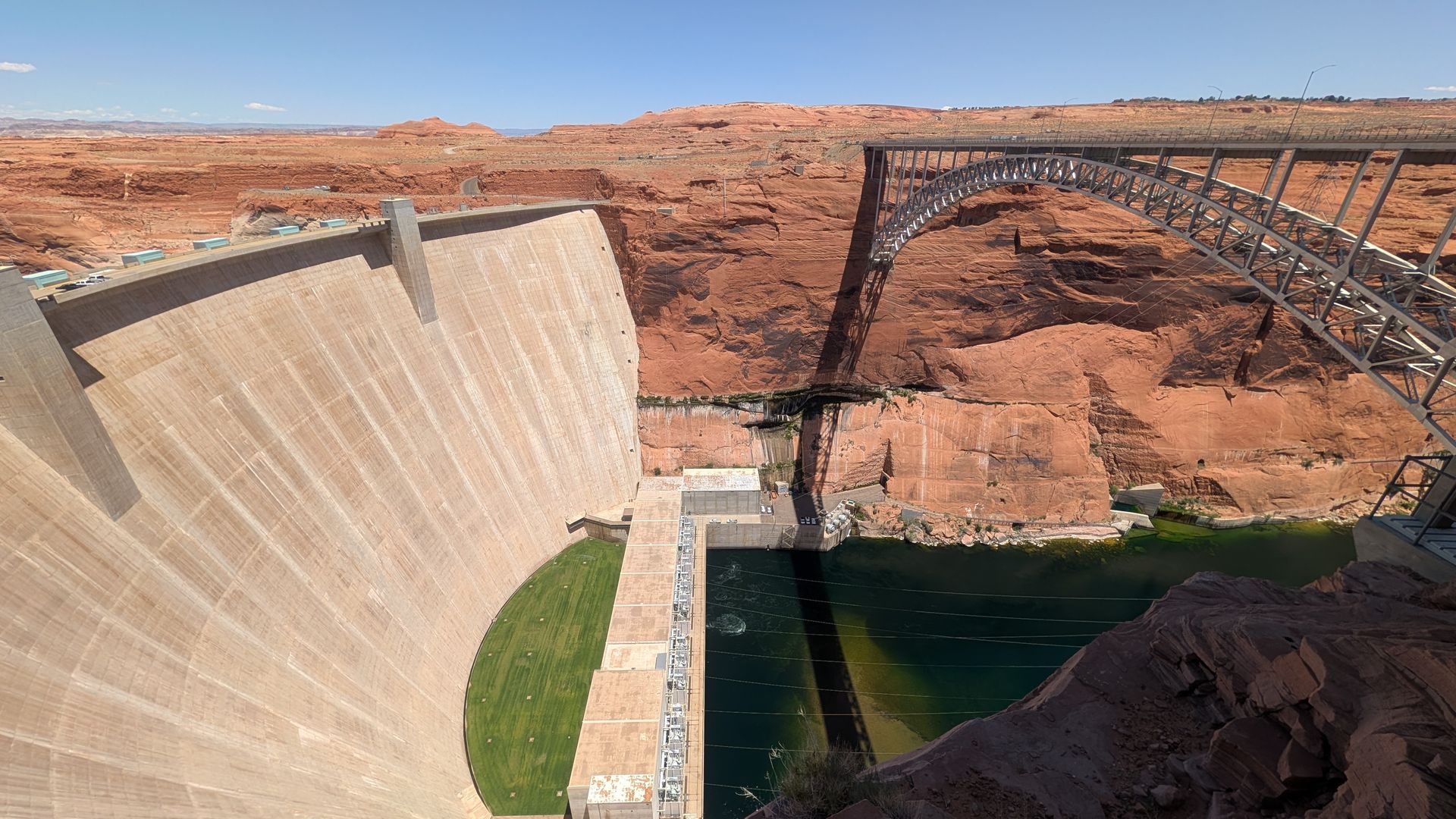
The Glen Canyon Dam. Photo: Erin Alberty/Axios
It's hard to internalize the scale of the Colorado River crisis until you actually lay eyes on the record-low water levels upstream of the Glen Canyon Dam.
- I saw the dam for the first time this week, and I went from scared to dam(n) scared. The vagaries of western water law may be hard to understand, but the flow of water is not.
Why it matters: For those of us in the upper basin — most of Utah, Wyoming, Colorado and New Mexico — the stakes of the river's failure are far more remote than they are downstream of the dam.
- That can make the ongoing negotiations too abstract for all of us to pay close attention to, especially amid our own water crises.
Catch up quick: Laws written in the 1920s gave the upper basin and lower basin equal water. Then lower-basin population centers like L.A., Las Vegas and Phoenix exploded and the West got hotter and drier.
- Now, the lower basin overuses its share, while the upper basin has never used all of its allotment.
Meanwhile, our upper-basin water sources may dwindle over time, but the dam is effectively designed to entirely cut off the flow to the lower basin all at once if Lake Powell falls below the bypass tubes — the dam's lowest outlets.
The bottom line: We're legally entitled to more water than we're using, but Arizona, Nevada and California will bear the brunt of the consequences if we actually take it.
As long as we have that advantage over the mortals downstream, we should probably have a basic vocabulary for what could happen.
Here are the two major low-water marks to keep in mind:
Minimum power pool: 3,490 feet
- This is the lowest level Lake Powell can reach before the turbines have to stop generating electricity.
- That could affect rates for nearly 6 million households as far north as Wyoming and as far east as Nebraska.
- The most recent federal projections estimate the lake could come a few feet from that next spring, and below it by February 2028.
Dead pool: 3,370 feet
- At this level, the Colorado River can't reach the bypass tubes and stops flowing beyond Lake Powell.
- The loss of the river would pose an existential threat to some of the nation's biggest economies.
- It would devastate ecosystems from the dam to the Colorado River Delta, as well as Lake Powell itself, which would be "trapped, stagnant and heating in the sun, prone to algal blooms and deadly anoxia," per High Country News.
The latest: As of Wednesday, the lake was at 3,527.96 feet — the lowest for that date since Lake Powell first filled up in the 1960s.
Threat level: Flows could be compromised even before the lake reaches dead pool.
- When the bypass tubes were used in 2023, engineers discovered they were unexpectedly vulnerable to erosion.
What we're watching: Whether the bypass tubes' new lining holds up if they're used again.