Utah lawmaker proposes 6-week abortion ban


Add Axios as your preferred source to
see more of our stories on Google.
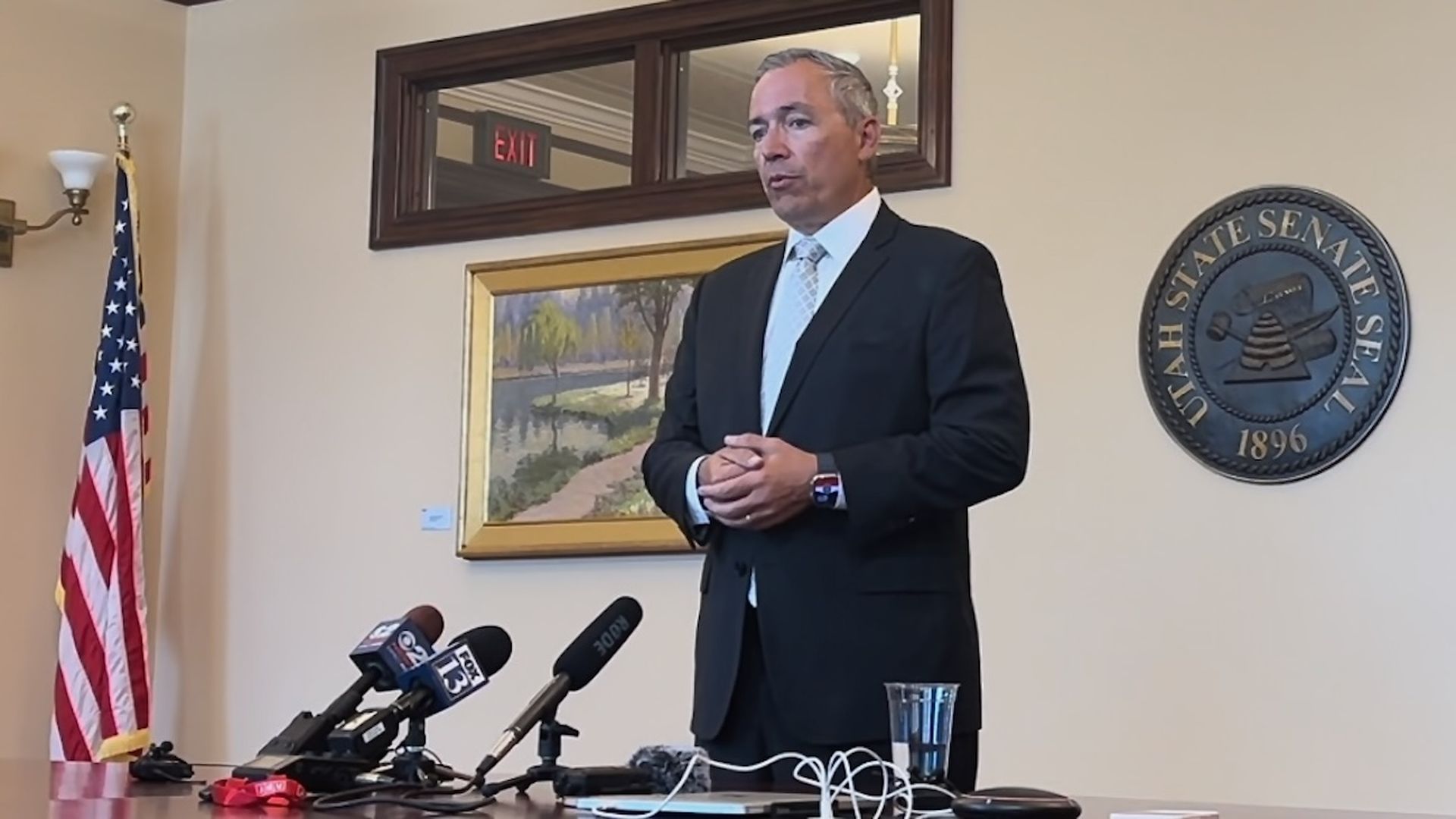
Utah Sen. Dan McCay (R-Riverton) speaks yesterday at the Utah State Capitol. Photo: Kim Bojórquez/Axios
A Utah lawmaker is calling for a special session to make abortions illegal after six weeks of pregnancy following a state Supreme Court ruling Thursday that kept the state's pending abortion ban on hold.
Why it matters: Many patients do not know they are pregnant after six weeks.
- In medical terms, pregnancy begins the first day of the person's most recent menstrual period, before an embryo actually has begun to develop.
Driving the news: State Sen. Dan McCay (R-Riverton) announced Thursday he had notified Gov. Spencer Cox and legislative leaders that he wants a special session to shorten the window for abortions, which is presently 18 weeks.
Reality check: It's not yet clear if McCay has the support from Cox or legislative leaders.
State of play: The Utah Supreme Court ruled 4-1 Thursday morning to uphold an injunction that has kept a near-total abortion ban from taking effect since the U.S. Supreme Court overturned Roe v. Wade.
What they're saying: "We're looking at states that have a six-week ban," McCay said during a news conference Thursday, noting that Iowa, South Carolina, Georgia and Florida all have one.
- "The courts already supported that, and we're hoping that that we might be able to make that adjustment as well," McCay said.
Yes, but: The legal questions that have held up Utah's ban are tied to the state constitution, which has no bearing on those other states.
- It's unclear how a six-week ban would survive the same arguments that have led courts to suspend both the state's trigger ban and a separate 2023 law that effectively bans abortion clinics from operating.
Catch up quick: Utah's heavily Republican legislature has sought multiple paths to outlaw abortions in the state since Judge Andrew Stone in 2022 blocked Utah's pre-written abortion ban days after it was triggered by the Dobbs decision.
- In addition to the clinic ban, lawmakers in February 2023 changed court rules to make it harder for judges to block state laws from taking effect.
- A judge previously could grant an injunction if a case posed "serious issues" that warranted further argument. Under the new rules, the party seeking an injunction must show they have a "substantial likelihood" of winning their case.
The intrigue: Thursday's ruling not only sidestepped the new injunction rules — it also gives some insight to how the court could weigh the arguments the ACLU of Utah and Planned Parenthood Association of Utah (PPAU) make in their pending 2022 lawsuit claiming the ban violates the state constitution.
- Although Thursday's decision does not "decide the merits of PPAU's claims," it does undercut several of the counterarguments the state is likely to make in defense of the ban's constitutionality.
The big picture: The decision affirms Stone's ruling that the implications for patients' rights were too serious for the ban to take effect while the lawsuit remains unresolved.
Between the lines: While the court's ruling does not decide the lawsuit itself, it bodes well for the ACLU and Planned Parenthood, which had to show that:
- The ban would irreparably harm people;
- The harm outweighs the state's goal to preserve fetal life; and
- Blocking the ban would not go against the public interest.