Salt Lake City tops the nation for growth in downtown activity

Add Axios as your preferred source to
see more of our stories on Google.
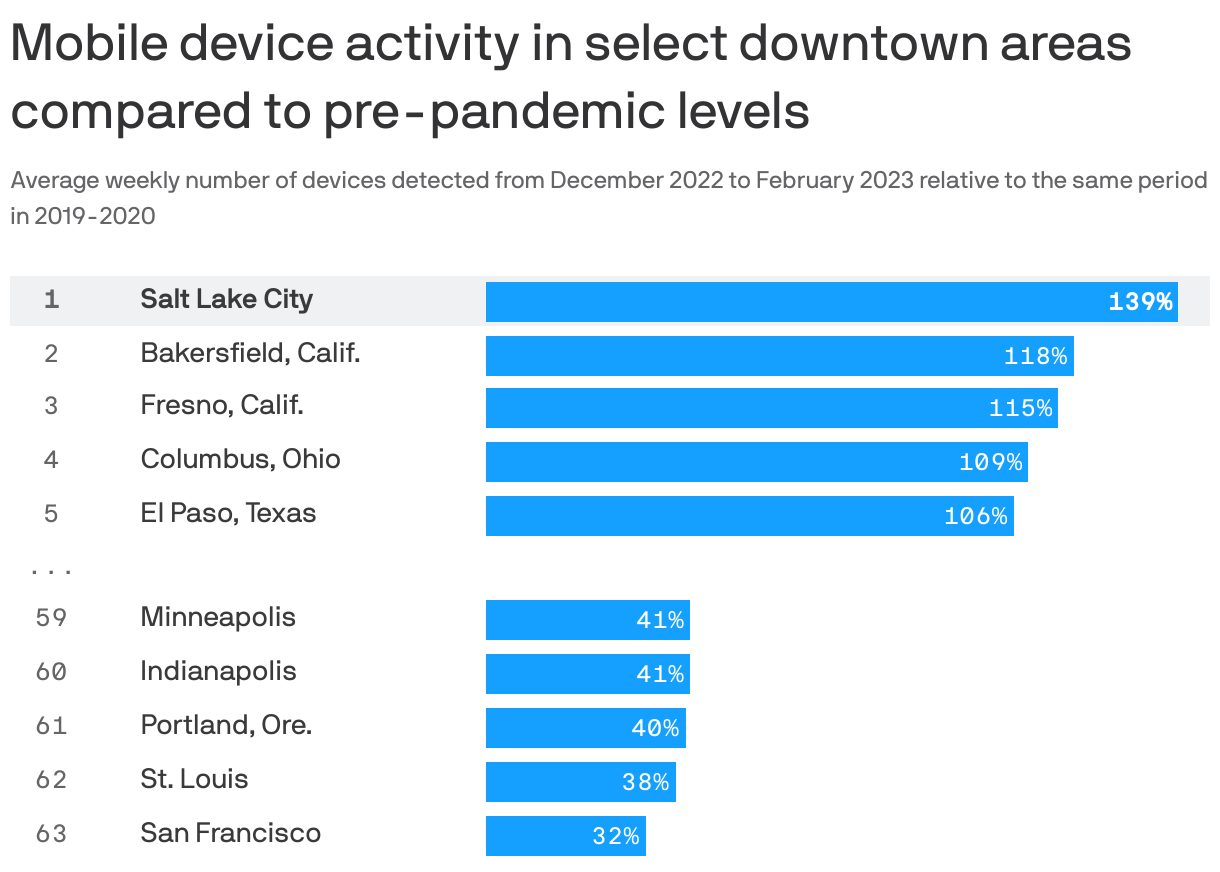
Salt Lake City's downtown is seeing nearly 40% more activity now than pre-pandemic, Axios' Alex Fitzpatrick and Alice Feng report.
- That's according to mobile device connectivity data analyzed for 63 U.S. cities by researchers at the University of Toronto's School of Cities.
Why it matters: Downtowns became ghost towns during the height of the COVID-19 pandemic as people sought to "flatten the curve" by staying home as much as possible.
- But downtown SLC was 39% busier this winter than in winter 2019-2020, researchers found — by far, the strongest recovery in the nation.
Zoom out: Downtown activity exceeds pre-pandemic rates in a handful of U.S. cities, but most are still struggling to attract the foot traffic they once did.
- Even as the pandemic ebbs, the era of remote and hybrid work it ushered in means fewer people visiting restaurants, bars and shops.
By the numbers: Salt Lake City (139%); Bakersfield, California (118%); and Fresno, California (115%) had among the country's highest post-pandemic downtown recovery rates as of February (the most recent data available), as measured by estimated foot traffic.
- San Francisco (32%), St. Louis (38%) and Portland, Oregon (40%) had among the lowest.
How it works: The researchers essentially treated smartphones and other mobile devices as a proxy for their owners — if a device pings a nearby cell tower, it's a good bet that's where the device's owner is.
- Of note: For this analysis, "downtown" is defined as areas of a given city with the highest employment density.
Catch up quick: A similar analysis a year ago showed an even bigger rise in springtime downtown activity — so it will probably get busier now that our record-breaking winter has finally ended.
Reality check: While downtown activity is one indicator of a city's economic health, it doesn't paint a full picture on its own.
What's next: Many cities are experimenting with various efforts to rethink their downtown neighborhoods — including, most notably, office-to-residential building conversions, which are poised to skyrocket in the coming years.
- Yet that idea is more cumbersome than it might seem, in part because the design and shape of some office buildings make them ill-suited for residential use.
The bottom line: Whether you feel like America's downtowns are once again thriving depends a lot on where you live.