What we're watching on election night in North Carolina

Add Axios as your preferred source to
see more of our stories on Google.
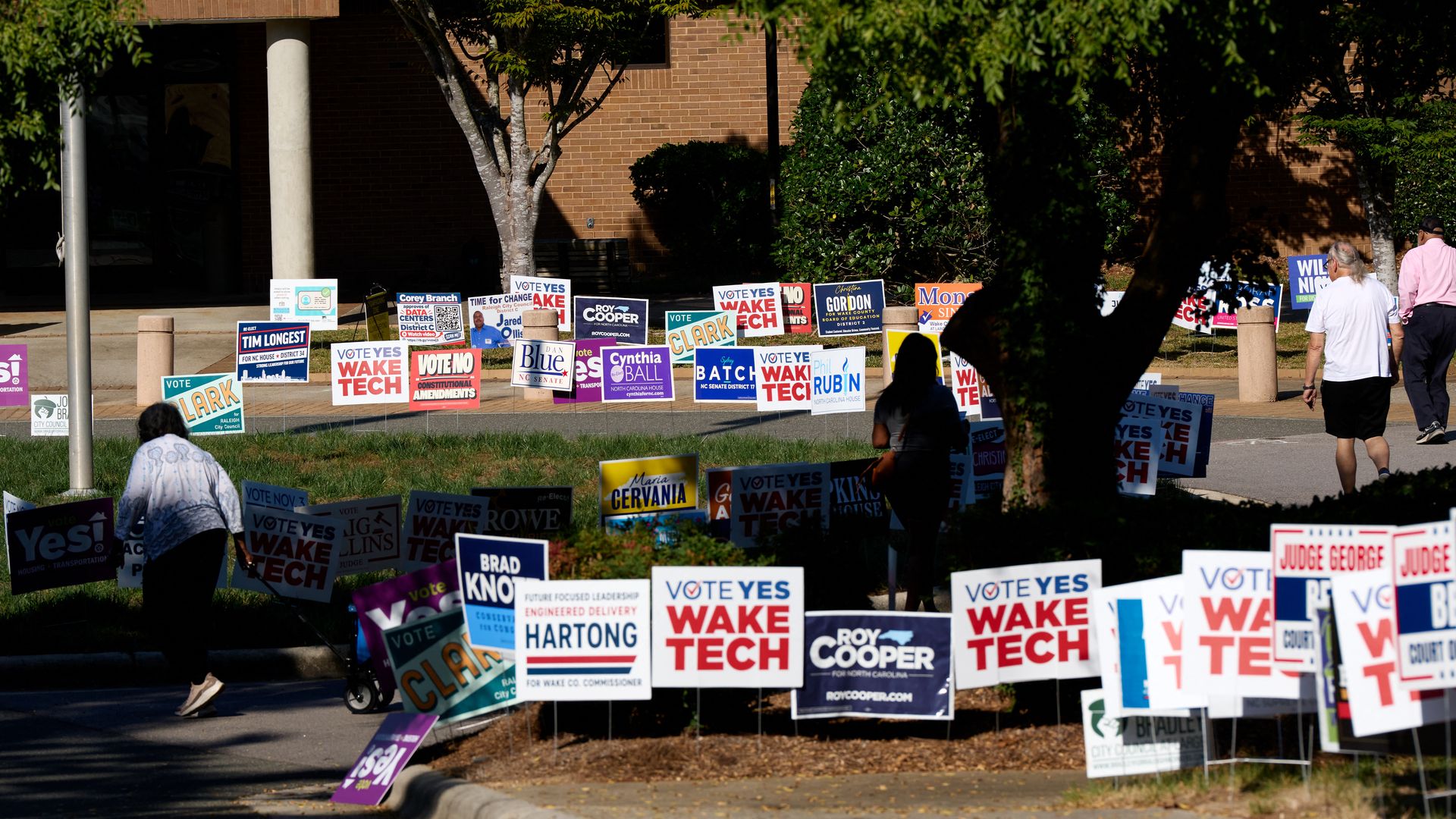
Voters walk through a sea of campaign signs in Raleigh on Oct. 15. Photo: Matt RAMEY / AFP via Getty Images
After months of ads, polling, rallies, tens of millions of dollars in spending and interviews, it's time to actually count votes in North Carolina's midterm elections.
Why it matters: The 2026 election results could reshape which policies and laws advance in Washington and Raleigh.
State of play: Here are five storylines to watch on election night in North Carolina:
Is Roy Cooper's lead really that big or is polling a mess? Polling wields a huge amount of influence over campaigns, helping guide where money is spent and what campaigns get attention.
- In the Senate race, Democratic candidate Roy Cooper's apparent large leads in polls were part of the reason some groups paused spending on Republican candidate Michael Whatley.
- Democrat Anita Earls has also shown strong polling against Republican Sarah Stevens in a big state Supreme Court race.
- Yes, but: Polling is not always accurate and pollsters have had mixed records in recent elections. The New York Times notes that Democrats have been way more likely to respond to surveys this year.
Zoom in: If Cooper's polling lead shows up as accurate in the returns on Election Day, it will give more evidence for what Democrats are hoping is a blue wave election in the Tar Heel State.
Could the N.C. House really flip? What was once talked about as an extreme long shot has become a more common talking point in Raleigh.
- Could Democrats actually take control of the N.C. House for the first time since 2010? According to an analysis from the N.C. Free Enterprise Institute, the N.C. House is now a toss-up.
Why it matters: Republicans have controlled both chambers of the N.C. General Assembly since taking office after the 2010 elections. One of the chambers flipping would have a seismic effect on how legislation is done in Raleigh for the next two years.
- Even if Republicans keep control of the House, though, it appears it will be much harder to override vetoes from Gov. Josh Stein moving forward.
Can one of Phil Berger's successors-in-waiting win his election? State Senate leader Phil Berger's primary loss earlier this year was one of the most shocking election results in recent North Carolina history.
- But could Michael Lee, one of Berger's top lieutenants and a favorite to replace him as Senate leader, also lose? Lee's New Hanover County district is also considered a toss up.
- As The Assembly notes, serving in such a competitive district could make Lee's quest to be Senate leader less appealing than some Republicans in safer seats, like Todd Johnson of Union County and Ralph Hise of Mitchell County.
How well do the constitutional amendments do? North Carolina voters are being asked to weigh in on three constitutional changes that would enshrine rules on voter ID and potential caps to property tax increases and state income tax.
- If they pass, the amendments could provide a bright spot for Republicans.
A Catawba College-YouGov poll showed strong support for all three, but views shifted for one when voters were presented with potential downsides of a cap on local property tax levies, Axios Charlotte reported.
- And local leaders of many of the state's largest cities, which are led by Democrats, have come out against the amendments, including Durham and Charlotte.
- "Whether the messaging by the campaigns that are opposing the amendments has been effective — I don't know," Michael Bitzer, a politics professor at Catawba College, said.
Will support for local bonds continue? For years, local voters have reliably passed bond referendums for a wide variety of issues.
- But cracks have started to appear in that support, with Cary voters rejecting two bonds in 2024 and many local residents expressing frustration over rising property taxes.
Zoom in: Raleigh and Wake County voters are being asked to vote on several local bonds, ranging from transit and affordable housing initiatives to funding for public schools and community colleges.
- But will voters weighing a constitutional limit to raising property taxes, be more or less supportive of local bonds now.