Willamette Valley suffers severe drought

Add Axios as your preferred source to
see more of our stories on Google.
Illustration: Aïda Amer/Axios
Oregon is seeing one of the driest springs and summers in more than a century, with severe drought concentrated in the Willamette Valley.
Why it matters: Lack of rain can exacerbate wildfire season and imperil salmon runs.
Driving the news: Oregon has seen the the third driest and third warmest spring and summer — April through August — since records began in 1895, state climatologist Larry O'Neill told Axios.
- "We got just about half of our usual precipitation during that time," O'Neill said.
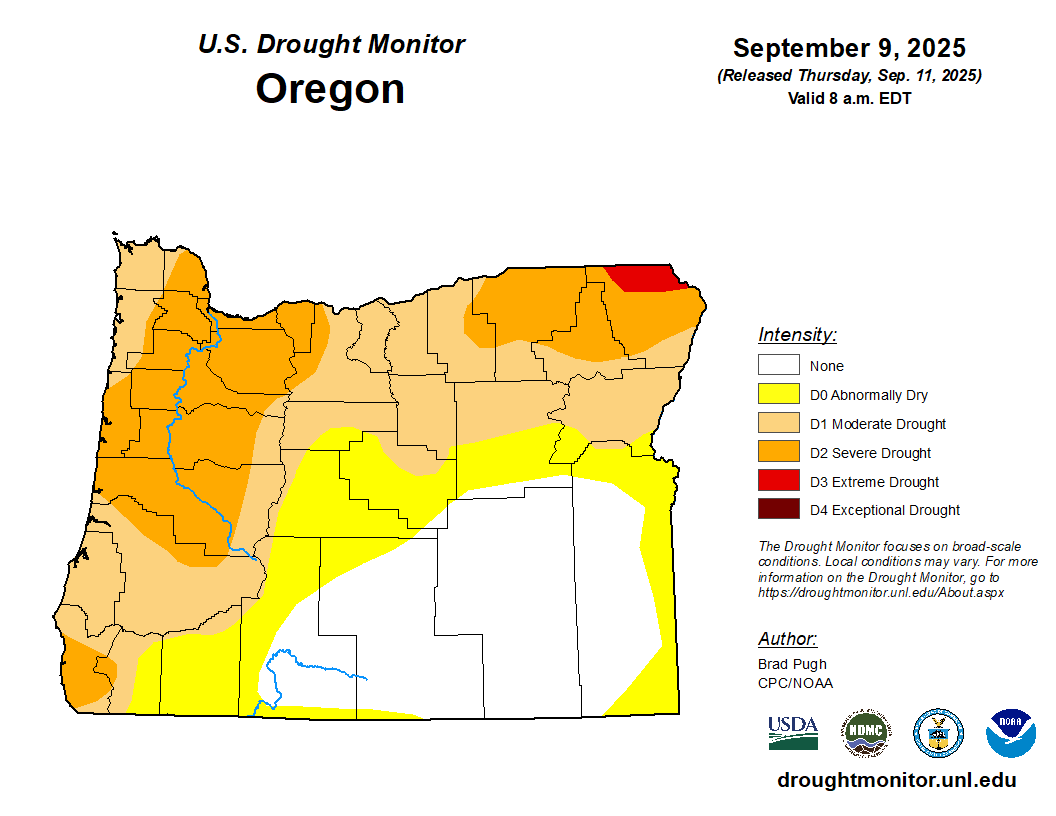
By the numbers: Nearly three-quarters of the state is either abnormally dry or in some level of drought, per the U.S. Drought Monitor.
- More than half of the state is in "severe drought," with many of the driest areas concentrated in the Willamette Valley.
Between the lines: Snowpack in the Cascades, which was at or above normal early this year, has melted quickly, according to O'Neill.
- That's left many streams running into the Willamette Valley at near-record lows.
Zoom out: Oregon is not alone, as severe and extreme drought has gripped large parts of the Pacific Northwest, with the vast majority of Washington and Idaho also seeing high levels of drought.
Between the lines: Changes in precipitation patterns, temperatures and snowpack — all intensified by human-caused climate change — have made drought more likely in Oregon and across the West, according to the state.
What's next: We do have moisture on the horizon, though, with the National Weather Service predicting "our first fall-like frontal system" and widespread rain starting tomorrow evening.
- The coast could pick up more than an inch of rain, with interior valleys collecting anywhere from a tenth to three-quarters of an inch before the storm blows out on Sunday.
Yes, but: O'Neill said we'll need more than one storm to fully quench fire season, and we'll need a wet winter to make up for this year.
- "If we get a dry winter, next year could be much more severe," he said.
The bottom line: Autumn can't come soon enough.