5 years on, Portland still wrestles with George Floyd's legacy

Add Axios as your preferred source to
see more of our stories on Google.
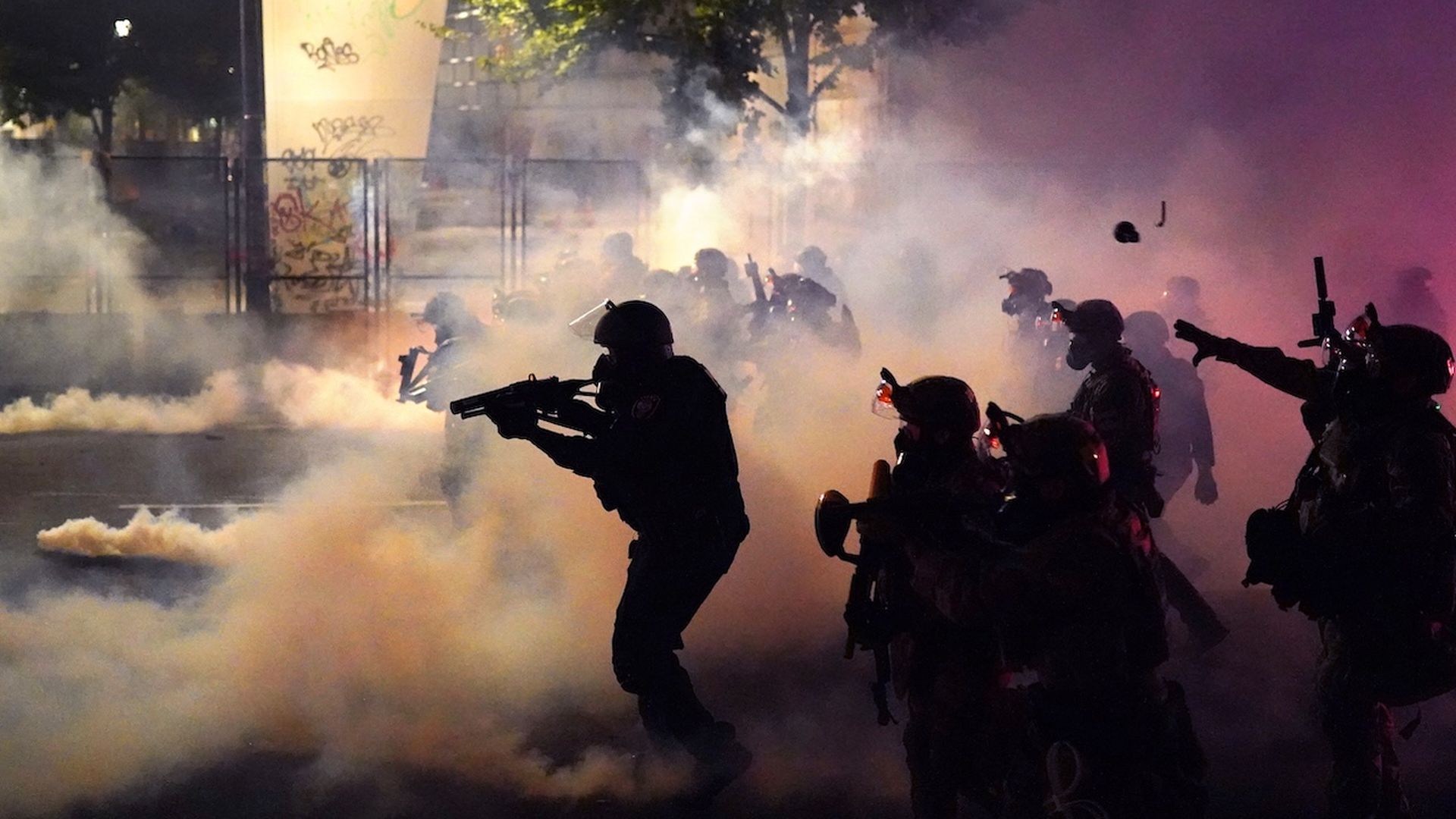
Five years ago, Portland's 100-plus days of protest over racial justice, ignited by George Floyd's murder, began. Photo: Nathan Howard/Getty Images
It's been five years since George Floyd was murdered by Minneapolis police officer Derek Chauvin, setting off a wave of protests across the country and in Portland.
State of play: Protests started in the city three days after Floyd's death on May 25, 2020 and continued for more than 100 consecutive nights, garnering international attention and scorn from President Trump, who sent in federal troops in response.
- In the aftermath, Portland has paid millions of dollars to settle lawsuits related to the police's response, including claims of excessive use of force. But sustained policy changes remain elusive.
- Plus: Portland was left with an embattled reputation it has since struggled to recover.
The big picture: The Portland Police Bureau implemented some reforms, like body-worn cameras, but public trust and staffing challenges still plague the agency post-2020.
Flashback: Downtown and surrounding areas — including Pioneer Square, Multnomah County Justice Center and the Mark O. Hatfield federal courthouse — became ground zero for demonstrations that dominated the summer of 2020.
- Roughly 1,000 people were arrested in connection to the protests during the first 100 days, including about 50 on the 100th night.
- Yes, but: Few were actually charged with crimes by the former Multnomah County District Attorney Mike Schmidt, who said his office was focused on those who caused harm.
Friction point: While many protesters demonstrated peacefully, some nights saw incidents of arson, vandalism, property damage and clashes with police.
- Police responded with what the city called unprecedented levels of tear gas, flash bangs, rubber bullets and other crowd-control devices, resulting in public outcry.
- One study found Portland police's use of tear gas in 2020 was so severe it could cause irreversible health effects. Former mayor Ted Wheeler later heavily restricted CS gas as a way to disperse protesters.
The latest: Five years on, PPB revamped its crowd-control unit, which now focuses on de-escalation and community engagement. The previous team shut down in June 2021 after a member was charged with criminal assault and officers resigned in protest.
- Voters overwhelmingly approved the Community Board for Police Accountability in 2020 to investigate police shootings.
- It has yet to get off the ground due to efforts to stall its implementation. Right now, potential board members can't have a bias for or against law enforcement, a definition the City Council has not come to a conclusion on.
- An outside review of the bureau in 2024 gave credit to its introduction of bodycams, but investigators expressed concern over how officers handled pro-Palestinian protesters at Portland State University.
By the numbers: Although the City Council cut $15 million from their budget in response to calls to defund police in 2020, PPB's budget has grown since.
- In the 2023-24 fiscal year, the agency's budget grew by $282 million.
- Mayor Keith Wilson proposed giving PPB another $2 million this budget cycle, but councilors voted to divert those funds to parks.