Portland gets a "C" for ozone pollution


Add Axios as your preferred source to
see more of our stories on Google.
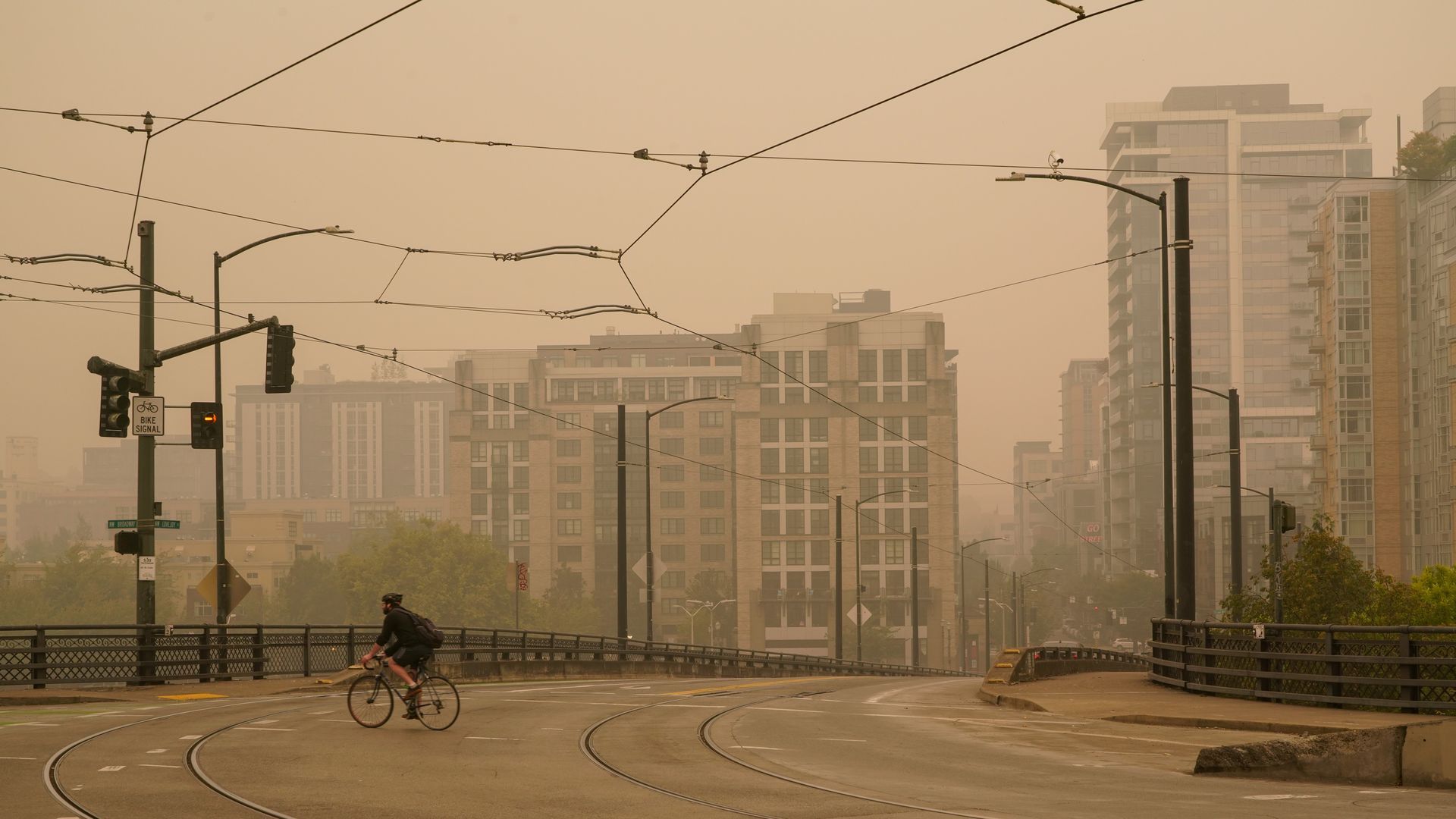
Not only does wildfire smoke contribute to poor air quality, seen here during Oregon's Labor Day fires in 2020, but it can also erode the ozone layer. Photo: Rebecca Smeyne/Bloomberg via Getty Images
The Portland metro area lands in the middle of the pack for ozone pollution, according to a new report from the American Lung Association, but Oregon still faces mounting climate challenges that affect air quality.
Why it matters: Air pollution threatens the health of everyone — especially children, seniors, and people with asthma or heart and lung conditions.
By the numbers: The Portland-Vancouver-Salem region ranked 105th worst out of 228 metropolitan areas for the number of high ozone days, per the report, which analyzed data from 2021-2023, "the most recent three years of quality-assured nationwide air pollution data publicly available."
- Eugene and Medford landed at 165th and 130th, respectively.
- As for short-term particle pollution (spikes in fine, unhealthy matter, like wildfire smoke, over a 24-hour period), Portland ranked 104th — far better than in last year's report, when the region ranked in the top 25.
How it works: The report uses local air-quality data to grade and rank locations based on ozone pollution, daily particle pollution and annual particle pollution.
- Ozone is a gas that, at ground level, is a harmful irritant. Particle pollution involves tiny airborne particles from wildfires, fossil fuel burning and more.
Threat level: Ozone pollution can reach unhealthy levels on warm, clear days when ground-level pollution — caused by vehicle exhaust, industrial emissions and electric utilities — interacts with the sun, according to Multnomah County.
- A bill in the Oregon Legislature that would mandate the state escalate its efforts to reduce greenhouse gas emissions has been sitting in a House committee for more than a month and is likely dead this session.
- Oregon is expected to warm by 5° by 2074 and by 7.6° by 2100 without meaningful reductions to climate-warming gases.
State of play: Extreme heat, wildfires and drought are degrading air quality nationwide, including in Oregon, the Lung Association says. All are linked to climate change.
The big picture: Just over 156 million Americans, 46% of the population, live in areas with unhealthy levels of ozone or particle pollution, per the Lung Association's report.
- That's up by nearly 25 million people from last year — the highest total in a decade.
- The findings, which predate the current Trump administration, come as the White House is reconsidering U.S. Environmental Protection Agency rules and regulations meant to curb pollution and promote cleaner air.
What they're saying: "Clearly, we need to do more to control the pollutants that are impacting our changing climate and worsening the factors … that are threatening our health, instead of thinking about how to roll them back," says Katherine Pruitt, senior director of nationwide clean air policy at the Lung Association and report author.