Portland's downtown activity flounders post-pandemic



Add Axios as your preferred source to
see more of our stories on Google.
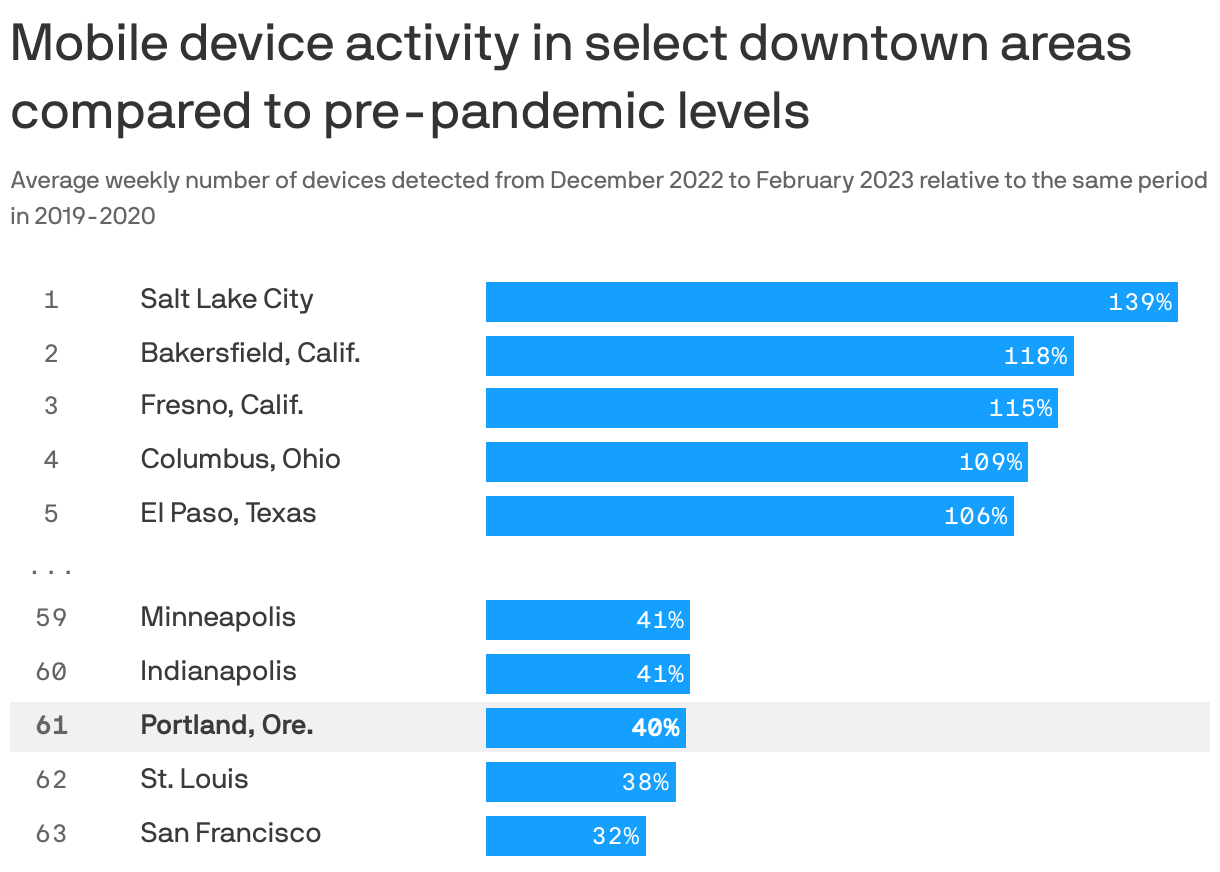
Downtown activity has yet to return to pre-pandemic rates in Portland.
- That's according to anonymized mobile device connectivity data analyzed by researchers at the University of Toronto's School of Cities.
Why it matters: Downtowns became ghost towns during the height of the COVID-19 pandemic as people sought to "flatten the curve" by staying at home as much as possible.
Driving the news: Mobile device activity in downtown Portland between December 2022 and February 2023 was 40% of what it was pre-pandemic, the researchers found.
Zoom in: Portland's downtown has been the epicenter of the city's struggles with chronic homelessness, petty crime and drug addiction.
- Dozens of businesses have left or plan to leave due to the rise in break-ins, robberies and vandalism.
- In an attempt to address the ongoing plight, city officials have made efforts to revitalize downtown — like initiatives to transform vacant storefronts, attracting new developments and rebuilding crumbled infrastructure.
What they're saying: "We need sustained action to maintain downtown," Peter Andrews, an executive at Melvin Mark Brokerage Company, told The Oregonian last month. "All of us — and that includes businesses and property owners — have a responsibility to solve these problems."
Zoom out: Even as the pandemic ebbs, the new era of remote and hybrid work means fewer people visiting restaurants, bars and shops.
- That has big implications for downtown economies, which have historically relied on commuting workers who spend money before, during and after their daily 9–5s.
How it works: The researchers essentially treated smartphones and other mobile devices as a proxy for their owners; if a device pings a nearby cell tower, it's a good bet that's where the device's owner is.
- Of note: For this analysis, "downtown" is defined as areas of a given city with the highest employment density.
Reality check: While downtown activity is one indicator of a city's economic health, it doesn't paint a full picture on its own.
What's next: Many cities are experimenting with various efforts to rethink their downtown neighborhoods — including, most notably, office-to-residential building conversions, which are poised to increase in the coming years.
- But that idea is more cumbersome than it might seem, in part because the design and shape of some office buildings make them ill-suited for residential use.