Pennsylvania's air quality to worsen due to climate change and wildfires


Add Axios as your preferred source to
see more of our stories on Google.
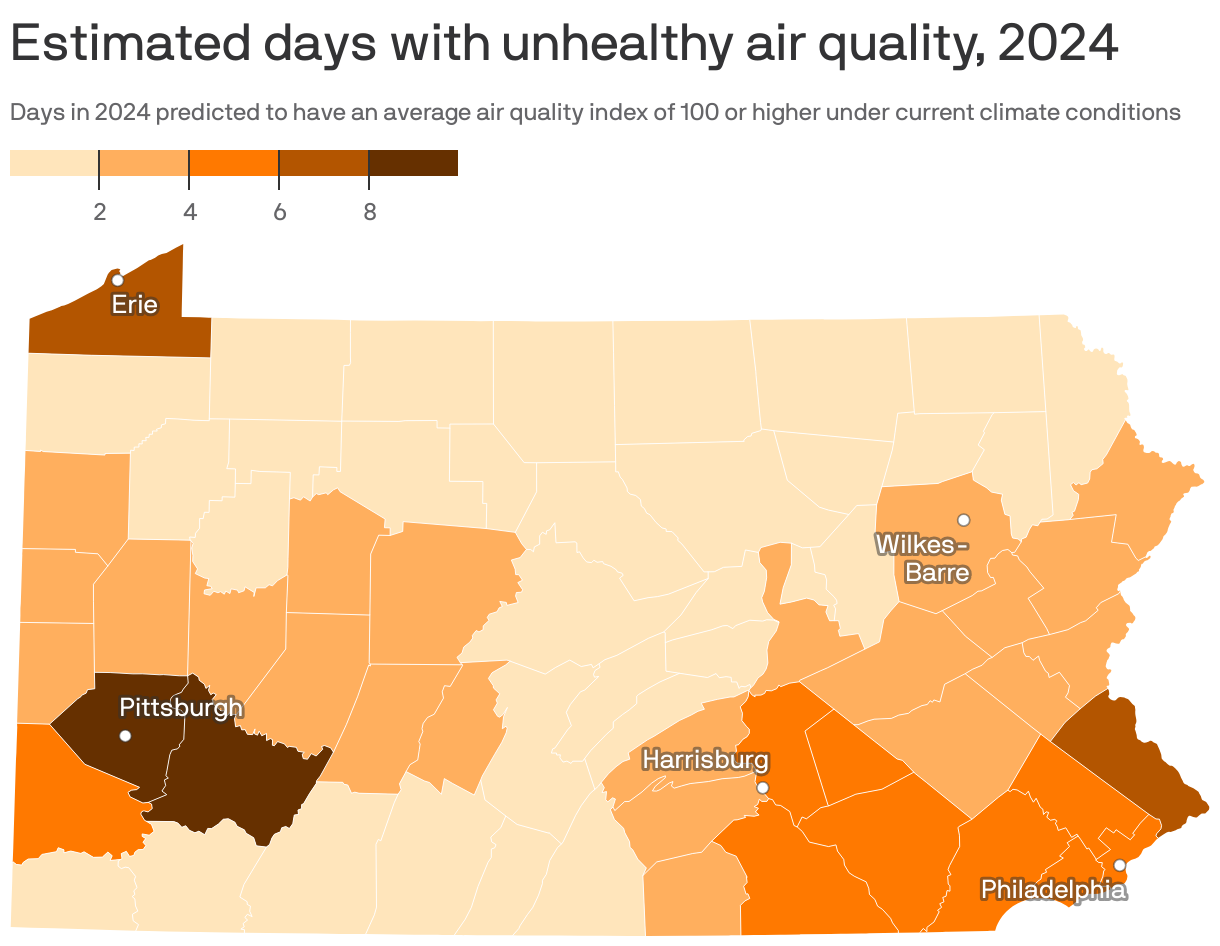
After recent progress in the Philadelphia metro toward cleaner air, climate change-related extreme events are expected to erase those gains through 2054.
Why it matters: Philly and surrounding Pennsylvania counties will deal with an uptick in "bad air quality" days per year, when pollution is above 100 on the air quality index, per new research from the First Street Foundation.
Flashback: Smoke from Canadian wildfires last year brought hazardous air quality conditions to the region and throughout the Northeast.
- Before that, the air quality here saw an improvement, helped partly by the 2019 closure of a South Philly refinery.
The big picture: An increase in large wildfires out west, along with heat waves and drought, are already yielding a growing "climate penalty" to air quality in the U.S., Axios Generate's Andrew Freedman reports.
The bottom line: The population of Americans exposed to "dangerous" days on the air quality index is projected to reach 11.2 million, a 13% increase, over the next 30 years.
- The population exposed to "hazardous" days on the AQI is likely to rise 27% during that time, per the report.
Zoom in: The report found that Philadelphia, Delaware and Montgomery counties will see their unhealthy air quality days increase from five to eight over the next 30 years, in part due to smoke from wildfires elsewhere.
- Bucks and Chester counties are expected to see their "bad air quality" days rise to seven per year.
Zoom out: Nearly all of Pennsylvania's 67 counties will have an increase in unhealthy air quality days by 2054, per the report.
- Allegheny and Westmoreland counties in western PA are both projected to have the most unhealthy air quality days (11) in the state by 2054.
What they're saying: "The climate penalty associated with the rapidly increasing levels of air pollution is perhaps the clearest signal we've seen regarding the direct impact climate change is having on our environment," Jeremy Porter, head of climate implications at First Street, tells Axios.