How "heat islands" are making extreme heat worse


Add Axios as your preferred source to
see more of our stories on Google.

As dangerously high temperatures hit much of the U.S. this summer, a new analysis finds urban "heat islands" significantly exacerbate such extreme weather.
Why it matters: A stifling, widespread heat wave brought some of the hottest and most perilous temperatures of the summer to more than 40% of the U.S. population last week.
Furthermore, urban heat islands (UHIs) are boosting temperatures within 65 major U.S. cities, including Indianapolis, according to a recent analysis from Climate Central, a nonprofit climate research group.
- Nearly 34 million people live in environments where UHIs could raise temperatures by at least 8°F.
How it works: Heat islands — urban hotspots with higher temperatures compared to surrounding areas — are created when roads, buildings, parking lots and so on "trap" heat.
- Often such neighborhoods are poorer and lack trees and plants that would otherwise help cool the area.
Zoom in: Two-thirds of Indianapolis residents live in environments where UHIs can amplify summer temperatures by at least 8°F, according to Climate Central.
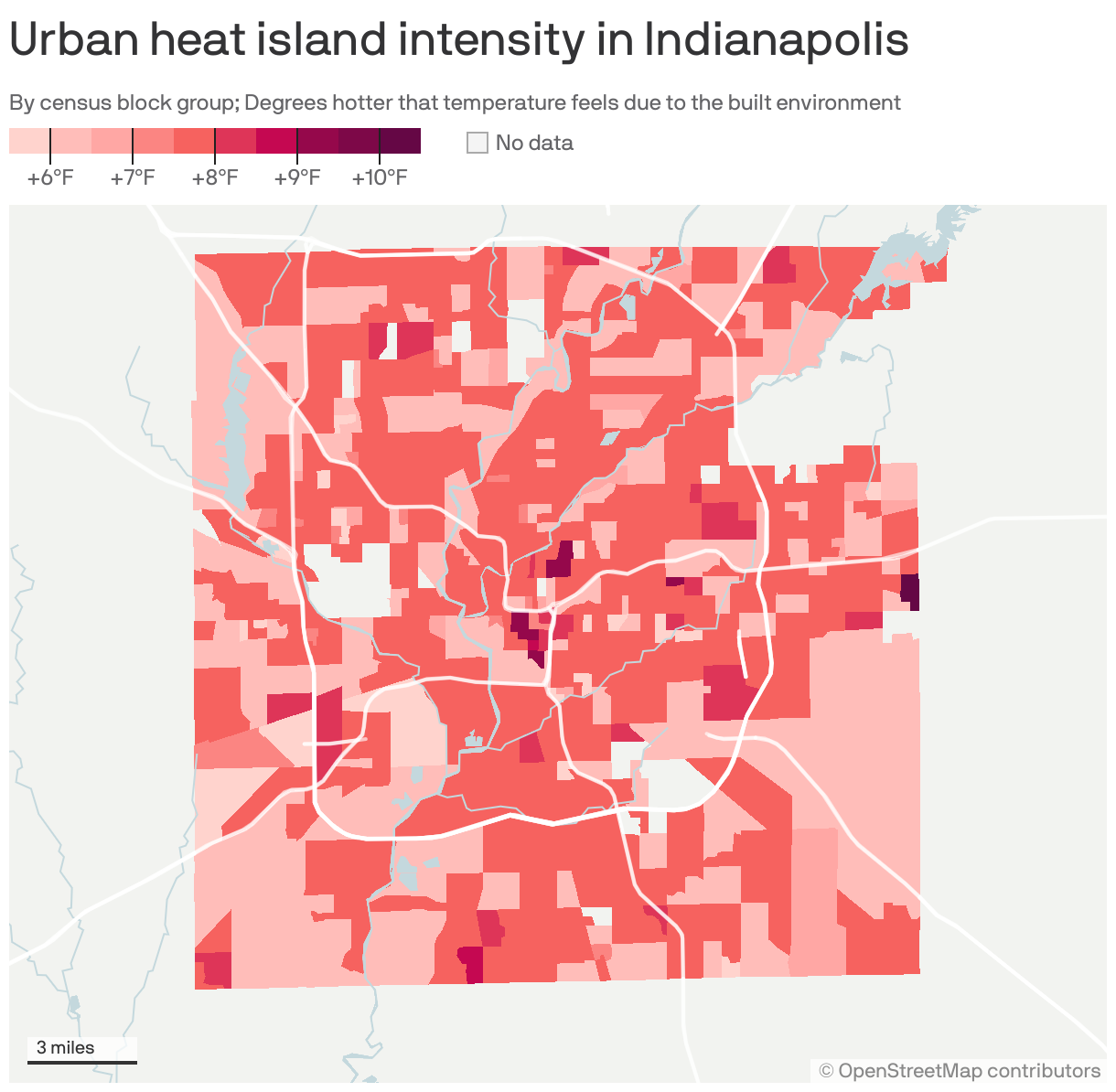
What they're saying: "Urban heat islands already expose residents to disproportionate heat risks and cooling costs, which will only climb as long as carbon pollution drives up global temperatures," Climate Central's Jennifer Brady said in a statement.
- "The entire planet is warming due to human-caused climate change, but the built environment further amplifies both average temperatures and extreme heat in cities," per the analysis.
Caveat: Scientists factor the heat island effect into their climate change monitoring and projections, and it does not explain the sharp uptick in global average temperatures, melting glaciers, record ocean warmth and more.
The bottom line: Cities are increasingly understanding the need to combat the heat island effect by adding more green space, using reflective paint on roads and buildings, opening cooling centers and more.
- But their efforts may not be going far enough.