"Heat islands" worsening extreme temperatures across the U.S.

Add Axios as your preferred source to
see more of our stories on Google.
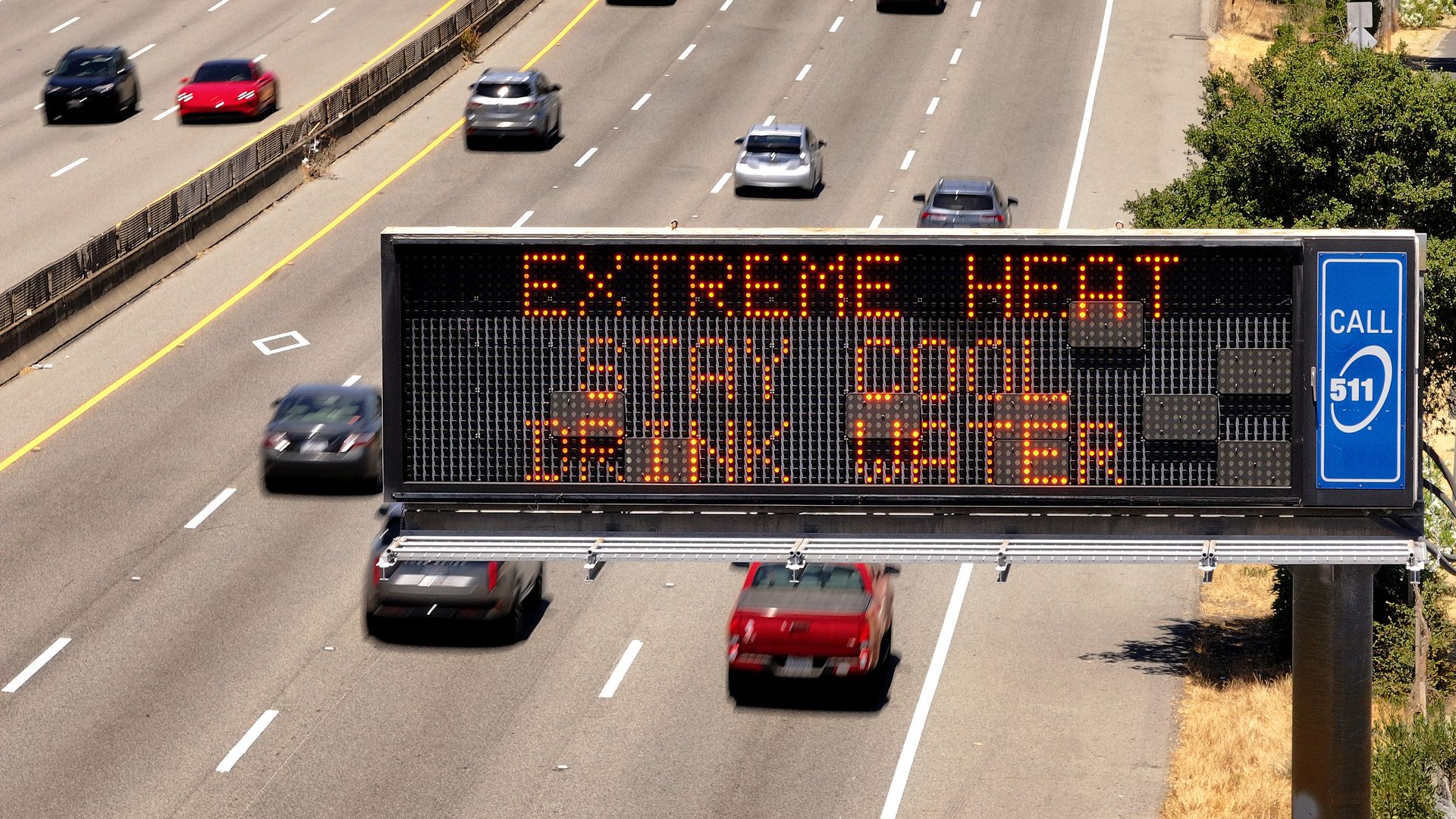
A Caltrans changeable message sign on Highway 101 displays a warning about extreme heat on July 2 in Corte Madera, in the Bay Area of California, where excessive heat warnings remain in effect through July 12. Photo: Justin Sullivan/Getty Images
As dangerously high temperatures sweep much of the U.S., new analysis finds urban heat islands can significantly worsen the situation during such extreme weather events.
The big picture: Urban heat islands (UHI) are boosting temperatures within 65 major U.S. cities that are home to 50 million people, or 15% of the total U.S. population, according to Climate Central's analysis.
- Nearly 34 million, or 68% of the 50 million people, were found to live in environments where UHIs were capable of boosting temperatures by at least 8°F.
Driving the news: "The entire planet is warming due to human-caused climate change, but the built environment further amplifies both average temperatures and extreme heat in cities," per a Climate Central statement announcing the new data.
- Contributing factors driving the UHI index are built environments, such as roads, buildings and parking lots, a reduced percentage of green space with not enough plants to help cool the air and dense populations.
- More than 5 million people in New York City, Chicago and San Francisco live in environments where UHIs are capable of amplifying summer temperatures by at least 10°F, according to the analysis. Excessive heat warnings are in effect across the Bay Area through Friday due to the current extreme heat wave.
- In cities with sprawling heat intensity, such as Houston, which is also currently affected by searing temperatures, high UHI index values are spread across a vast developed land area.
By the numbers: The 10 U.S. cities in the Climate Central analysis whose citywide urban heat island effects can increase temperatures the most include:
- New York (+9.6°F), San Francisco (+9.1°F), Newark, N.J. (+9.0°F), Chicago (+8.7°F), Philadelphia (+8.5°F), Washington D.C. (+8.5°F), West Palm Beach, Fla. (+8.5°F) Boston (+8.4°F), Miami (+8.4°F) and Baltimore (+8.4°F).
What they're saying: "Urban heat islands already expose residents to disproportionate heat risks and cooling costs, which will only climb as long as carbon pollution drives up global temperatures," said Climate Central's Jennifer Brady in a statement.
Threat level: The extreme heat has killed at least 28 people, mostly in Oregon and California, where it's hampering emergency services' response to wildfires, but also in Maryland, the Washington Post notes.
Zoom out: "Extremely dangerous heat" will continue in the U.S. West for the rest of the week, where widespread excessive heat warnings and heat advisories are in effect, per the National Weather Service.
- "Hazardous heat will expand in coverage over portions of the central and eastern U.S. late this weekend into next week, with the heat expected to persist longer over portions of the southeastern U.S. and the East Coast."
In photos: Persistent, dangerous heat wave takes a toll on U.S. life

In southeastern Texas, the combination of power outages from Hurricane Beryl and heat indices of up to 106°F prompted heat advisories, per the NWS.
- More than 1.3 million customers in the affected region that includes Houston were still without power on Thursday morning, according to poweroutage.us.
- "This heat is especially dangerous if you remain without power and doing strenuous outdoor work," the NWS' Houston office warned. "Please stay hydrated and use safe generator practices."

People in Las Vegas, Nevada, on Wednesday sweltered through a record fifth straight day of temperatures over 115°F. The city has a UHI index of over 7°F.
- The NWS' Vegas office noted in a Wednesday forecast discussion that its seven climate sites had set or tied 29 daily record high temperatures, including four all-time records, since July 1.
- "The most intense heat wave in our area's recorded history" will continue through the rest of the workweek, it warned.

Across Oregon, new daily record high temperatures were set on Wednesday, the NWS' Portland office noted. These included Portland, which hit 100°F, the city's airport, which reached 104°F, and Salem and Eugene, which each peaked at 106°F. Portland has a UHI index of 8°F.
- The heat wave that's "gripped Oregon significantly" increased the fire danger across the state, where three large blazes are burning, a local official told Oregon Public Broadcasting on Wednesday.
- At least 10 people in Oregon have died of "suspected heat-related illnesses" as of Wednesday from the heat wave that began last week, state officials said.

Death Valley has in recent days reached at least 129°F, just 1°F shy of the hottest reliably measured temperature on Earth, and similar temperatures have been forecast for Thursday.
- Despite the searing heat, hundreds of tourists have been reported to have visited the desert valley this week.
- A motorcyclist died from heat exposure in Death Valley on July 6, when the temperature reached 128°F, which the National Park Service noted would be a new daily record if confirmed.
Go deeper: Warmest June on record hits Earth, boosting odds of warmest year
