Warmest June on record hits Earth, boosting odds of warmest year

Add Axios as your preferred source to
see more of our stories on Google.
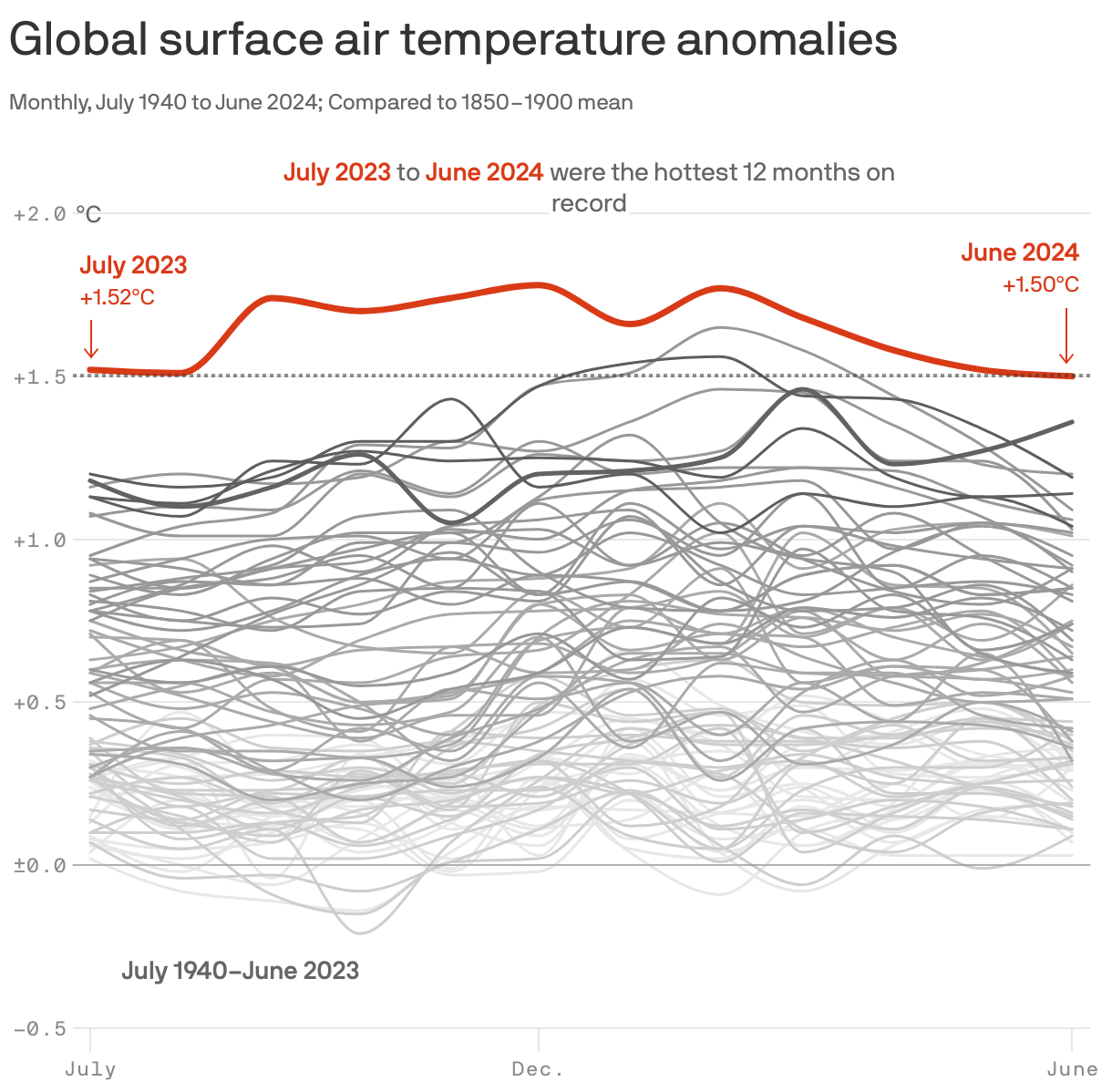
June was the warmest such month on record worldwide, according to figures released Monday, extending a heat streak even longer.
Why it matters: The monthly milestone increases the odds that 2024 will eclipse 2023 as the warmest year on record, and adds to the consecutive months that exceeded the crucial 1.5°C threshold in the Paris Agreement.
- The global average temperature for the past 12 months, from July 2023 to June 2024, came in as the highest on record, at 1.64°C (2.95°F) above the pre-industrial average.
Zoom in: The new numbers come from the Copernicus Climate Change Service, a European center that keeps tabs on the global climate.
- They illustrate the continued global warmth this year, which has occurred even after a strong El Niño event ended, with La Niña conditions now developing in the tropical Pacific Ocean.
- Based on early trends in July, however, June may have been the last month of the extended global hot streak, since global sea surface temperatures as well as air temperatures are trending down slightly, toward second-hottest territory.
By the numbers: June global average surface temperatures were 0.67°C (1.2°F) above the 1991-2020 average, exceeding last year's June reading by 0.14°C (0.25°F).
- Relative to the pre-industrial average, global average temperatures last month were 1.5°C above average, which makes it the 12th straight month to meet or beat the 1.5°C threshold.
- The month was the 13th in a row to rank as the warmest respective month in Copernicus' temperature database, which dates back to 1940. A similar streak occurred during 2015-2016, Copernicus noted in a statement.
- Global ocean temperatures during June also hit a record high, extending the streak of record warm months to 15. The oceans absorb about 90% of the trapped heat from the human-caused buildup of greenhouse gases in the atmosphere.
Yes, but: The pre-industrial average offers a useful comparison, illustrating that warming is already causing the planet to bump up against that limit for as long as a year.
- However, the 1.5-degree target as defined in the Paris Agreement hasn't been met or breached yet, since it's defined as a 20-to-30-year global average temperature.
- Studies show that more significant climate change impacts would occur if warming exceeds 1.5-degrees, which given emissions trends we are on track to do.
The big picture: The record warm ocean and air temperatures have had major consequences for society, with floods, wildfires, deadly heat waves and other climate-linked extreme events affecting nearly every continent during 2023 and 2024 to date.
- Multiple studies have shown that for heat waves, in particular, such events could not have happened without human-caused climate change.
Zoom out: The odds that 2024 will overtake 2023 as the warmest year on record may be as high as 95% now, according to climate scientist Zeke Hausfather, via a post on X.
- Scientists are investigating the causes for 2023's extreme global warmth, including whether it is an indication that global warming has accelerated.
- Suspects include a 2022 volcanic eruption in the South Pacific, which injected vast quantities of water vapor into the upper atmosphere.
- Another is a reduction in pollution from marine shipping vessels, via rules that went into effect in 2020. This has lowered emissions of sulfate aerosols, which reflect incoming solar radiation and can lead to slight cooling.
- These factors may have worked alongside the strong El Niño to cause global average temperatures to climb to new heights. However, studies so far have come up short in pinpointing these factors as the clear cause or combination of causes.
The bottom line: Only significant downward trends in global average temperatures may be enough to prevent another warmest year milestone.
