"Potentially deadly" heat wave envelops East Coast

Add Axios as your preferred source to
see more of our stories on Google.
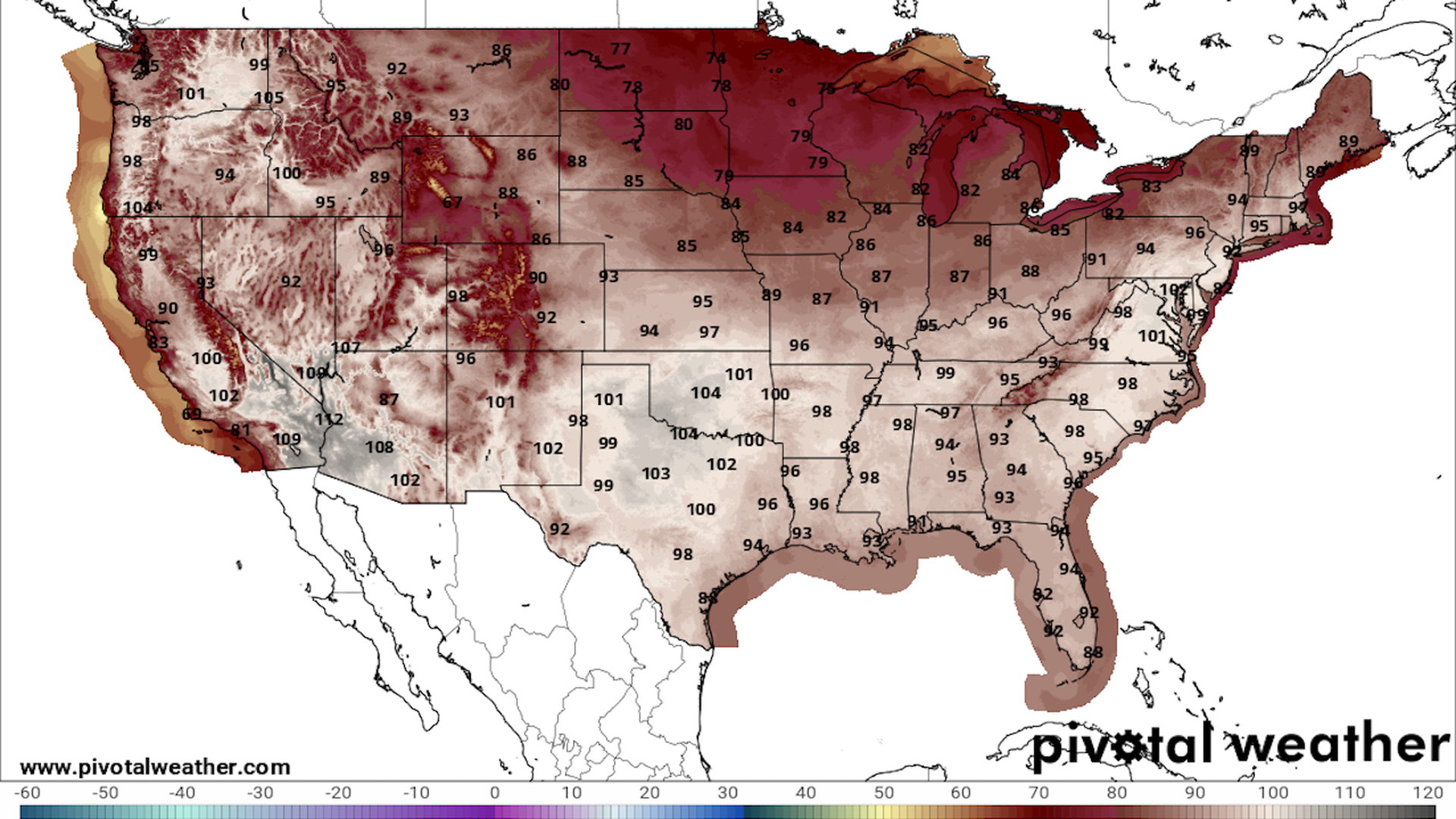
Map of forecast high temperatures across the U.S. on July 16. Image: Pivotal Weather
A searing, widespread heat wave is bringing some of the hottest and most perilous temperatures of the summer to about 130 million people in the U.S. on Tuesday, with a particular emphasis on the East Coast and Central states.
Threat level: About 227 million people in the U.S. will see temperatures exceed 90°F during the next seven days, according to Weatherbell Analytics.
- Prolonged exposure to such heat can cause serious illness and even prove fatal. More than two-dozen deaths have already been attributed to the heat in the U.S. so far this summer. This is likely a significant undercount.
- On Monday, temperatures soared to 102°F in Washington, D.C., setting a daily record, beating the old milestone of 100°F set in 1988.
- In D.C., the high temperature climbed to 104°F on Tuesday, tying the longest streak of consecutive 101°F or hotter days, set during the Dust Bowl era of 1930. It also tied the daily record for the sizzling summer of 1988.
- In addition, a large expanse in the Southern Plains and Mississippi River Valley will also see temperatures reach dangerous thresholds Tuesday.
Zoom in: Heat indices — the combination of how air temperature and humidity make the air feel to the human body — will reach 105°F to 110°F or higher along the East Coast and in the Plains, such as Oklahoma City, eastward to parts of Arkansas and Tennessee.
- This includes Washington, Baltimore and Philadelphia.
State of play: Extreme heat warnings and advisories stretch up and down much of the East Coast.
- According to the NWS' Heat Risk Scale, which goes from level 1 to 4, many of the most populated areas of the East Coast will see the highest risk category of "extreme" on Tuesday with "impacts likely in most health systems, heat-sensitive industries and infrastructure."
By the numbers: About 45 million people will experience high temperatures above 100°F, based on National Weather Service data.
- Based on NWS forecasts, on Tuesday, Washington, D.C. is expected to see highs exceed 100°F again. The city is in the midst of its hottest summer-to-date.
- Philadelphia is also forecast to reach 100°F on Tuesday, according to NWS forecasts.
- Little Rock, Arkansas could come within 2-degrees of 100°F on Tuesday before cooling off for the rest of the week.
What they're saying: The NWS is emphasizing the seriousness of the health risks due to the combination of heat and humidity, particularly in the East and Southeast.
- "The near-record temperatures and high humidity suggest Major to Extreme HeatRisk conditions for portions of the East, Tuesday and Wednesday. Extremely dangerous and potentially deadly heat, particularly for urban areas in the Southeast and East Coast, are forecast," the NWS said in a forecast discussion Tuesday morning.
- "Heat stress will build rapidly for those without adequate cooling or hydration."
Context: Human-caused climate change, largely from burning fossil fuels such as coal and natural gas, has greatly increased the odds of heat waves and led them to become more intense and longer lasting, research shows.
- According to the Climate Shift Index from the research organization Climate Central, human-caused climate change is making daytime highs on Tuesday at least three times as likely in Washington, D.C., while hot overnight minimum temperatures also show a significant climate change fingerprint.
- This is compared to a preindustrial atmosphere without added amounts of planet-warming greenhouse gases.
What's next: The extreme heat is likely to abate for some in the Northeast, Midwest and parts of the Mid-Atlantic during midweek, but will fester in the Southeast.
- Meanwhile, after two weeks of searing, record-breaking heat that dramatically boosted wildfire risks, computer model projections are showing yet another round of intense heat building in California during the coming weeks.
- So far, California has seen a much above average area of land burned so far this year, and multiple large fires are burning with red flag warnings in effect in northern California.
- After an unusually wet winter spurred vegetation growth and weeks of record warm conditions dried the land out, there is abundant, extremely dry fuels for wildfires to burn.
The bottom line: The U.S. is already having its second-warmest summer, with many cities on track to have their warmest such season.
- The continued intense July heat, which may stretch into early August, makes it more likely that these records will be clinched.
Go deeper: Warmest June on record hits Earth, boosting odds of warmest year
This story has been updated with the latest weather information.
