University of Chicago tops college free speech rankings


Add Axios as your preferred source to
see more of our stories on Google.
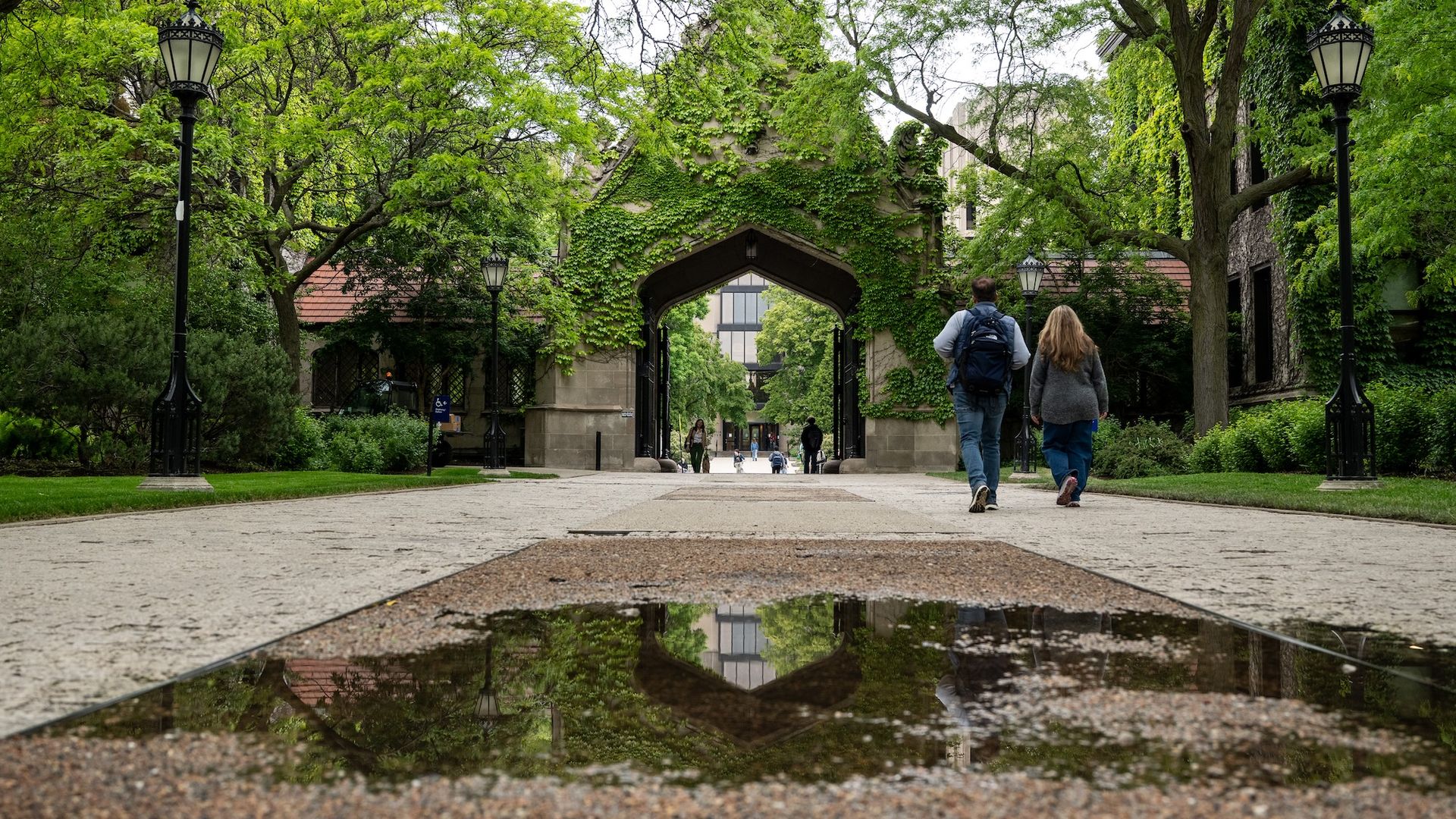
Cobb Gate at the University of Chicago campus. Photo: Christopher Dilts/Bloomberg via Getty Images
American colleges are largely failing to create a healthy free speech climate on campus, but the University of Chicago breaks from that trend, according to a new national ranking.
Why it matters: Students are self-censoring at high rates amid intense political pressure from the Trump administration and efforts by some universities to change policies in response.
By the numbers: The rankings involved surveying around 63,000 students at 262 campuses, finding an average overall score of D-, the highest recorded in seven years, according to the Foundation for Individual Rights and Expression (FIRE).
Zoom in: University of Chicago tops FIRE's list for the third time in seven years, with a B- grade.
- Northeastern Illinois University is the second-highest-ranked Illinois school, coming in at No. 74, followed by Northwestern at No. 90.
- Both schools scored a D grade.
- Only 24 schools received a C or better.
How it works: FIRE defined self-censorship as refraining from sharing views because of fear of social, professional, legal or violent consequences.
- The topic students identified as the most difficult to discuss was the Israeli-Palestine conflict, with 50% of students reluctant to broach it.
- Trump followed at 46%, and conservative activist Charlie Kirk, who was assassinated a year ago, at 44%.
- Abortion ranked fourth at 43%. Immigration and transgender rights tied at roughly 38%.
Context: FIRE officially endorsed UChicago's "Chicago Statement" in 2015, a free speech policy statement produced by the university's Committee on Freedom of Expression.
- The statement was part of the Committee's 2015 report outlining the school's approach to free speech and debate on campus.
- "In a word, the University's fundamental commitment is to the principle that debate or deliberation may not be suppressed because the ideas put forth are thought by some or even by most members of the University community to be offensive, unwise, immoral, or wrong-headed," the report reads.
- FIRE's methodology for the annual rankings considers colleges' adherence to the Chicago Statement.
Between the lines: The Israeli-Palestinian conflict remains the most "taboo topic on campuses" for the third straight year.
- Protests in response to the war were active at Chicago-area universities during 2024, including UChicago, DePaul, Northwestern and the School of the Art Institute.
- Those demonstrations, and some schools' agreements with protesters, led Congress to call then-Northwestern president Michael Schill to testify in front of a Republican-led House committee hearing on antisemitism.
Zoom out: The rankings come as President Trump increasingly tries to control what schools can teach, what diversity programs they can offer and which international students can attend American universities.
- The administration has also pushed schools to restrict protests that it describes as antisemitic, including by withholding federal funding and pursuing lawsuits and investigations against universities.
What they're saying: "President Trump will always protect the First Amendment rights of all Americans," White House spokesperson Davis Ingle told Axios in an emailed statement.
- "President Trump is committed to holding elite universities accountable, which is why he's taking long-overdue action to restore excellence to higher education, encourage a vibrant marketplace of ideas on campus, and maintain America's advantage for generations to come."
- A Department of Education spokesperson told Axios that "[i]t is no surprise that public confidence in our colleges is at an all-time low when so many institutions have abandoned free speech and viewpoint diversity on campus."