SNAP cuts unclear after judges' order

Add Axios as your preferred source to
see more of our stories on Google.
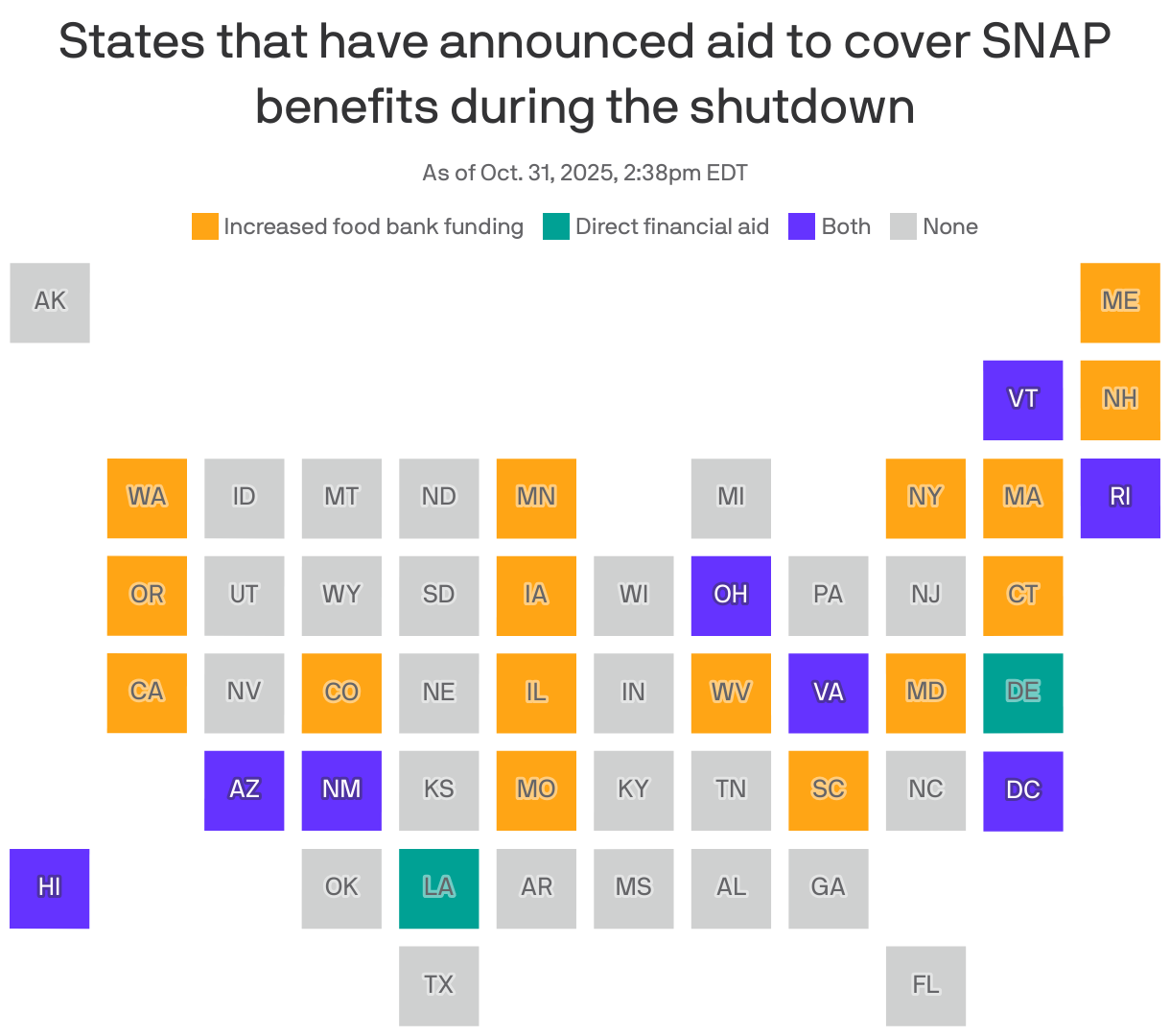
Two federal judges ordered the Trump administration to continue funding SNAP benefits during the government shutdown, but if and when payments will resume remains unclear.
Driving the news: In separate cases, the judges said the USDA must tap contingency funds to keep benefits available, at least temporarily.
The big picture: The rulings could provide some support and reassurance to 42 million SNAP recipients nationwide, and nearly 2 million in Illinois — while in the process making it easier for Democrats to keep holding out rather than quickly voting to end the shutdown.
- But if the Justice Department can successfully appeal those orders — as it has with any number of other court orders — the stop-start-stop of critical benefits could create significant confusion for low-income Americans.
Zoom in: Gov. JB Pritzker last week signed an executive order directing $20 million to food banks across the state, but that's only a temporary stopgap solution.
- Food banks and pantries are already strapped from demand driven by tens of thousands of federal workers who have not been paid because of the shutdown.
Catch up quick: Illinois joined 24 other states in suing the U.S. Department of Agriculture last week, claiming it's illegally withholding funds that could sustain benefits.
- $6 billion in federal contingency funding was set aside for SNAP to respond to a shutdown, but the USDA said it could not use those funds to cover fiscal year 2026 regular benefits, according to a memo obtained by Axios' Marc Caputo.
- An Office of Management and Budget spokesperson told Axios on Wednesday that the contingency fund is "not available" to support "regular benefits because the appropriation for regular benefits no longer exists."
State of play: The Greater Chicago Food Depository (GCFD) has a list of food pantries across the state, as does the Illinois Department of Human Services (IDHS).
- Delivery services like DoorDash and Instacart are also offering assistance.
By the numbers: Nearly 900,000 Cook County residents use the SNAP program to purchase groceries, according to IDHS.
- More than 60% of SNAP participants are families with children at home.
- $192 a month was the average SNAP benefit per person in 2024.
- An estimated 1 in 5 Chicago area households experiences food insecurity, according to GCFD.
Between the lines: "I think there's a media perception that people on food assistance can just buy junk food or soda. In reality, there are guardrails on what people can purchase, and these programs often combine nutrition education with food access and assistance," Northwestern clinical dietician Bethany Doerfler said in a statement.
- "When children don't have enough to eat, it hurts their school performance," Doerfler added. "Food insecurity doesn't just mean hunger, it means exposure to environmental toxins, poorer learning and psychological stress for children."
What they're saying: "For every meal provided by the Feeding America network of food banks, SNAP provides the equivalent of nine meals. We are proud of our impact and our ability to respond in times of crisis, but we cannot grow nine times in size," GCFD said in a statement.
- "We will do everything in our power to make sure food is available for anyone who visits a local pantry."
How to help: Here are several ways to donate to GCFD.
- You can also check in with individual pantries to see what kind of donations would be most useful.