"Enemy from within": Trump ramps up rhetoric against Chicago


Add Axios as your preferred source to
see more of our stories on Google.
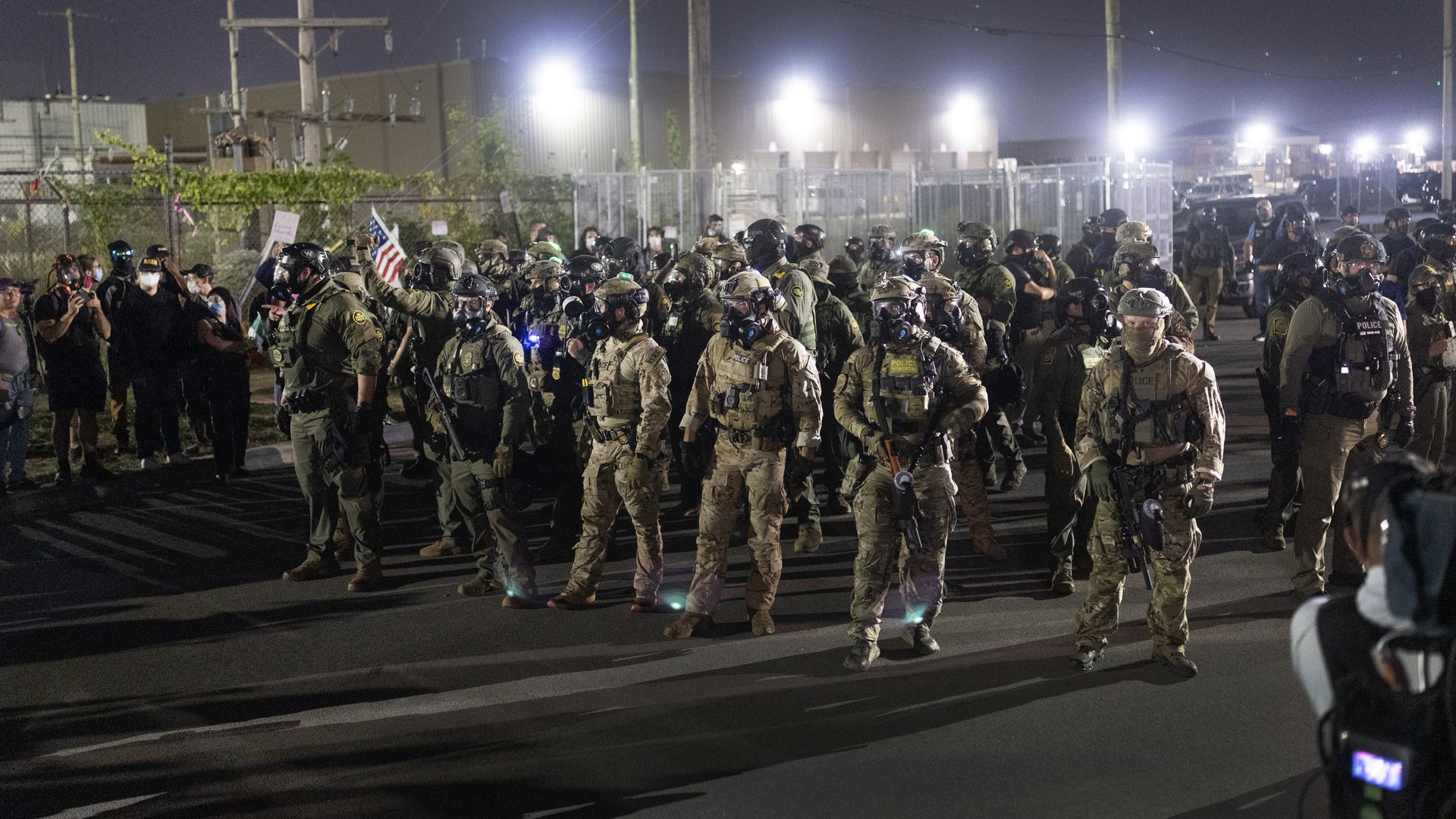
Federal law enforcement agents confront demonstrators protesting outside of the Broadview immigrant processing center on Sept. 27. Photo: Scott Olson/Getty Images
President Trump spent the majority of the summer attacking Chicago, but on Tuesday, he ramped up his rhetoric further in his speech to military leaders.
The big picture: While speaking to the assembled generals at an unprecedented meeting in Quantico, Trump suggested deploying the military to "dangerous" U.S. cities like Chicago as "training grounds."
What he's saying: He told military leaders, "We have to handle" the so-called "enemy from within."
- "We've brought back the fundamental principle that defending the homeland is the military's first and most important priority."
- Trump described Chicago as a "big city with an incompetent governor."
Why it matters: It's unclear from the president's remarks who "the enemy from within" is and if he's talking about deploying troops to fight crime, to aid in apprehending undocumented immigrants, to secure facilities against "radical left" protesters or to intimidate political enemies like Gov. JB Pritzker.
Between the lines: Pritzker, who announced Monday at a press conference surrounded by other state leaders that DHS is requesting federal troops, said, "This is not about fighting crime or about public safety. This is about sowing fear and intimidation and division among Americans."
The intrigue: Since Trump first floated the idea of federalizing the National Guard in Chicago in late August, state and local leaders have questioned the legality of it. One workaround was to justify the need for troops to protect federal assets and agents.
- Pritzker believes ICE agents are provoking "chaos" in Broadview for this purpose. "What I have been warning of has now been realized," Pritzker added.
Reality check: Even though the National Guard has yet to be deployed, federal agents from the Department of Homeland Security, the U.S. Border Patrol and the U.S. Immigration and Customs Enforcement have been.
Zoom in: Many Chicagoans have already seen militarized border patrol agents walking past popular parks, tourist attractions and restaurants downtown.
- Or in neighborhood immigration raids, like Tuesday morning in South Shore, where ICE agents were seen in full military gear.
- Their presence has reportedly led to a drop in business for neighborhood restaurants and shops.
Axios reached out to DHS to ask how the new federal troops would be used, but they refused to comment.
The fine print: If the National Guard is deployed without the consent of the governor, it can only be used to support law enforcement, secure federal facilities, provide disaster relief and repair critical infrastructure.
- Without the governor's consent, the National Guard cannot assume the role of military police.
The other side: While Chicago leaders are admonishing the deployment of troops, some residents are happy to see them.
- "Whether it's to protect ICE agents or to safeguard the neighborhood, what a welcome sight that someone in our government gives a crap about everyday, middle-class city residents," Anne, a reader from River North, tells Axios.
The bottom line: While the debate over militarizing Chicago escalates, Chicagoans are already seeing it firsthand.