What Chicago leaders can do to stop federal agents from patrolling its streets

Add Axios as your preferred source to
see more of our stories on Google.
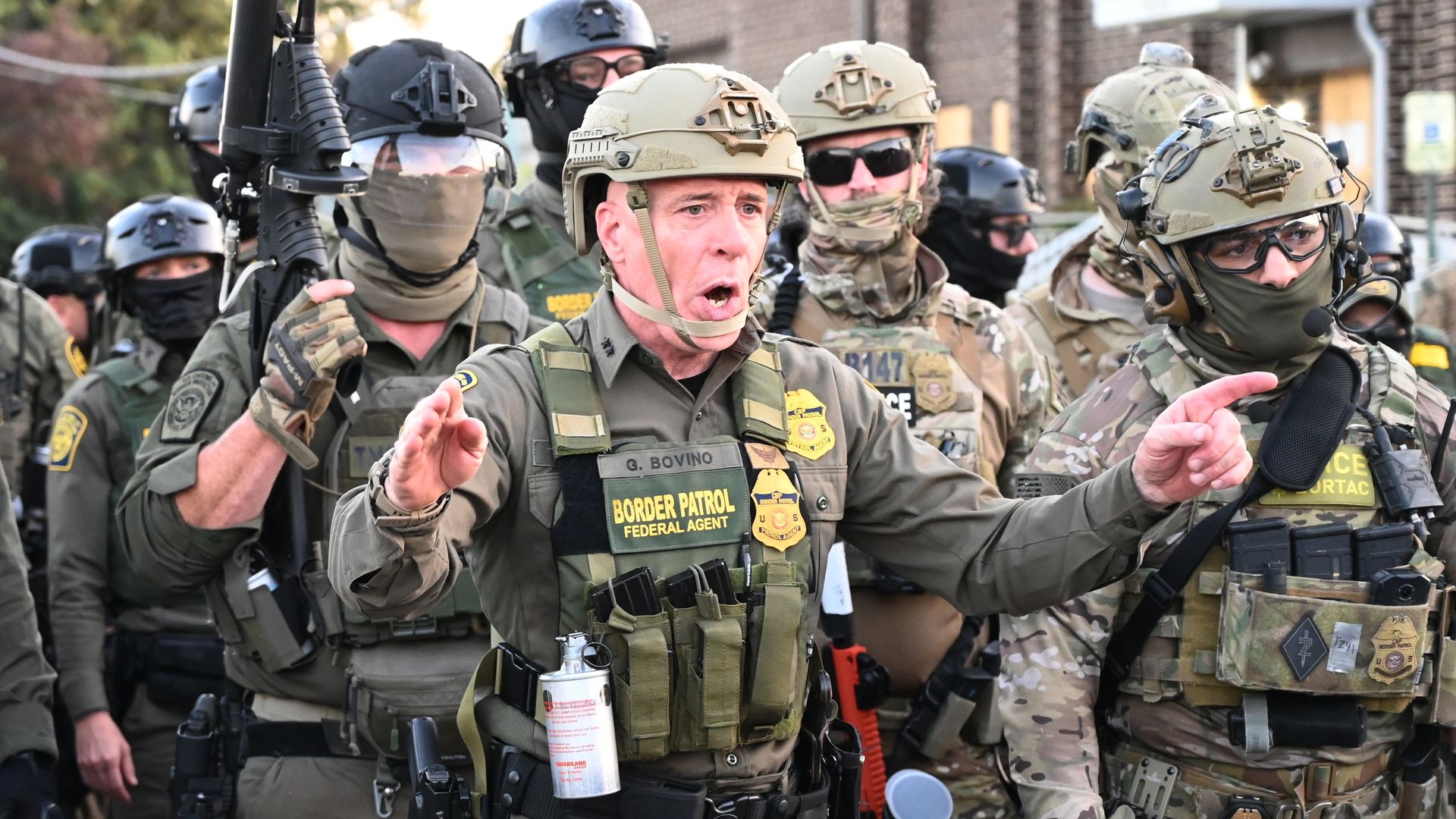
Border Patrol Chief Gregory Bovino stands amid a protest outside an ICE facility in Broadview on Saturday. Photo: Jacek Boczarski/Anadolu via Getty Images
This weekend, Chicagoans were shocked to see armed federal agents in military gear patrolling downtown and parts of River North, and Gov. JB Pritzker says the Department of Homeland Security is asking to send more federal troops here.
The big picture: These armed agents are part of the U.S. Border Patrol sent to help support U.S. Immigration and Customs Enforcement agents in their "Operation Midway Blitz" aimed at detaining undocumented immigrants in the Chicago area. They have not been, so far, members of the National Guard, but that could change quickly.
The latest: Pritzker said at a press conference Monday that the Department of Homeland Security has asked the Department of War for more military personnel, including possibly National Guard troops, to aid in protecting ICE agents in the Chicago area.
What they're saying: "All of this has been aimed at causing chaos and mayhem in the hopes of creating a pretext to deploy military troops against Chicago," Pritzker said.
Why it matters: Mayor Brandon Johnson and Pritzker declared victory against Trump's plan to federalize National Guard troops earlier this month, but after a weekend of clashes with protesters, that victory may have been short-lived.
State of play: Several local lawmakers released statements against federal troops and the weekend patrols, calling them a "publicity stunt" designed to intimidate citizens, but they have stopped short of saying deployments are illegal.
- "We've been here before," Northwestern Pritzker School of Law professor Paul Gowder tells Axios. "In the period before the Civil War, and especially after the Fugitive Slave Act of 1850, free states were forced to come up with creative ways to impede the federal government's abusive efforts to spirit away their community members."
- "Generally, the federal government is free to use its discretion, within the law, to enforce federal law," Gowder continued.
Yes, but: "Even though ICE, the Border Patrol, etc., are authorized to enforce federal law, they still have to abide by the law themselves."
The intrigue: One of the ways Pritzker or Johnson could retaliate is to enforce laws over due process, trespassing or excessive force by federal agents.
- Pritzker has said he's closely monitoring situations outside the ICE facility in Broadview and other immigration actions.
Between the lines: Gowder says another way local governments could push back is to create new laws that pertain directly to federal agents, like in California, where the state government passed a law restricting federal agents from wearing masks.
- "If Illinois, or maybe even Chicago, passed legislation like that they might be able to enforce it against ICE officials," Gowder adds.
Zoom in: If law enforcement isn't possible, look to Pritzker and Johnson to continue using their legal departments to sue the Trump administration.
The bottom line: It'll be hard for local governments to stop more federal agents from patrolling Michigan Avenue, but Pritzker and Johnson have options to try to prevent it.