Best and worst Chicago neighborhoods for kids

Add Axios as your preferred source to
see more of our stories on Google.
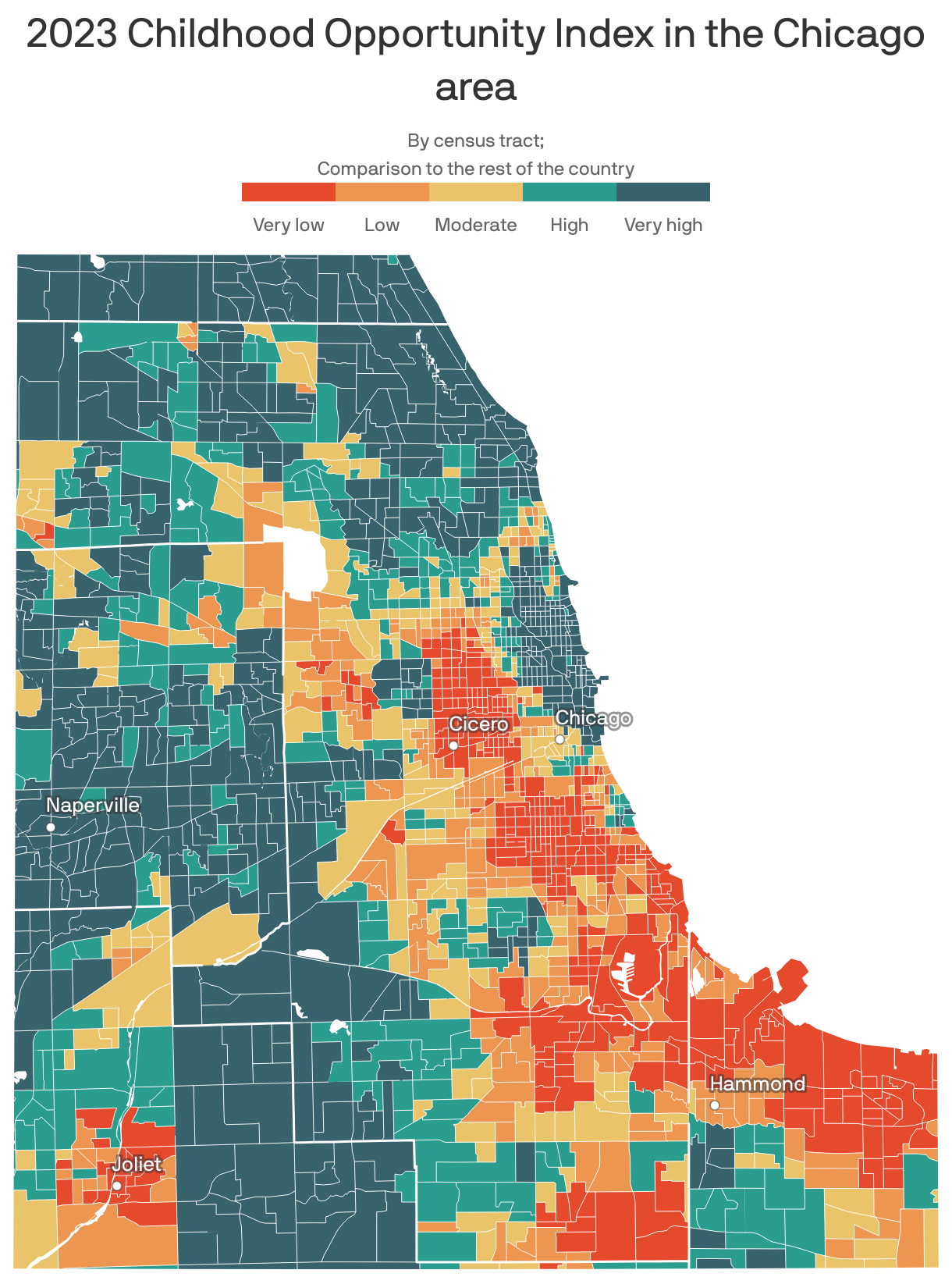
A new analysis of quality-of-life data across the country reinforces what many already knew: Kids in Chicago's poorest neighborhoods face daunting odds on multiple levels compared to their counterparts in affluent areas.
The big picture: The conclusion comes from the latest report of the Childhood Opportunity Index (COI), which rates communities on 44 factors that help determine a child's success, and awards scores from 1 to 100. The above map delineates census tracts, but we analyzed ZIP codes.
- The 10 lowest-scoring ZIP codes (earning 1 to 11 points) cover majority low-income Black and Latino neighborhoods including Englewood, Austin, Lawndale, Garfield Park, West Lawn, South Deering, Roseland, Humboldt Park and South Shore.
- The 10 highest-scoring ZIP codes (earning 96 to 100 points) cover affluent, largely white areas of downtown, Lincoln Park, West Town and Lakeview.
What they're saying: "Neighborhoods are important for families and children, shaping the economic, social and environmental contexts of their everyday lives and influencing their childhood and long-term health, education and socioeconomic outcomes," the authors write in the latest report.
Backstory: The COI was created in 2014 by Boston University researchers to gather rigorous data "to improve child wellbeing and increase racial and ethnic equity in opportunities for children."
- Researchers originally calculated scores on 19 metrics, but in this latest report, based on 2023 data, the metrics have more than doubled to now cover areas of school quality, safe housing, access to healthy food, parks, clean air and economic opportunities.
Zoom out: Chicago's racial opportunity gap correlates with national trends. "Hispanic and Black children are more likely to have lower opportunities for healthy development," the report notes.
- "They live in families and neighborhoods with much higher poverty rates and attend schools with more limited resources than white children. This inequity affects not only children but all of us."
The intrigue: Over the 11 years of the study, at least two gentrifying ZIP codes have seen dramatic improvements in their COI scores.
- Between 2012 and 2023, the 60622 ZIP code, covering areas of Bucktown, West Town, Wicker Park and Ukrainian Village, jumped from a score of 63 to 90.
- During the same period, Pilsen's 60608 ZIP code rose from 7 to 45.
The latest: The City of Chicago has embarked on multiple recent programs aimed at addressing issues in the report by:
- Launching a campaign to close the life expectancy gap between Black residents and others
- Building more affordable housing
- Installing a large network of air quality sensors
- Expanding schools that double as social service hubs in underserved neighborhoods
- Increasing summer job opportunities for Chicago youth
The bottom line: While these programs could help, it's worth noting that, after years of similar campaigns, most of the ZIP codes at the very top and bottom of the index list still hold the same place they did in 2012.
- Major improvements in Chicago's opportunity equity could take some time.