Chicago tries to close life expectancy gap

Add Axios as your preferred source to
see more of our stories on Google.
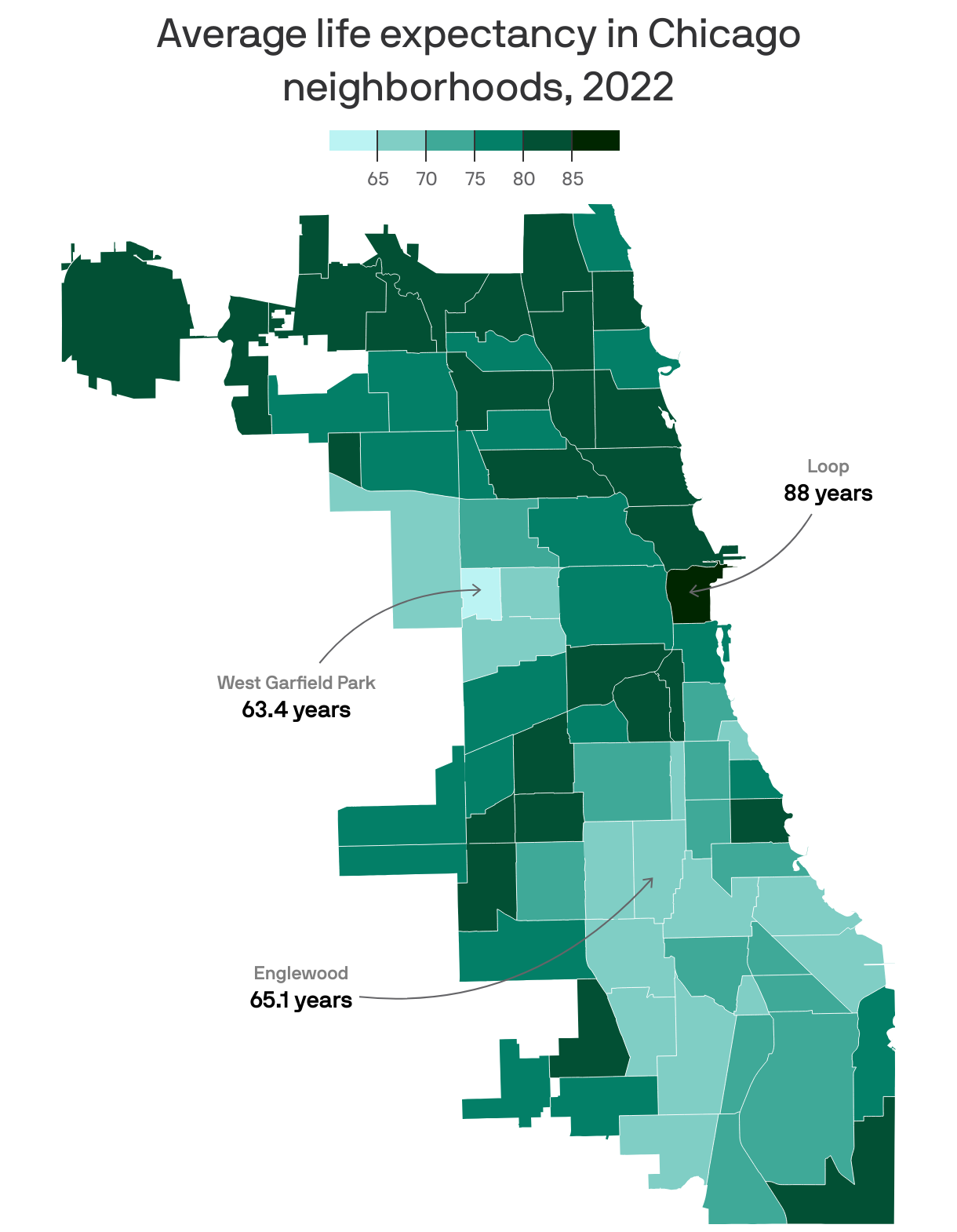
A new city campaign aims to close the whopping 11-year life expectancy gap between Black Chicagoans and their non-Black peers.
The big picture: As the city enters an era where its racial makeup is nearly 30% white, 30% Black and 30% Latino, Axios is starting a yearlong series examining racial equity in the city across several metrics from opportunities and perks to health disparities and disadvantages.
Backstory: The life expectancy gap wasn't always this big. In 2010, the disparity between Black and non-Black Chicagoans was 8.4 years.
- In 2020, Black life expectancy in Chicago fell below 70 for the first time in decades, driven largely by COVID deaths.
- During the pandemic in 2021, the gap peaked at 12.7 years before settling at 11.4 in 2022.
- Across all races the average life expectancy is 77 years.


Driving the news: The "Healthy Chicago 2025 Strategic Plan" focuses on the root causes of health inequity including economics, housing and access to health care while zeroing in on the primary drivers of Black mortality, like chronic disease and opioid overdose, and the neighborhoods with the highest rates.
Zoom in: Chicago Department of Public Health is concentrating on these neighborhoods with a life expectancy much lower than the city's 77-year average.
What they're saying: "Preventing premature mortality from chronic diseases (namely heart disease), violence, and opioid overdose offer the most room for progress in reducing the racial life expectancy gap," CDPH commissioner Olusimbo Ige tells Axios.
- "Reversing these trends will require consistent, long-term commitment to increase access and uptake of health protective behaviors and resources. We have already seen significant reductions in opioid overdose and violence, and we want to build on these successes."
The cost: While the report doesn't quote a specific cost of the program, it cites the use of hundreds of millions in funds for health-related projects including sports programs, alternative policing, homelessness services, prison re-entry programs and more.
Between the lines: Even before the pandemic, life expectancy in some largely Black neighborhoods was falling, in part, due to opioid deaths. Declines from 2010 to 2019 included:
- Englewood: 3.3 years.
- East Garfield Park 3.23 years.
Yes, but: COVID accelerated the drop further, seeing life expectancy declines from 2019 to 2020 of 5.84 years in West Garfield Park and 4.2 years in North Lawndale.
The intrigue: While Black communities saw an overall 4.6-year life expectancy drop from 2019 to 2020, Latinos saw the biggest decline of 6.3 years.
- Most Black Chicagoans who died of COVID were people 70 years old and older, but at least 50% of Latino COVID deaths were in people aged 40-69, which CDPH attributes largely to a high representation among essential workers.


Here is how CDPH is trying to address the disparity by cause of death:
Chronic disease: Strategies include tobacco prevention and cessation programs through community partnerships.
- Using the PlayStreets initiative to increase youth and adult physical activity.
- Increasing healthy food access and navigation.
- Increasing health literacy and promoting risk reduction resources.
Violence prevention: Strategies include "a proactive 2025 summer violence prevention plan."
- Investing in community greenspace by cleaning vacant lots and promoting tree plantings.
- Hospital-based violence interventions.
Opioid overdose reductions: Strategies include expanding access to treatment and recovery services and making overdose reversing drug Naloxone more available.
- Surprising stat: In 2020, the opioid-related overdose death rate among Black males aged 45-64 years was six times higher than the rate among White males of the same age group.
Infectious disease: Strategies include modernizing public health surveillance systems and approaches to enhance rapid response.
- Identifying highest-risk community areas.
- Tailoring vaccine messaging for communities of color.
- Promoting the uptake of the HIV services.
Infant and maternal health: Strategies include hyperlocal outreach to promote safe sleep practices.
- Understanding barriers to prenatal care and creating a media campaign for improvement.
- Modernizing the Women, Infants, and Children (WIC) program.
Mental health: Strategies include improving the city's Mental Health Equity Network and Crisis Assistance Response and Engagement program.
- Developing "a housing to recovery continuum of care" for unhoused people and those with behavioral health conditions.
Federal effect: Ige acknowledges that Trump administration policies restricting funding for for equity-based work could affect federal support for the plan, but says, CDPH "intends to deploy programs and resources to serve the needs of Chicagoans with a priority on the people and places most impacted by adverse health outcomes."
What's next: CDPH says it should have updated life expectancy numbers this spring.