From New Orleans to Chicago: How Katrina reshaped lives


Add Axios as your preferred source to
see more of our stories on Google.
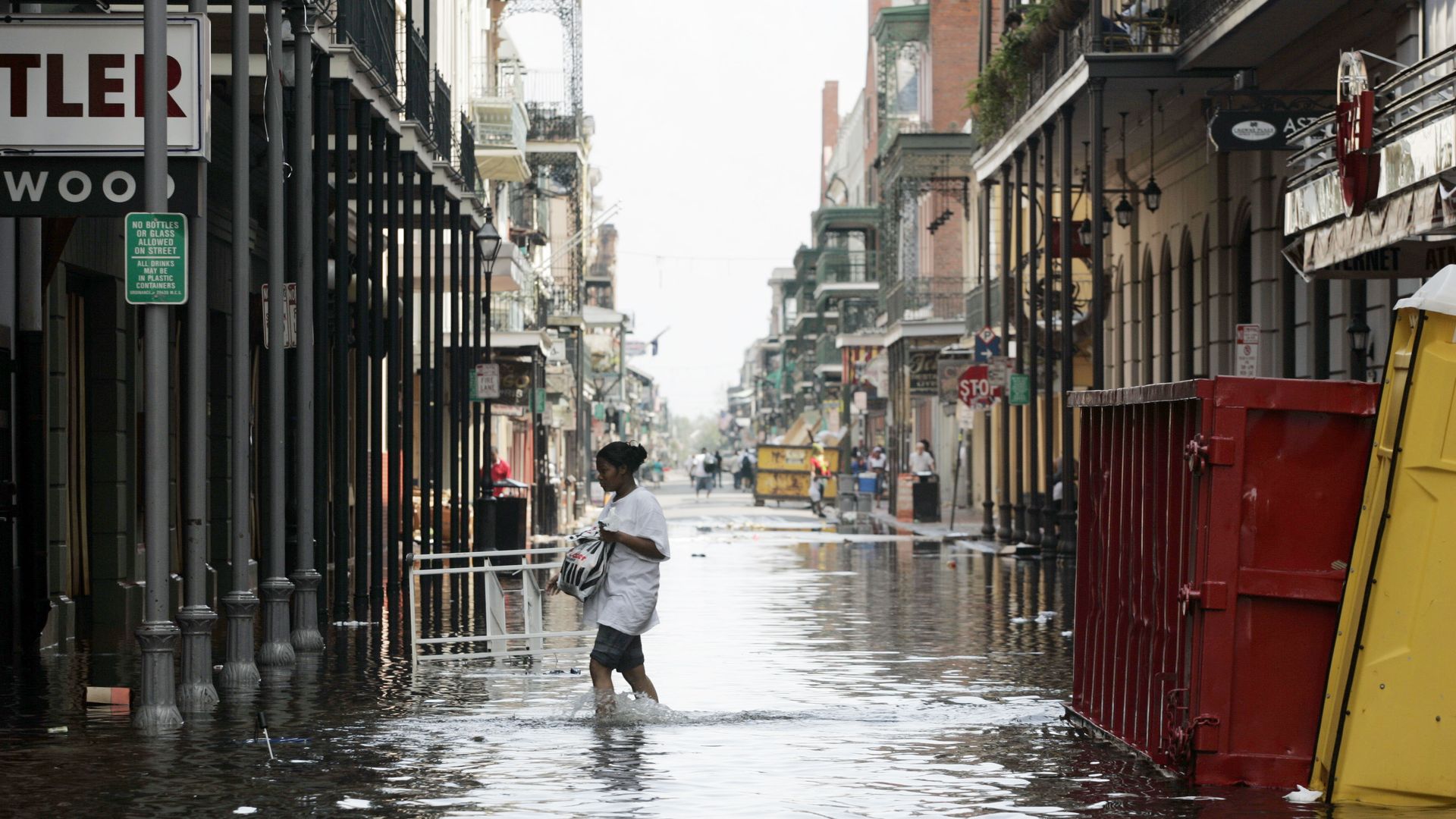
A woman crosses a flooded Bourbon Street in the French Quarter on Aug. 31, 2005 in New Orleans. Photo: Scott Morgan/Getty Images
When New Orleans flooded during Hurricane Katrina in August 2005, tens of thousands of displaced residents fled across the country, and new data shows for the first time exactly where they went.
Why it matters: The data identifies cities that proved stickier than others, researcher Elizabeth Fussell tells Axios.
Flashback: When the levees broke, about 80% of the city was flooded, leaving much of New Orleans suddenly uninhabitable.
By the numbers: New Orleans' population fell from 484,674 in April 2000 to an estimated 230,172 in April 2006, the Data Center says.
Reality check: Population data tells us trends but doesn't follow individuals.
- Government officials have only granted Fussell access to that kind of specificity within the data. She used census records to identify New Orleans residents impacted by Katrina, then followed them from 2006 to 2019.
She found that 33% of Katrina-affected New Orleanians had not returned to the metro by 2006.
- By 2019, her research shows, 31% of Katrina-affected New Orleanians still lived elsewhere.
Zoom in: An interesting nuance in the data, Fussell says, shows that cities like Los Angeles and Chicago were more likely to have attracted non-Black residents.
- And, she says, they were less likely to stay for the long term.
- One possible reason, Fussell says, is because non-Black residents were less likely to have been born in New Orleans.
- And if you weren't born there, you likely had social connections elsewhere.


Diane Chaine grew up in Park Ridge, but moved to New Orleans in 1998. She didn't evacuate before the hurricane because her family didn't have transportation. They hunkered down in a second-floor apartment in the French Quarter with friends and her 18-month-old baby.
What they're saying: "We dodged the hurricane, but not the catastrophic levee breaches," Chaine tells Axios. "It was part of the city without water. We stayed there for eight days."
- "I was truly lucky to have not had to use an ax to escape my home, or to spend time in the Superdome. I'm lucky we didn't die."
Chaine says it was an Australian police officer who came to the rescue, locating a car to use to leave. She drove to Houston, then Tulsa and then eventually flew back to Chicago.
- When she and her daughter arrived back in Chicago, they were showered with gifts and even handmade cards from kids at the local school. "I was so proud of my home state for not only treating me very well but also many others who had nothing but the clothes they were wearing."
Yes, but: While her family pleaded for her to stay in Chicago, even offering up places to stay, Chaine decided to return to New Orleans in 2006, almost a year after the hurricane.
- "Despite people questioning whether New Orleans mattered enough to be rebuilt, it was the resiliency of the people and a ton of hard work to get this city back up and running."
Today, Chaine still lives in New Orleans. And her baby? She just turned 21.
- "I do still feel emotional," Chaine reflected. "It was a 'death' (of our former lives before) and therefore the pain will never totally go away despite having learned to manage that pain over time."