Chicago's and Trump's different plans for homelessness

Add Axios as your preferred source to
see more of our stories on Google.
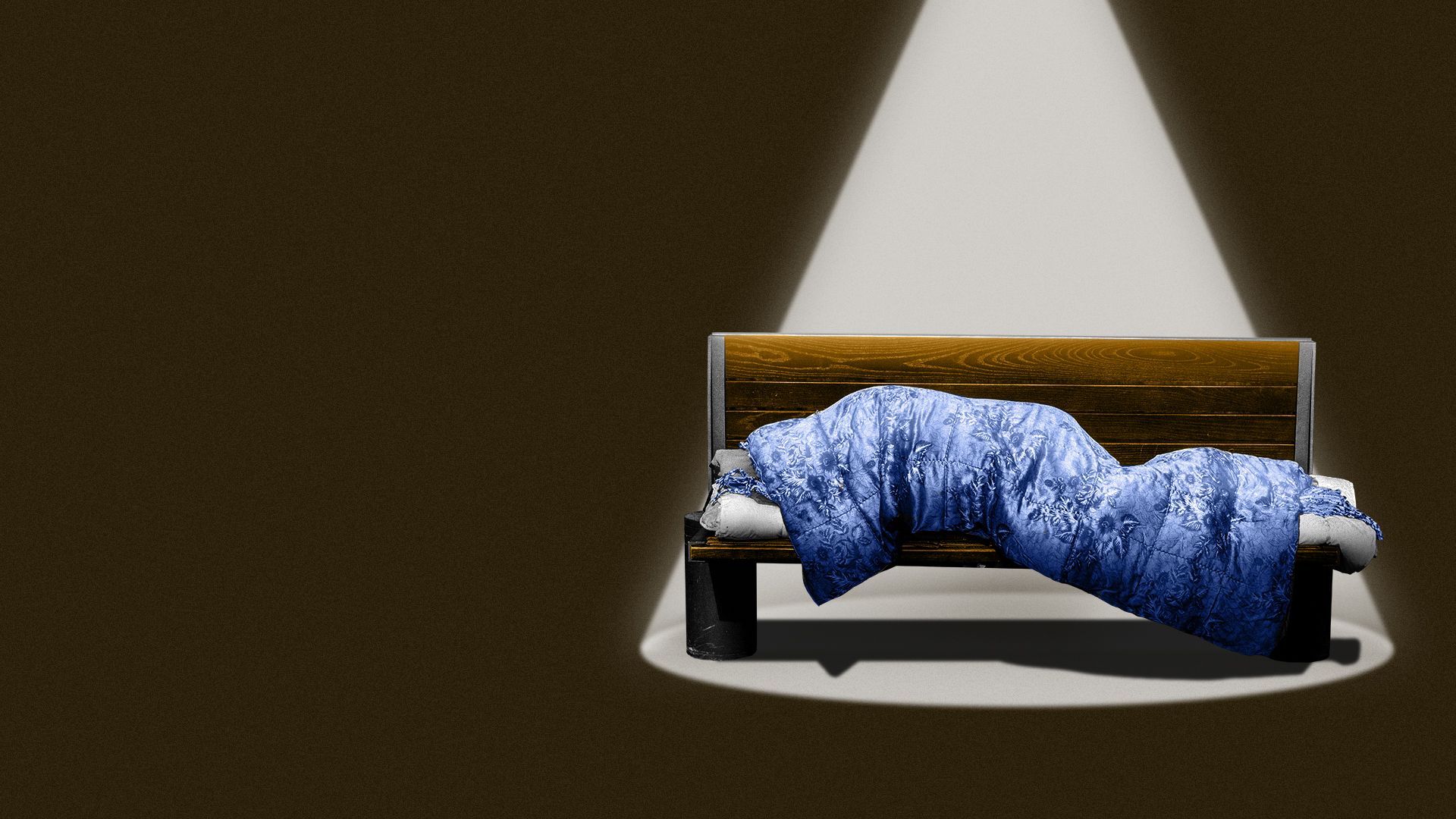
Illustration: Lindsey Bailey/Axios
Mayor Brandon Johnson is funneling $40 million into new services for Chicago's homeless people, while President Trump is calling for the country's unhoused to be moved to "long-term institutional settings."
Why it matters: About 76,000 people experienced homelessness in Chicago in 2022, according to the Chicago Coalition to End Homelessness (CCH). The mayor's new investment aims to modernize current shelters and give unhoused people more dignified and safe transitional housing.
Between the lines: The CCH's count is considerably higher than the city's point-in-time count as it includes all people who aren't in stable housing, such as those temporarily living with others, compared to the annual count of unhoused and sheltered people on one specific night.
Driving the news: Johnson announced a plan last week to update 750 shelter beds and add more than 350 beds in private sleeping rooms and bathrooms for families and individuals who avoid shelters because of the congregate setting.
- The initiative is paid for by $20 million in federal HOME-ARP funding and $20 million in locally issued bond funds.
- The following day, Trump issued an executive order that calls for "shifting homeless individuals into long-term institutional settings for humane treatment" to "restore public order."
What they're saying: "He's more interested in their criminalization than their fundamental right to be able to have an affordable place to live and a school to send their child to, [and a] good-paying job," Johnson tells Axios about Trump's order.
State of play: The White House plan repeatedly, without proof, refers to the unhoused population as people who are criminals, addicted to drugs or suffering from mental health conditions.
- It also instructs federal agencies to give funding priority to states and cities that outlaw outdoor camping and squatting — Chicago does not — and to take funding away from programs that focus on harm reduction and clean needle dispensation.
- The White House did not respond to Axios' request for comment.
The other side: Doug Schenkelberg, executive director of CCH, tells Axios the executive order demonizes unhoused people, which is already a common reaction. "It is this perception of feeling unsafe when really it's more about feeling uncomfortable."
- "One of the jobs we have to do is help shift that narrative. So people, when they see someone experiencing homelessness, they don't recoil, but they think, 'We, as society, have to do something more,'" Schenkelberg adds.
Plus: "There's a lot of questions from a practical side how these pieces [of the EO] can actually be implemented," Schenkelberg says. "If you're saying that you're going to involuntarily commit people to institutions, how does that even work? Where are the institutions? There's a whole host of questions above and beyond it being just a really bad policy."
Reality check: While Schenkelberg and other advocates welcome Johnson's new initiative, shelters are still a temporary solution to the larger issue of permanent, affordable housing. The question of how to pay for more affordable housing remains.
What we're watching: The mayor acknowledged that 100,000 affordable housing units are needed, but he wouldn't commit to new taxes when Axios asked if that was how Chicago could pay for it and didn't offer any other specific solution.