Chicago's parks rating slips in annual ranking


Add Axios as your preferred source to
see more of our stories on Google.
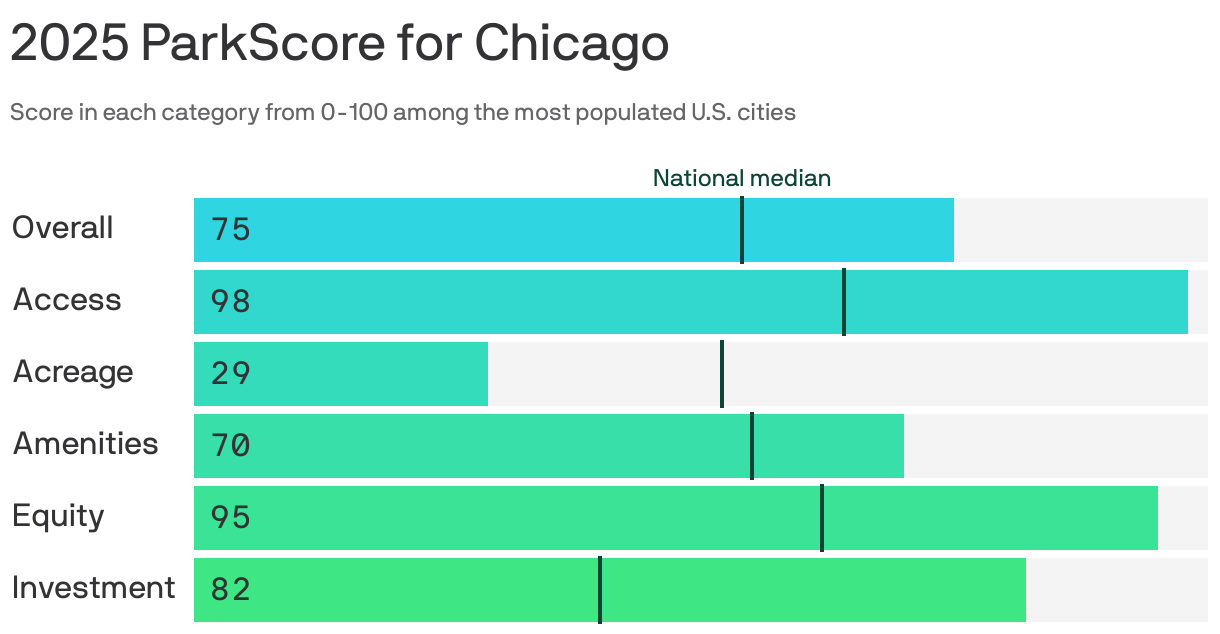
Chicago just missed the top 10 for an annual ranking of parks in the U.S.
Why it matters: Chicago has more than 1,200 parks that serve as free community meeting spots, offer indoor and outdoor space for exercise, and are often a factor in choosing which neighborhood to live in. But they require investment, attention and protection.
Driving the news: We are No. 11 on the Trust for Public Land's 2025 ParkScore index of park systems in the 100 most populous cities in the country, down from No. 10 last year.
- The ranking is based on five categories: acreage, access, amenities, investment and equity.
Zoom in: Chicago received high marks for park access with 98% of Chicagoans living within a 10-minute walk to a park.
- We also score well for amenities like playgrounds, sports facilities and water features.
- Chicago spent more than $220 per person on its park system, compared to the national average of $133.
Yes, but: Washington, D.C., the country's best city park system, spends nearly $400 per capita on parks.
Zoom out: D.C. uses more than 21% of its land for parks compared to Chicago, which uses 9%.
- Irvine, California, came in second and Minneapolis ranked third on the ParkScore rankings.
- Denver etched Chicago out of the top 10 in this year's rankings.
The intrigue: TPL highlights Chicago in a section about parks as great unifiers, specifically focusing on Douglass Park as a common meeting place for the predominantly Black residents in North Lawndale and largely Latino parkgoers in South Lawndale.
Stunning stats: Among the cities analyzed, $12.2 billion was invested in park and recreation systems in 2024, while 76% of residents now live within a 10-minute walk of a park.
- Those are both records since TPL started tracking such figures in 2007 and 2012, respectively.
What's next: Some of the money cities are spending on public parks lately is tied to pandemic-era federal infrastructure funding, which won't last forever.
- "It'll be interesting to see over the next couple of years, if there aren't replacement funds ... what that will mean for cities and communities that are really wanting to invest in parks," TPL president and CEO Carrie Besnette Hauser tells Axios.