Evanston high school implements "bell to bell, no cell" policy

Add Axios as your preferred source to
see more of our stories on Google.
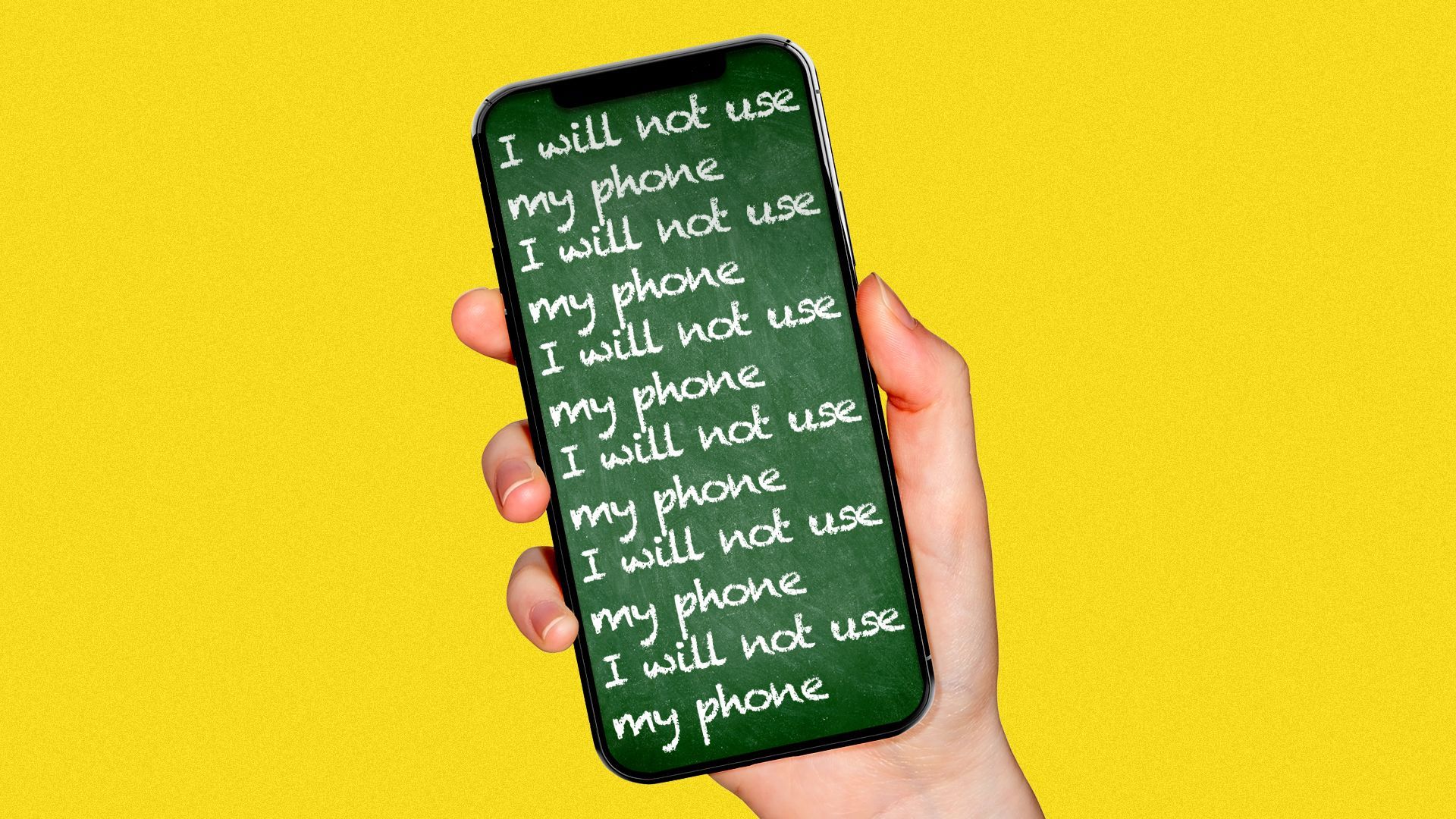
Illustration: Sarah Grillo/Axios
The nationwide push to ban cell phones in K-12 classrooms has reached the Chicago area.
Why it matters: Smartphones can be a great educational resource and way for parents to reach their kids, but they're also a distraction and becoming more addictive.
- The constant access to social media has been proven to have a negative effect on young people's mental health.
Driving the news: Evanston Township High School (ETHS) enacted a "bell to bell, no cell" policy before this school year that requires students place their phones in a designated area and remove earbuds.
Yes, but: They're not calling it a "ban" because students can use their phones during passing periods and at lunch.
Flashback: ETHS principal Taya Kinzie tells Axios that phone and social media dependence reached a new level during and after COVID, prompting the school to create a working group with staff and students last year to determine what the policy should be.
- "The amount of time that we know that it takes for even one minor disruption to recalibrate and redirect attention ... we know from studies it can take a minute to five minutes just to redirect," Kinzie says.
Zoom out: Other states and cities are considering widespread bans on cell phones in schools.
- Last spring, Indiana became one of the first states to pass a law that banned portable wireless devices during class time unless needed for learning, a disability or a medical issue.
Zoom in: CPS, the largest district in the state and fourth largest in the U.S., does not have a student cell phone usage policy. Instead, individual schools craft rules for student cell phone use while in class, a spokesperson tells Axios.
Threat level: U.S. Surgeon General Vivek Murthy has called social media a public health issue, citing research that shows more than three hours a day on social media doubles teens' risk of anxiety and depression symptoms.
The other side: Parents are often one of the biggest opponents to cell phone bans because they want to be able to reach their kids, especially during tragedies like school shootings.
- Kinzie tells Axios that when families need to get in touch with students for a family emergency, the school will make that happen by pulling the student out of class.
Reality check: While schools report students are more engaged when their phones are out of the classroom, experts are quick to remind educators and parents that access to the internet is a great learning tool.
What they're saying: Annika Wartowski, 16, agrees with the policy, for the most part.
- "It forces students to interact with each other and be in the moment. The only thing I don't like is teachers will say, 'Well usually we use our phones for this assignment but we're not allowed to.' I think we should be able to use our phones as a tool when needed."
Wartowski's mom, Alecia, likes that cell phones are put away during class.
- "It allows kids a little independence and separation during the day. Cell phones make it easy to be connected to your child every moment of the day, but I'm not sure how healthy that is for fostering independence and decision making."
- ETHS parent Jill Corr agrees: "Cell phones are so addicting, it's almost impossible for students to have access to them and not be using them. I've had no issue reaching my son during the day — he responds during passing periods and at lunch."