Chicago's 2022-23 winter was wetter than average


Add Axios as your preferred source to
see more of our stories on Google.
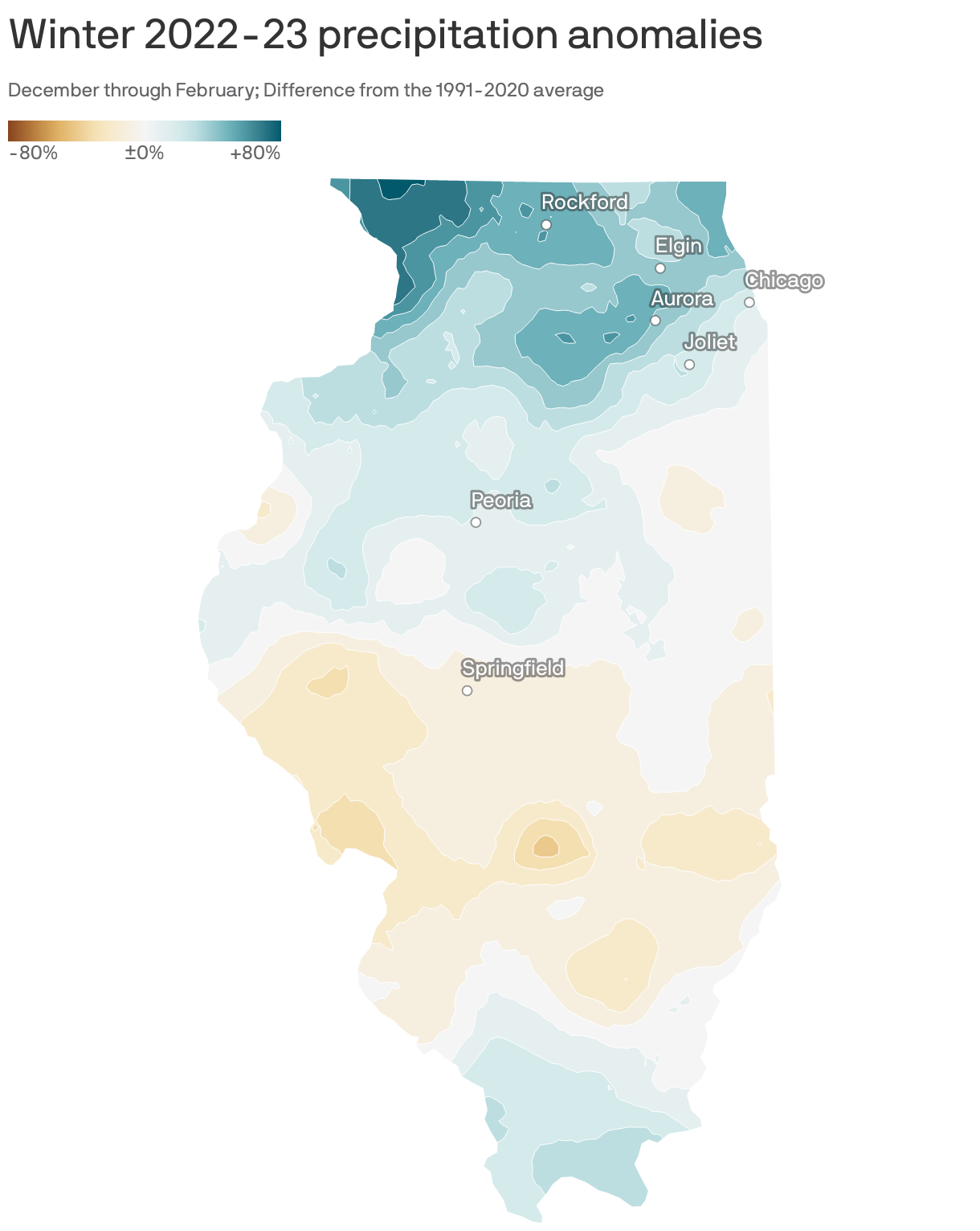
Chicago got 8.6 inches of precipitation — 2.5 inches more than average, according to data from the National Oceanic and Atmospheric Administration.
Why it matters: Wintertime precipitation can cause hazardous conditions from blizzards and ice storms — which prevent travel and knock out power — but it can also alleviate drought.
The big picture: Nationally, a band of heavier-than-usual precipitation stretched from California to Minnesota.
- Much of California and the midwestern United States had some of the wettest winter weather on record.
- The opposite was true in the Pacific Northwest and in parts of Texas and Florida, which were significantly drier than average.


Driving the news: It makes sense that several California towns set or neared wintertime precipitation records, considering the frequent strong storms affecting the Golden State in recent months.
- In Chicago, we didn't see much snow accumulation, though that was offset by more winter rainstorms than usual.
- The winter was the 15th-wettest in recorded history, dating back 150 years.
Zoom in: Minneapolis had its second-wettest winter on record, with about 6.4 inches of precipitation — around 3.5 inches more than normal (this includes the amount of water contained in snowfall there).
- San Francisco had its third-wettest, with a whopping 22.4 inches — nearly 10.4 inches more than typical.
- Naples, Florida, meanwhile, had its driest winter on record, with just 0.95 inches of precipitation — about 3.5 inches below average.
Of note: For this analysis, "winter" is defined as Dec. 1, 2022 through Feb. 28, 2023.
The bottom line: Climate change is raising the likelihood and the severity of precipitation extremes — both heavy rain and snow, as well as prolonged and severe dry spells.
- However, it does not mean that every season, or even each year, will set a record.