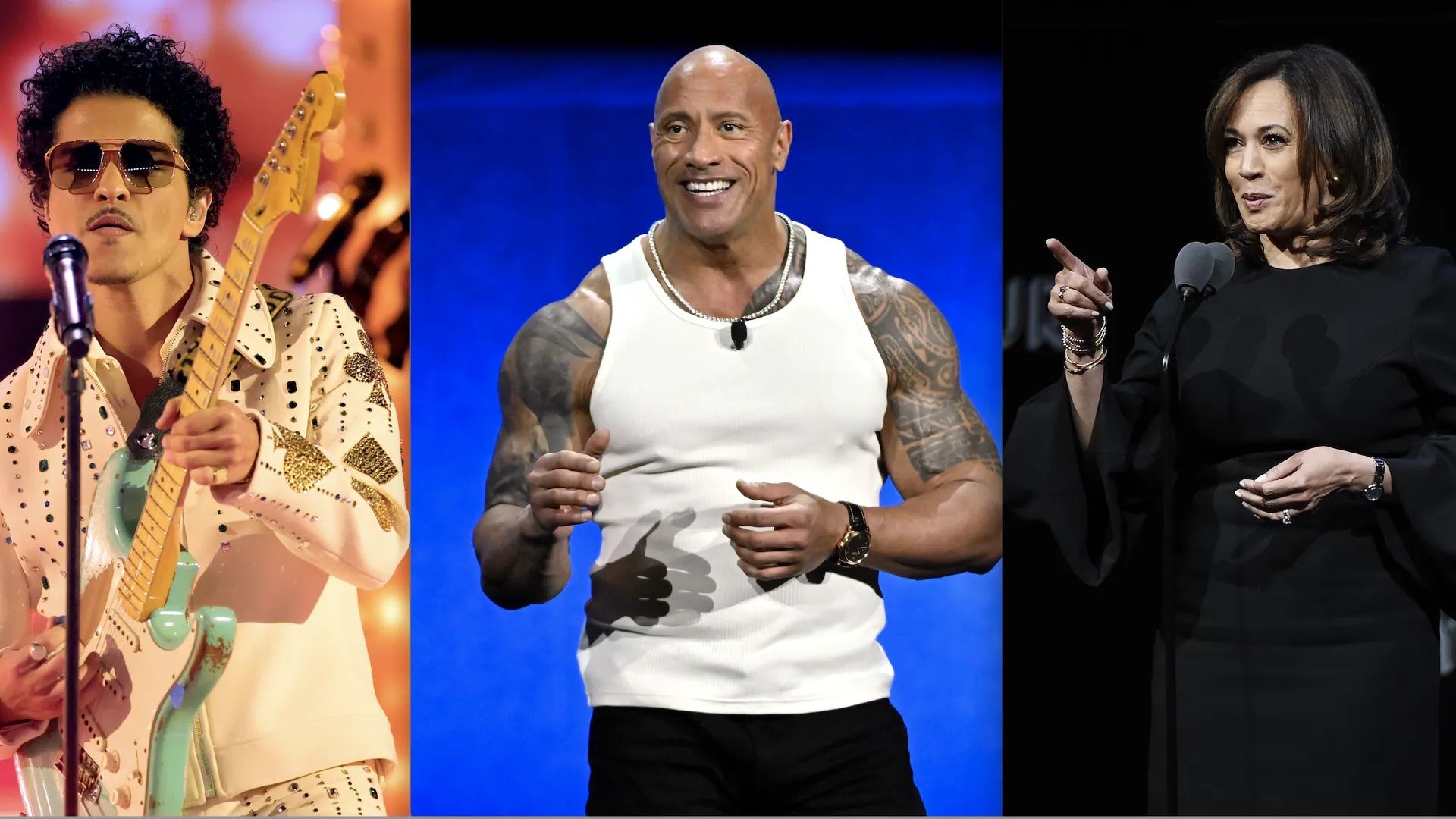
Bruno Mars, who is Puerto Rican/Filipino/Jewish; Dwayne "The Rock" Johnson, who is Black/Samoan; and Kamala Harris, who is Indian American/Black. Photo: Rich Fury/Getty Images for The Recording Academy/David Becker/WireImage/Jamie McCarthy/Getty Images for Glamour
Former PresidentTrump's false attack againstVice President Kamala Harris, questioning if she can identify with more than one race, arrives as the number of people in the U.S. identifying as multiracial is surging.
Why it matters:Trump's comments illuminate how some Americans consistently misunderstand the complexities of people from multiple racial and ethnic backgrounds and how those identities shape their lives.
Catch up fast: Trump's comments to reporters at theNational Association of Black Journalists annual convention last week, saying Harris primarily identified as Indian and "became Black" recently, stirred discussions about her background.
Reality check: Harris regularly cites her background as the daughter of a South Asian immigrant mother and a Jamaican immigrant father.
Harris graduated from Howard University (an HBCU), joined the historically Black sorority Alpha Kappa Alpha and was a member of the Congressional Black Caucus as a U.S. senator.
Harris is hardly alone. People who identify as multiracial, ormore than one race, are among the fastest-growing segments of the U.S. population, according to theU.S. Census.
The 2020 Census found that those who identify as multiracial more than tripled from 9 million in 2010 to 33.8 million a decade later.
In Massachusetts, 8.7% of the population identify as multiracial, more than 600,000 individuals.
The number of non-white legislators is growing, and majority-minority cities like Boston are seeing similar shifts at the municipal level.
Zoom in: The number of multiracial residents doubled in Greater Boston between 2010 and 2020, partly because of the rise of mixed-identity births, according to a 2021 Boston Indicators report.
Nearly 1 in 5 babies born in Massachusetts in 2019 were of mixed race or ethnicity — more than the number of Black and Latino babies combined.
"This creates a uniquely American demographic group that can effectively navigate in different communities and bring people together," Trevor Mattos, research manager at Boston Indicators, wrote in 2021.
"But at the same time, an increasingly multiracial society can also create fear and be leveraged as a weapon for racism and nativism."