Five explosive moments from Trump’s off-the-rails NABJ interview

Add Axios as your preferred source to
see more of our stories on Google.
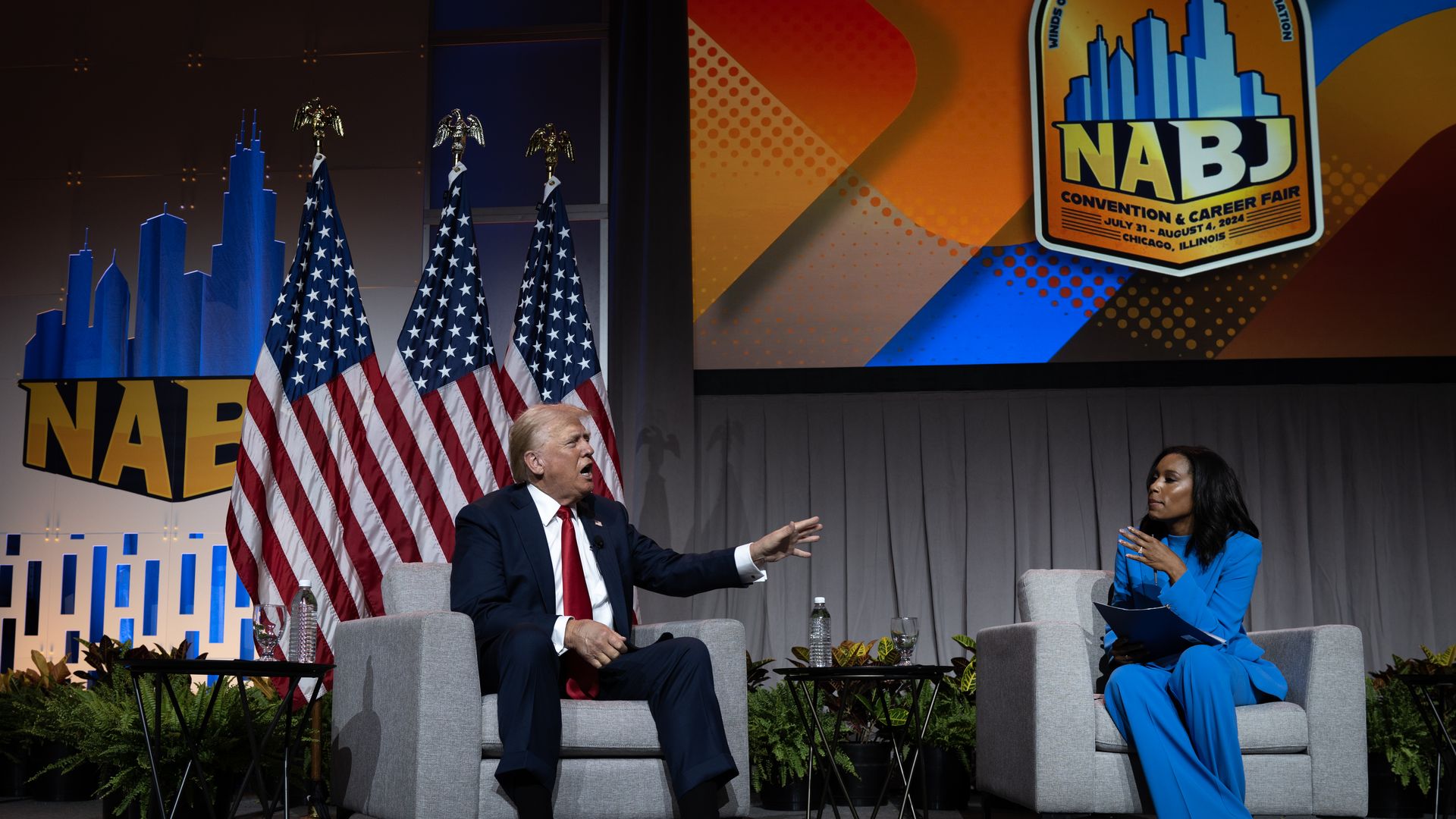
Former President Donald Trump speaks with Rachel Scott, senior congressional correspondent for ABC News, during a question and answer session at the National Association of Black Journalists convention on July 31, 2024 in Chicago, Illinois. Photo: Scott Olson/Getty Images
Former President Trump's interview at the National Association of Black Journalists annual convention in Chicago Wednesday quickly turned chaotic after the GOP presidential nominee took the stage more than an hour late.
Why it matters: Trump's invite to the event caused internal and external controversy. His interview with three Black women journalists descended into combative exchanges and lies about Vice President Kamala Harris' heritage.
- "Today's biased and rude treatment from certain hostile members of the media will backfire massively," the Trump campaign said in a statement after the interview.
1. Trump attacks Harris over her race
Trump was asked about repeated Republican attacks on Harris' race and gender characterizing her as a "DEI candidate" chosen because of her race and gender rather than her merits. Given the opening to denounce those accusations, Trump questioned Harris' race.
Zoom in: "She was always of Indian heritage, and she was only promoting Indian heritage," he said. "I didn't know she was Black until a number of years ago when she happened to turn Black."
- "I don't know, is she Indian or is she Black?" he asked, seemingly questioning the ability of the first Black and Asian American vice president to share both Indian and Black identities.
Reality check: Harris has talked at length — including in her book, during her 2020 presidential campaign and in her time as vice president — about her multiracial heritage. Her father is Jamaican; her mother was Indian American.
- Harris graduated from Howard University, joined a historically Black sorority and was a member of the Congressional Black Caucus.
Flashback: Trump has pushed "birther" conspiracy theories against other rivals, recently against then-primary opponent Nikki Haley and against President Obama.
- During the 2020 election, a Trump campaign official lobbed a similar attack against Harris, questioning whether she was eligible for the vice presidency because her parents weren't naturalized citizens at her birth.
2. Trump said he would "absolutely" pardon Jan. 6 rioters
Trump reaffirmed previous statements that he would pardon those convicted in the Jan. 6 attack, saying, "If they're innocent, I would pardon them."
Driving the news: He claimed those found guilty — hundreds of rioters — were convicted "by a very tough system."
- "How come the people that tried to burn down Minneapolis, how come the people that took over a large percentage of Seattle, how come nothing happened to them?" he questioned, pointing also to recent D.C. protests against Israeli Prime Minister Benjamin Netanyahu's congressional address, which led to several arrests.
What he's saying: Asked about videos from that day that depict officers who responded to the attack being beaten and dragged down the stairs of the Capitol, Trump said, "They shot a young lady in the face who was protesting," referring to the deadly shooting of Ashli Babbitt.
- Trump then falsely claimed "no one died," right after referencing Babbitt's shooting.
- He also echoed a conspiracy theory about the Capitol attack, saying officers were "ushering" rioters into the building.
3. Trump downplays VP importance in wake of JD Vance criticism
Trump said it is "well documented, historically, the vice president, in terms of the election, does not have any impact" amid mounting backlash over his own No. 2 pick's past comments about women and family.
- He contended after "two or three days" the excitement over a running mate dies down, and then it's "all about the presidential pick."
He doubled down, reiterating the choice makes "no difference."
- He said he thinks Sen. J.D. Vance (R-OH.) is "outstanding" but added, "You're voting for me."
Yes, but: Allies of the former president hoped the Rust Belt native would bolster the former president's support in key swing states.
4. Trump gives little detail on police immunity proposal
The former president said the officer who killed Sonya Massey, an unarmed 36-year-old woman who was fatally shot in her home in Illinois after calling 911 earlier in July, "might not" receive immunity when asked about his campaign proposal to give police officers immunity from prosecution.
Zoom in: "It depends," he said of when an officer would be granted immunity, arguing he was referencing "much different" cases.
- Trump said he didn't "know the exact case" when asked about Massey but saw something that "didn't look good to me."
Zoom out: Trump did not give any concrete outline of how the proposal would work.
- Trump lost the previous election in 2020 against President Biden months after historic anti-racism protests sprung up following the Minneapolis police killing of George Floyd.
- When asked about details of his pledge, he said, "There's a big difference between being a bad person and making an innocent mistake — but if somebody made an innocent mistake I would want to help that person."
- He said sometimes "very bad decisions" are made but not from an "evil standpoint."
5. Trump references Black jobs (again)
During the presidential debate in June that prompted widespread calls for President Biden to exit the 2024 race, Trump said immigrants were taking "Black jobs" — a statement that prompted the question, what is a "Black job"?
The latest: He was asked that question Wednesday, responding, "A Black job is anybody that has a job."
- "They're taking the employment away from Black people," he baselessly claimed of migrants.
The other side: Biden slammed Trump over the comment earlier this month, saying to a crowd at an NAACP event, "Folks, I know what a Black job is — it's the vice president of the United States."
Go deeper: Former President Trump at NABJ conference divides journalists
