Trump attack on Harris comes as U.S. multiracial population exploding


Add Axios as your preferred source to
see more of our stories on Google.
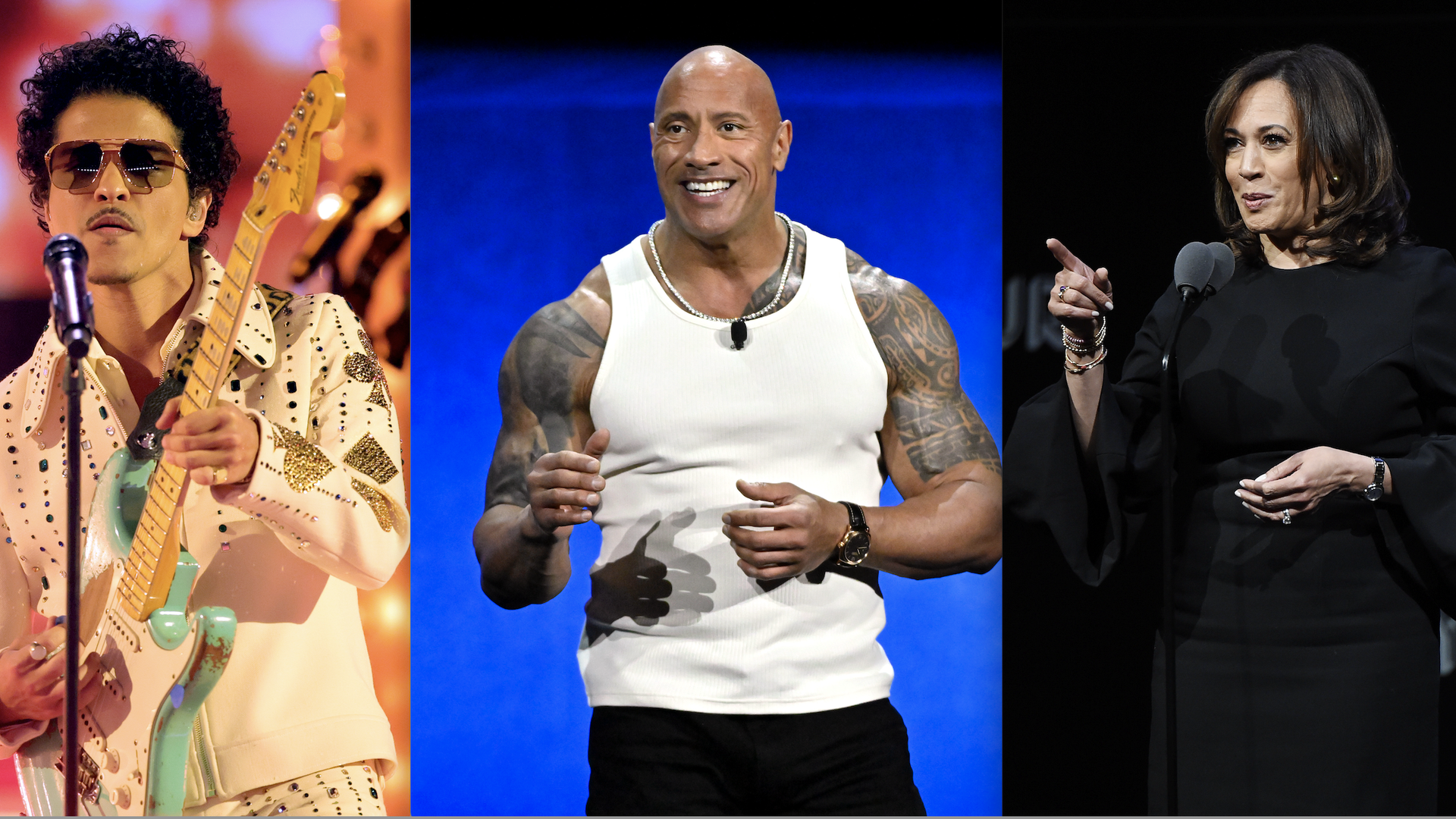
Bruno Mars, who is Puerto Rican/Filipino/Jewish; Dwayne "The Rock" Johnson, who is Black/Samoan; and Kamala Harris, who is Indian American/Black. Photo: Rich Fury/Getty Images for The Recording Academy/David Becker/WireImage/Jamie McCarthy/Getty Images for Glamour
Former President Trump's false new attack against Vice President Kamala Harris, questioning if she can identify with more than one race, arrives at a time when the number of people in the U.S. identifying as multiracial is surging.
Why it matters: Trump's comments illuminate how some Americans consistently misunderstand the complexities of people from multiple racial and ethnic backgrounds and how those identities shape their lives.
- In an exchange with reporters at the National Association of Black Journalists annual convention Wednesday, Trump suggested falsely that Harris "became a Black person" after identifying primarily as Indian.
- "I don't know, is she Indian or is she Black?" he said.
Reality check: Harris regularly cites her background as the daughter of a South Asian immigrant mother and a Jamaican immigrant father.
- Harris graduated from Howard University (an HBCU), joined the historically Black sorority Alpha Kappa Alpha and was a member of the Congressional Black Caucus as a U.S. senator.
What they're saying: Jasmine Mitchell, a professor of Puerto Rican and Latino studies at Brooklyn College, says Trump's comments get at the common misconception that the mixing of races is new in the U.S., though it has been common in the Americas for centuries.
- Annabelle Lin Atkin, an assistant professor of Human Development and Family Science at Purdue University, said multiracial people like Harris challenge decades-old racial hierarchies, and their very presence breaks the rules.
- "We live within this mono-racial framework where we assume that race is mutually exclusive... you can only check one box on the form. Our society has functioned this way for such a long time that people have a hard time understanding that this is changing."
State of play: People who identify as multiracial, or more than one race, are among the fastest-growing segments of the U.S. population, according to the U.S. Census.
- The 2020 Census found that those who identify as multiracial grew from 9 million in 2010 to 33.8 million a decade later — a 276% jump.

The intrigue: Those who identify as Asian plus another race (like Harris) jumped by 56% during the same period and are the fastest-growing multiracial group.
- The number of Americans who identify as Asian American Pacific Islander Latinos also has more than doubled over the last two decades, according to a study released in May.
Between the lines: The influence of multiracial Americans is everywhere in art, sports, science, government, pop culture — even a former president, Barack Obama.
- Experts say multiracial Americans routinely have their racial identities questioned, ridiculed or dismissed, and Trump's line of false attacks opened up painful wounds.
Bruno Mars, for example, is a Puerto Rican/Filipino/Jewish singer who grew up in Hawaii and struggled early in his career because record executives couldn't categorize him because of his race.
- He also faced heat from some Black music critics who have accused him of appropriating Black music while playing "up his racial ambiguity."
- "Don't look at me. Listen to my damn music," Mars told The New York Times in 2010. "I'm not a mutant."
Subscribe to Axios Latino to get vital news about Latinos and Latin America, delivered to your inbox on Tuesdays and Thursdays.
