Trump's new birtherism

Add Axios as your preferred source to
see more of our stories on Google.
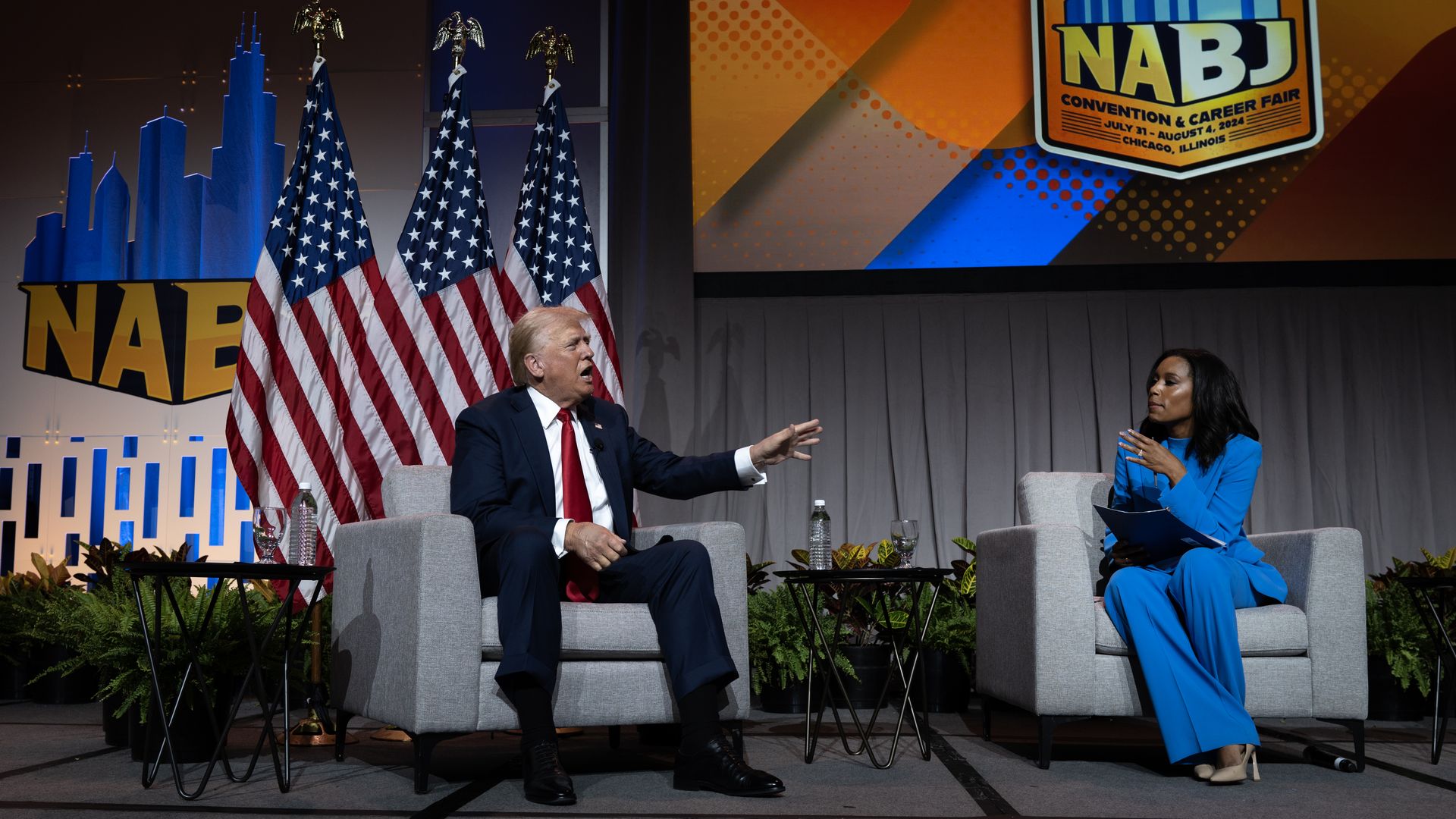
Trump during an exchange with ABC's Rachel Scott at NABJ. Photo: Scott Olson/Getty Images
Donald Trump's audacious lie about Vice President Kamala Harris' race confirmed what many had long suspected: running against a Black woman could summon the former president's worst impulses.
Why it matters: Amid outrage from Democrats and discomfort from Republicans, Trump is doubling down on his incendiary claim that Harris recently "became a Black person" for political convenience.
- In one fell swoop, Trump hijacked a news cycle dominated by the enthusiasm surrounding Harris' campaign — and redirected attention to his long and controversial record on race.
- It's a nightmare for Republicans already reeling from the tightening race: They know Trump has a strong chance of beating Harris on the issues, but fear he could alienate swing voters with attacks on her identity.
Catch up quick: In a chaotic and combative interview at the National Association of Black Journalists convention, Trump falsely claimed that Harris "happened to turn Black" after years of promoting her Indian heritage.
- "So I don't know, is she Indian or is she Black?" the former president asked, drawing pushback from ABC News moderator Rachel Scott.
- "I respect either one, but she obviously doesn't, because she was Indian all the way, and then all of a sudden she made a turn and she went — she became a Black person."
- Trump concluded, as he often does, with a conspiratorial flourish: "I think somebody should look into that too."
The big picture: Trump's political rise began with a yearslong crusade to delegitimize the nation's first Black president, Barack Obama.
- Much has changed since 2011, but Trump has never strayed far from the conspiratorial and racist roots of the birther movement.
- In 2020, Trump said he had "heard" that Harris was not born in the U.S. and thus "doesn't meet the requirements" to be vice president. Harris was born in California.
- Even during the GOP primary earlier this year, Trump falsely claimed that rival Nikki Haley was ineligible to be president because her parents weren't U.S. citizens when she was born.
Reality check: Harris is the first Black, South Asian and woman vice president.
- She's the daughter of an Indian mother and a Jamaican father, and was a member of a historically Black sorority at a historically Black college.
- Like millions of mixed-race Americans, who represent one of the fastest-growing demographics in the country, the vice president identifies with both of her cultures.
What they're saying: "Let me just say: The American people deserve better. The American people deserve better," Harris said at a historically Black sorority event in Houston, accusing Trump of putting on the "same old show" of "divisiveness and disrespect."
- Sen. Mark Kelly (D-Ariz.), a potential VP pick for Harris, was more direct, telling CNN that Trump's attacks were "overtly racist."
What to watch: Trump's remarks on Wednesday's panel weren't a one-off. His campaign, for now at least, seems to be leaning in.
- Trump followed up by posting a 2019 video of Harris discussing her Indian heritage with Indian-American actress Mindy Kaling, labeling Harris a "stone cold phony."
- At his rally hours later in Harrisburg, Pennsylvania, the Trump campaign displayed a Business Insider headline recognizing Harris as the first Indian-American elected to the Senate.
- Sen. JD Vance (R-Ohio), Trump's running mate, called Harris a "total phony who caters to whatever audience is in front of her."
- Speaking before Trump, lawyer and Trump adviser Alina Habba said: "Unlike you Kamala, I know who my roots are."
The bottom line: Harris did not just "become" Black. But Trump's questioning of her identity just became a big part of the 2024 campaign.
