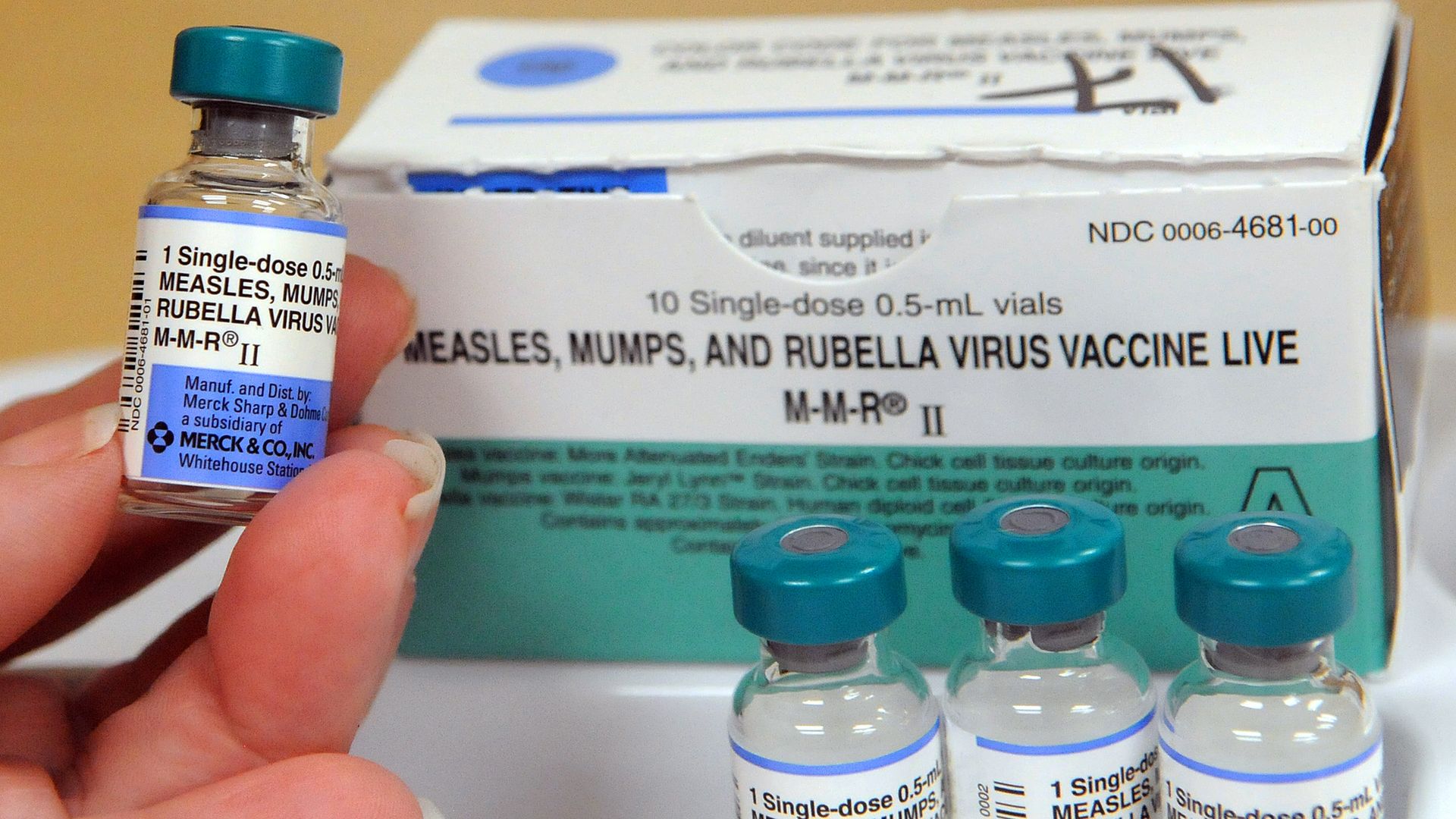
Measles vaccination rates have steadily declined around the world since the start of the COVID-19 pandemic, leaving millions of children susceptible to the virus, according to new data in a joint report by the Centers for Disease Control and Prevention (CDC) and the World Health Organization (WHO).
Why it matters: The organizations said measles is "an imminent threat in every region of the world," as it is one of the most contagious human viruses — though it is also entirely preventable through vaccination.
The Georgia state Supreme Court on Wednesday temporarily reinstated the state's six-week abortion ban, which had been struck down by a lower court last week.
The big picture: The Georgia attorney general indicated they plan to appeal last week's decision on the ban shortly after it was issued. They simultaneously asked the state Supreme Court to temporarily “stay” the lower court ruling and reinstate the law in the meantime.
The Food and Drug Administration on Tuesday approved a gene therapy for hemophilia — the latest in a series of decisions to advance pricey, personalized treatments that bring new hope to patients, along with cost concerns to the health system.
Why it matters: With a list price of $3.5 million, Hemgenix from CSL Behring LLC will become the most expensive therapy in the world.
As Axios' Caitlin Owens reported in September, while the expected number of patients who'll receive such treatments is relatively low, employers, insurers, and public payers like state Medicaid programs may absorb large costs all at once.
Details: Hemgenix is used to treat Hemophilia B, an inherited disorder affecting about one in 40,000 people that stems from missing or insufficient levels of a protein that's required to produce clots to stop bleeding.
The treatment is given as a single dose by IV and contains a viral vector carrying a gene for the clotting factor.
Its effectiveness was established based on decreases in the annualized bleeding rate of subjects in two studies.
“Gene therapy for hemophilia has been on the horizon for more than two decades," said Peter Marks, director of the FDA’s Center for Biologics Evaluation and Research, adding Tuesday's decision "represents important progress in the development of innovative therapies for those experiencing a high burden of disease associated with this form of hemophilia.”
Catch up quick: The FDA recently approved two other multi-million-dollar gene therapies: Bluebird bio's Zynteglo for a blood disorder called beta-thalassemia and Skysona for a rare neurological disorder called cerebral adrenoleukodystrophy.
Menopause — a condition that's little discussed and poorly understood — is gaining more attention from employers rethinking the health benefits they offer women.
Why it matters: Support for workers experiencing telltale symptoms like hot flashes, fatigue and mood swings is becoming more essential after the pandemic and its economic shockwaves led a disproportionate number of women to exit the workforce.
Enrollment in Affordable Care Act marketplaces is on pace to set a new record, Health Secretary Xavier Becerra told Axios on Tuesday, with subsidies that Congress renewed through 2025 softening the blow of premium increases.
Why it matters: Consumers are flocking to ACA plans as employers and insurers grapple with higher premiums and higher out-of-pocket costs.
Outgoing NIAID director Anthony Fauci appeared at his last White House press briefing Tuesday, urging Americans to get their updated COVID-19 booster shots.
Driving the news: Fauci, who served as President Biden's chief medical adviser since January 2021, announced in August that he would be retiring from government service in December in order to "pursue the next chapter" of his career.
Despite private equity owning only an estimated 5% of the nursing home industry, its high-profile problems in the sector have made it a bogeyman to politicians and the public.
Why it matters: Even as studies show that 9 of 10 adults prefer to age in place, the need for an institutionalized setting will persist. But the climate has long made investing a challenge for PE.
The much-feared twindemic — or even tripledemic — of respiratory viruses is here, but Americans are too COVID-fatigued to care.
The big picture: Flu in the southeast and RSV infections in multiple regions are filling up hospital wards and causing some facilities to cancel elective surgeries and bring back triage tents.