The potent venom of a cone snail that lives deep in the ocean contains a pain-suppressing compound, scientists reported this week.
Why it matters: The compound is similar to a hormone that inhibits pain in the human body, but the snail version lasts far longer and could be used to help develop new pain medicines.
With America in a pandemic lull, communities across the country are choosing to shut down COVID testing and vaccination sites, even as experts warn that another wave could be on the horizon.
Tuberculosis cases in the U.S. jumped over 9% in 2021 from 2020 numbers, though cases are still significantly lower than years prior, according to a new study published by the Centers for Disease Control and Prevention (CDC).
Driving the news: Cases "substantially" fell by nearly 20% in 2020, which researchers say is likely due to either delayed diagnoses or a true reduction because of mitigation efforts and changes in travel policies due to the COVID-19 pandemic.
The Supreme Court Friday ruled Friday that the Navy is allowed to consider vaccination status when planning deployments or assignments for SEALS and other special operations personnel.
Why it matters: The Biden administration had asked the Supreme Court to allow the Department of Defense to enforce its vaccination requirement after a federal judge sided with 35 unvaccinated Navy SEALs in January, and said they had a right to refuse the vaccine because of their religious beliefs.
Half of all women getting 3D mammograms will experience a false positive over a decade of annual screening, a study published Friday in JAMA Network Open found.
Why it matters: False positives — when a mammogram is flagged as abnormal, but there is no cancer — have always been a problem. But 3D mammography has been aggressively marketed by hospitals, doctors and some patient groups for its ability to provide higher image quality images — and previous studies have found they result in fewer false positives.
What they're saying: "Whenever you're called back for an additional workup, it's very stressful because women think they may have cancer," Diana Miglioretti, a lead author and professor and division chief of biostatistics at UC Davis Department of Public Health Sciences, told Axios.
"Often it may take days to even weeks to get that resolved," she said. "The main thing is we want to alleviate women's anxiety over these false positives and understand they are very common."
The details: The researchers analyzed data from the Breast Cancer Surveillance Consortium on 3 million screening mammograms for more than 900,000 women ages 40–79. The screenings were performed between 2005 and 2018 at 126 radiology facilities.
Researchers estimate over 10 years of getting 3D mammograms, 50% of women will experience at least one false-positive recall compared to 56% of women screened with 2D digital mammograms.
Women with dense breasts or who were younger, as well as those who screened every year compared to once every two years, had a higher chance of a false positive.
Yes, and: Beyond the anxiety false positives cause, there are additional out-of-pocket costs for the follow-up diagnostic workups that can be problematic, Miglioretti pointed out.
What's next: It's still a work in progress, but researchers are working on AI that might better identify cancers in mammograms.
Miglioretti's team is studying the risk factors for getting called back for more imaging.
"If we can identify women, like younger women, women with dense breasts at higher risk of being recalled, we can have the radiologist read the mammogram while she waits so that she can get any additional workup that day. That greatly reduces women's anxiety because they don't get this call saying, 'We need you to come in for additional imaging,'" she said.
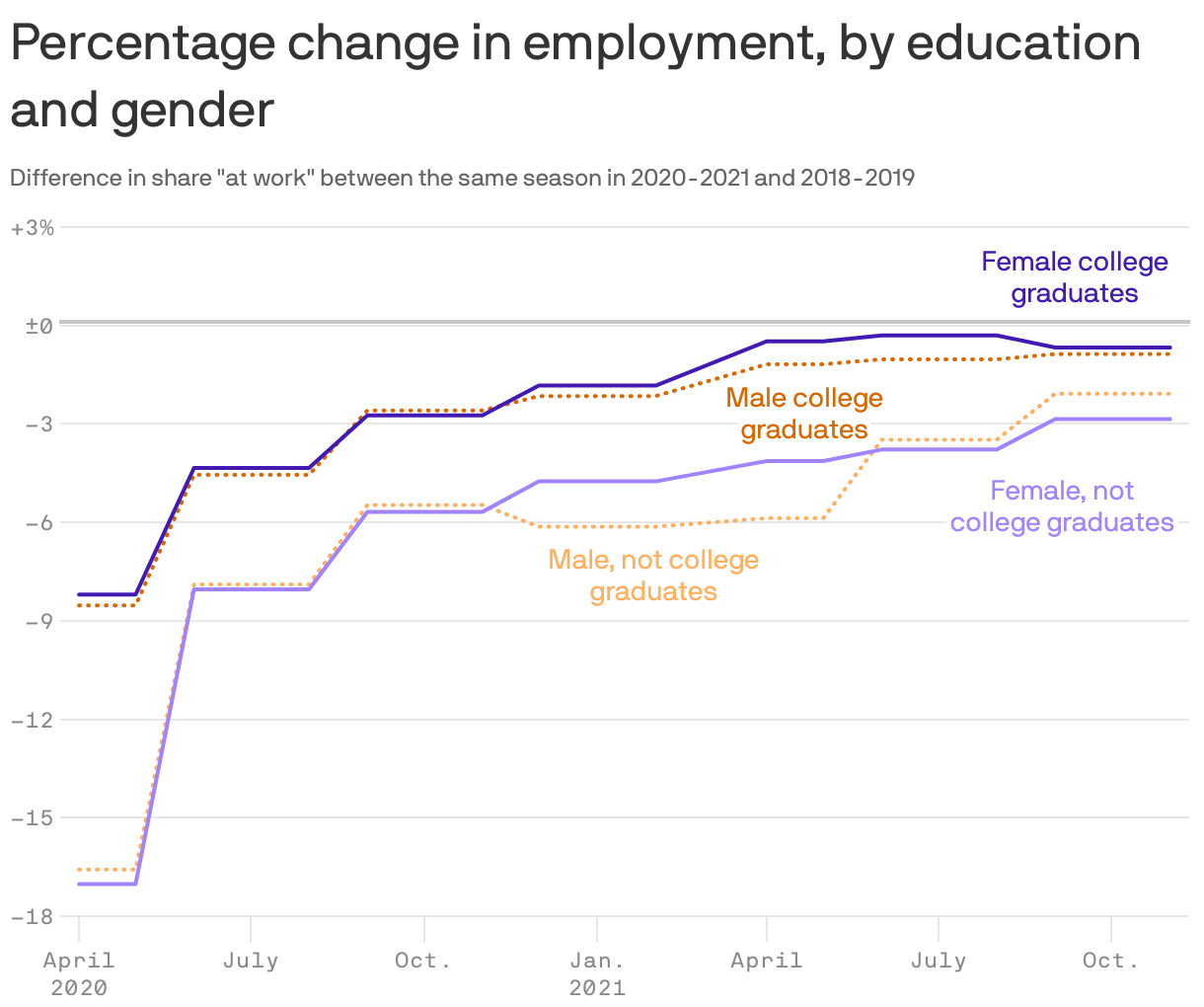
Data: CPS monthly accessed via IPUMS; Chart: Baidi Wang/Axios
College-educated motherswere stressed and under extreme pressure at home and at work during the pandemic. But that didn't lead them to leave the job market in greater numbers than men, new research finds.
Why it matters: The findings, from Harvard economics professor Claudia Goldin, debunk one of the storylines that came out of the pandemic — the idea that droves of well-educated women left or would leavethe labor force.
COVID is killing more people per 100,000 in red states than in blue states, a reflection of GOP resistance to vaccines.
Why it matters: "The COVID-19 pandemic removed any doubt that state policies can affect health outcomes," Virginia Commonwealth University professor Steven Woolf recently argued in JAMA.
Why it matters: The families had sued the state over a law that gives parents the right to exempt their children from mask-wearing in schools without providing a reason.