New York City health officials reported zero new coronavirus deaths on Sunday for the first time since the state's first death was recorded on March 11, according to NBC New York.
Why it matters: Once the epicenter of the U.S. and global outbreak, New York successfully flattened its curve and has thus far proven to be a model for how states can safely and cautiously lift lockdown restrictions.
U.S. Surgeon General Jerome Adams defended his and other health officials' reversal on whether people should wear face coverings to protect against the coronavirus, arguing on CBS News' "Face the Nation" on Sunday: "When we learn better, we do better."
Why it matters: Adams has faced significant criticism for tweeting in February, "Seriously people- STOP BUYING MASKS! They are NOT effective in preventing general public from catching #Coronavirus, but if healthcare providers can't get them to care for sick patients, it puts them and our communities at risk!"
Miami-Dade Mayor Carlos Giménez said on CNN's "State of the Union" that six hospitals in his county have already reached capacity, and that "it won't be long" until other systems are overwhelmed as the number of coronavirus cases continues to surge in Florida.
Why it matters: Giménez's concern over hospital capacity comes as the state reported 15,299 confirmed coronavirus cases on Sunday — shattering the previous record for highest single-day increased that any state has reported during the pandemic.
Former FDA commissioner Scott Gottlieb said on CBS News' "Face the Nation" Sunday that he expects the coronavirus outbreaks in Southern states like Texas, Florida and Arizona to reach their apex in the next two to three weeks — but warned that this would likely be followed by an "extended plateau," as seen in places like Brazil.
Why it matters: Southern states were among the first to reopen after lockdowns in March and April and are now experiencing a surge in cases. Gottlieb said that while the death rate has been lower than it was in the spring, it's likely to increase to over 1,000 new deaths a day as infections seep into older populations.
Florida reported 15,299 confirmed coronavirus cases on Sunday — a new single-day record for any state, according to its health department.
The big picture: The figure shatters both Florida's previous record of 11,458 new cases and the single-state record of 11,694 set by California last week, according to AP. It also surpasses New York's daily peak of 11,571 new cases in April, and comes just a day after Disney World reopened in Orlando.
Education Secretary Betsy DeVos told "Fox News Sunday" that public schools that don't reopen in the fall should not get federal funds, and that the money should be redirected to families who can use it to find another option for their children.
Why it matters: The Trump administration is engaged in a full-court press to reopen schools this fall, despite warnings from some public health officials that the coronavirus outbreak is out of control in many states and that it will be difficult for many schools to reopen safely.
The Trump administration's coronavirus testing coordinator Adm. Brett Giroir said on ABC's "This Week" that "everything" — including the "stringent lockdowns" that many governors implemented in March and April — should be "on the table" in states where new infections are skyrocketing.
Why it matters: President Trump said in June that the U.S. "won't be closing down the country again" — a view shared by many Republicans who believe that the economic damage caused by stay-at-home orders was too great to justify a second round of lockdowns.
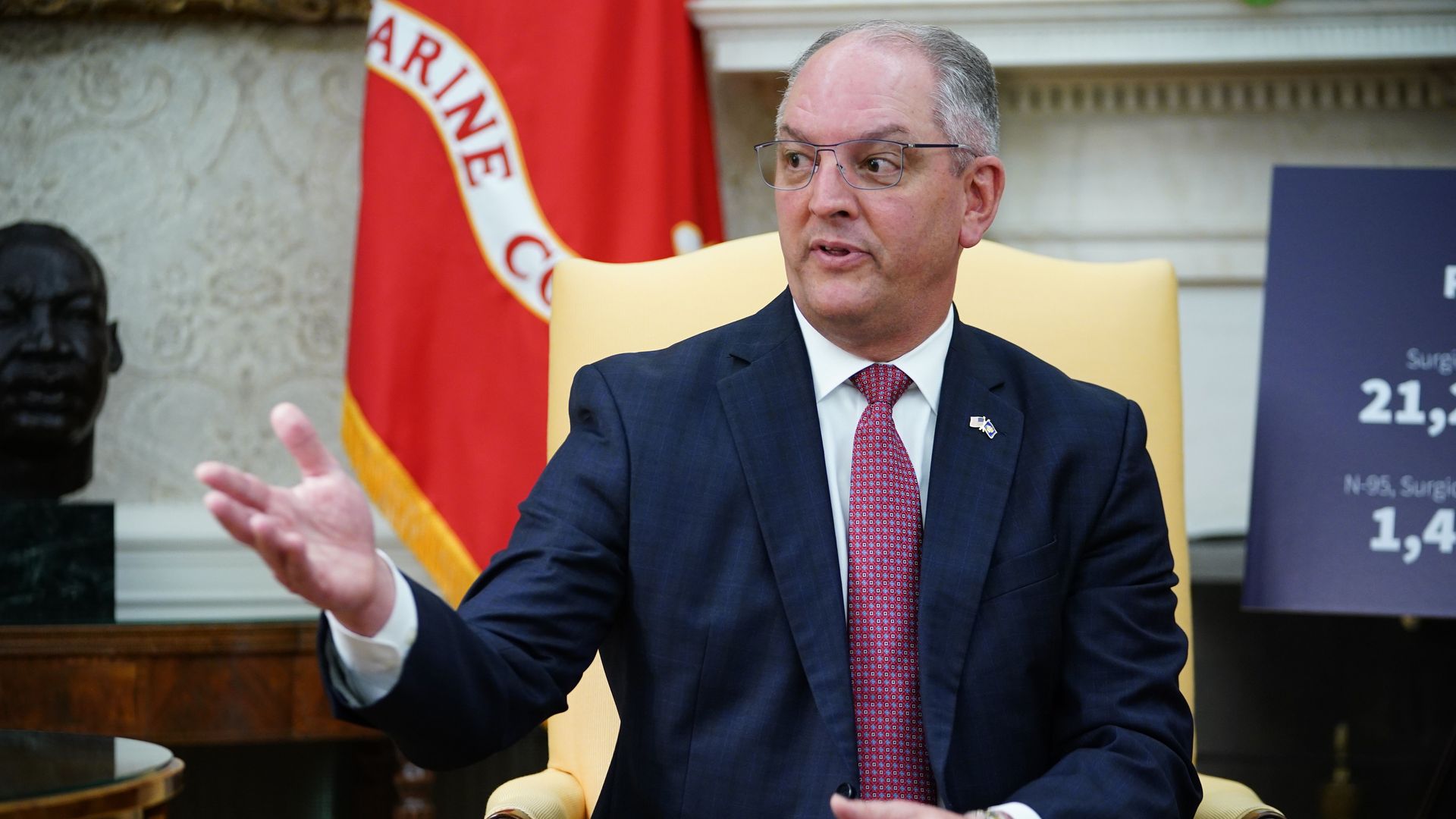
Louisiana Gov. John Bel Edwards (D) issued an executive order on Saturday requiring all people ages 8 and older to wear face coverings in public to curb the spread of the coronavirus, according to The Advocate.
Why it matters: Louisiana is now the 25th state to issue some form of a mask mandate as case counts surge across the U.S.
India is set to reinstate mandatory lockdowns for cities as medical facilities across the country are strained due to a recent surge in new coronavirus infections, the New York Times reports.
Why it matters: Roughly four months ago, India's Prime Minister Narendra Modi announced a national lockdown to prevent the spread of the virus, hoping to avoid the large-scale crisis it's now experiencing.