Friday's health stories

FDA moves forward on opioid "blister packs"
The FDA announced yesterday that it's requesting feedback on requiring certain opioids to be made available in "blister packs," which would include a limited number of pills.
How it works: The goal is to reduce the number of opioid pills prescribed, especially in situations when the typical 30-pill prescription is probably unnecessary.
Juul exploring opening its own store

Juul is considering opening its own stores, WSJ scooped yesterday, although it hasn't made a final decision.
The intrigue: It's hired staff for potential locations in Dallas and Houston, which both have high smoking rates. The stores would only allow adults inside, and would only sell tobacco, menthol and mint flavors in the stores.

The hospitals staying silent on Medicare for All

Large hospital systems and trade groups have vociferously criticized Democrats' "Medicare for All" proposals, but rural facilities and public hospitals that treat mostly low-income patients are sitting on the sidelines of the debate.
Why it matters: Safety nets and many rural hospitals could hypothetically benefit under Medicare for All, but expressing support would put them at odds with their larger brethren.

Deciphering the role microbiomes may play in human health and disease

Piece by piece, scientists are trying to solve the puzzle of the ancient but evolutionary relationship between humans and their microbiomes, or the genetic world stemming from bacteria, viruses, fungi and other microbes inside or on the human body.
What's new: In the second part of a more than decade-long project to decode the genetic influence from these mysteriously important "bugs," the Integrative Human Microbiome Project (iHMP) published 3 studies Wednesday in Nature and Nature Medicine that look at how changes in the microbiome could be related to inflammatory bowel disease (IBD), prediabetes and preterm births.
Measles cases break 25-year record in the U.S.


Measles cases today reached 971 in 26 states so far this year — eclipsing 1994's 963 cases reported for the entire year, the Centers for Disease Control and Prevention announced Thursday.
Why it matters: Measles was declared "eradicated" in the U.S. in 2000, years after the development and implementation of the MMR vaccine, which is 97% effective with 2 doses. But the extremely contagious virus has crept back into American society, mainly via pockets of communities who refuse to use the vaccinations, experts have told Axios.

John Hickenlooper on the issues, in under 500 words

Editor's Note: Hickenlooper dropped out of contention for the Democratic presidential nomination on Aug. 15, 2019. Below is our original article on his candidacy.
Former Colorado Gov. John Hickenlooper is positioning himself as a pragmatic, productive, drama-free moderate. He even weighed running on a joint ticket with former Ohio GOP Gov. John Kasich. On progressive policy proposals like Medicare for All and the Green New Deal, he said, "I reject the notion that it should become a litmus test of what it takes to be a good Democrat."
Key facts about John Hickenlooper:
- Current position: N/a — 2-term governor of Colorado until Jan. 8, 2019
- Age: 67
- Born: Narberth, Pennsylvania
- Undergraduate: Wesleyan University
- Date candidacy announced: March 4, 2019
- Previous roles: Governor of Colorado, mayor of Denver, restaurant and brewery owner, geologist
John Hickenlooper's stance on key issues:
- Climate change: Calls for the U.S. to reenter the Paris climate agreement, institute a carbon tax and collaborate with industry for infrastructure investment. He wrote an op-ed in March denouncing the Green New Deal, arguing that while he supports the "concept", the model "sets unachievable goals" and would inflate the government.
- Gun control: Signed legislation to require background checks for all gun sales and a ban on high-capacity magazines.
- Health care: Created an Affordable Care Act exchange for Colorado and opted to expand Medicaid.
- Economy: Was known as a pro-business governor, working to slim down the state's regulatory environment. He also worked to bring companies to Denver, created an apprentice program for high schoolers and launched a website to retrain displaced workers.
- Marijuana: Once opposed to the idea of legalization in Colorado, he has come around to it.
- Medicare for All: Said he supports single-payer health care, advocating for the general idea rather than hastily hashing out a specific policy. He opposed a ballot measure to bring a publicly-financed health care system to Colorado.
- Reproductive rights: Hickenlooper unveiled in a Medium blog a new plan to expand access to long-acting, reversible contraception (LARC), such as Intrauterine Devices (IUDs), if elected.
- Rural communities: Hickenlooper plans to strengthen rural communities by expanding broadband access, providing tax credits for small businesses and boosting funding for agricultural development, according to The Hill.
Key criticisms of John Hickenlooper:
- Moderation: Many feel moderation and nuance is not a winning formula for 2020 Democrats.
- Ethics complaint: Alleged to have violated Colorado rules by accepting free jet rides.
- Business-friendly: Pro-business agenda included being an outspoken supporter of the fracking industry.
1 fun thing about John Hickenlooper:
- He wrote in his memoir that when he was young he once tried to grow weed outside his bedroom window in Pennsylvania.
Go deeper: Everything you need to know about the other 2020 candidates

How Medicare can help biosimilar uptake
A new analysis finds that relatively minor changes to Medicare's payment policies could help jump-start the fledgling market for biosimilars.
Where it stands: The market for biosimilars is weak, and that means the drugs' expected savings aren't materializing. But Medicare could help kick things up a notch, according to Avalere estimates commissioned by a coalition of biosimilars manufacturers.

Medical AI has a big data problem

Facing increasingly overworked doctors and labyrinthine insurance systems, hospitals are searching for a lifeline in AI systems that promises to ease hard diagnoses and treatment decisions.
Reality check: The data underpinning the very first systems is often spotty, volatile and completely lacking in critical context, leading to a poor early record in the field.

Dick Durbin berates FDA commissioner over e-cigarette inaction
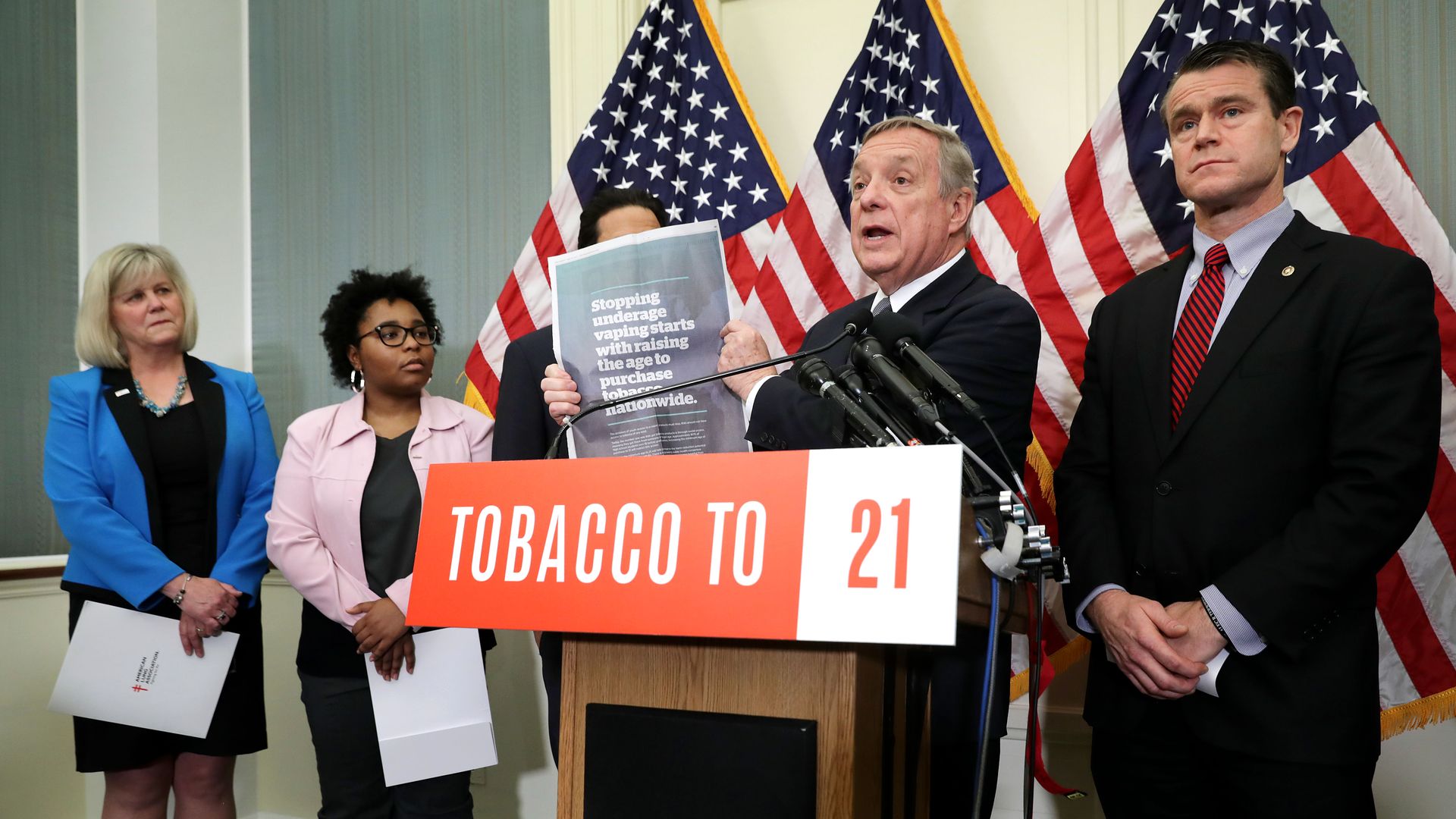
Sen. Dick Durbin (D-Ill.) sent acting FDA commissioner Ned Sharpless a biting letter on Wednesday, writing that he believes Sharpless has "no intention" of addressing the youth e-cigarette epidemic after a meeting between the two on May 14.
What he's saying: Durbin warned Sharpless not to make the same mistakes as his predecessor Scott Gottlieb by underestimating the impact of rampant youth vaping. "I write to again reiterate the specific actions that FDA should be taking, today, to protect children from a lifetime of addiction."