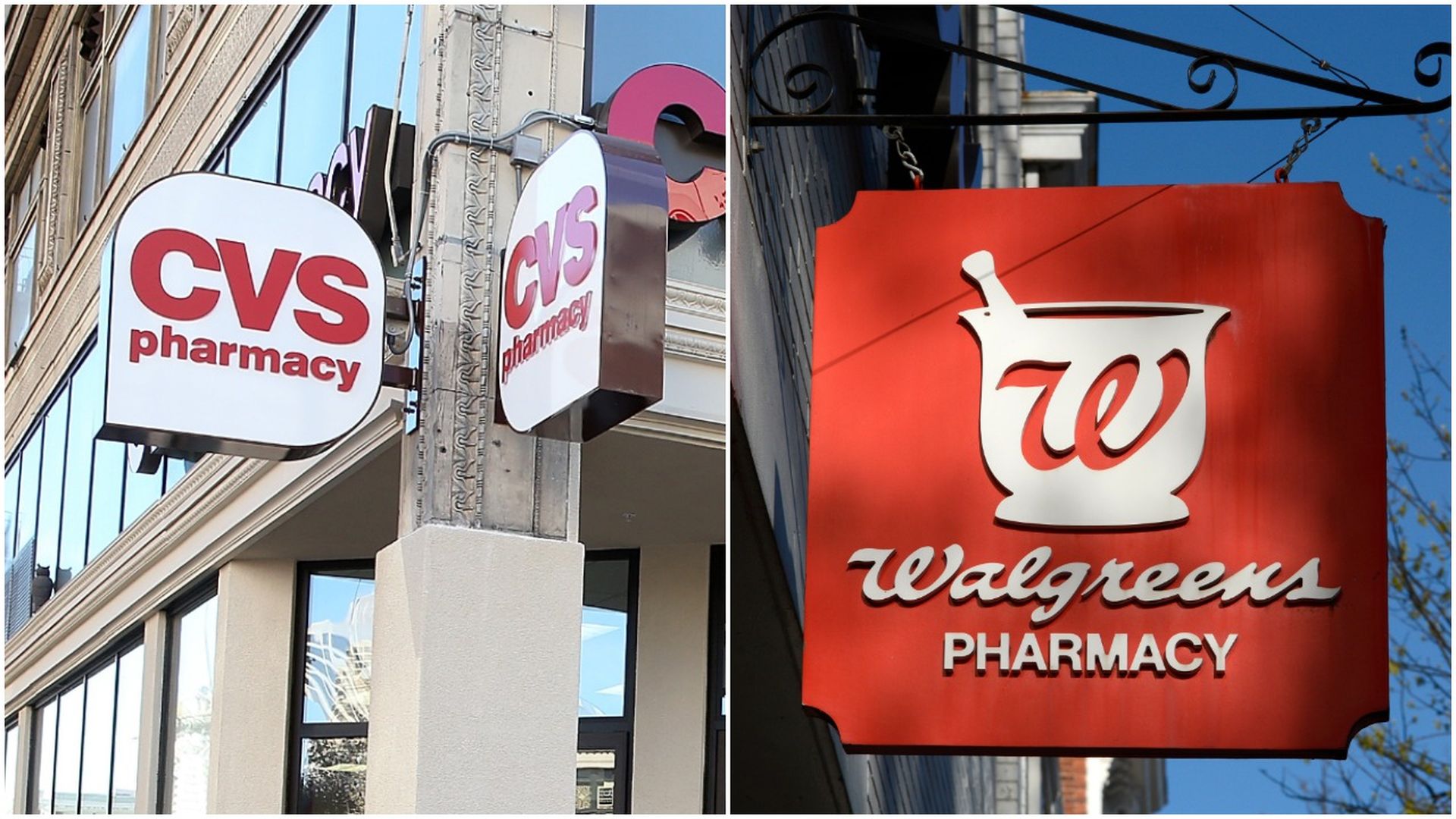
Florida sued Walgreens and CVS, the largest pharmacies in the U.S., alleging they contributed to the nation's opioid crisis by failing to stop "suspicious orders of opioids" and "dispensed unreasonable quantities of opioids from their pharmacies."
The details: Florida's Attorney General Pam Bondi added the retailers to a lawsuit the state filed last year against Purdue Pharma, the maker of OxyContin, and several opioid distributors, the AP reports. Kentucky also sued Walgreens earlier this year for ignoring its own safeguard systems designed to protect and monitor consumers' opioid consumption.
The system for setting drug prices in the U.S. is a labyrinth. It can be enormously frustrating for patients — and enormously rewarding for the drug companies, pharmacies, doctors, hospitals and assorted middlemen that profit along the way.
The big picture: The cost of a drug depends on many factors: whether it’s a brand-name product or a generic; secretive industry negotiations; even the way the drug is administered. Each patient's price may be different.
Drug prices are a big deal politically because they’re a big deal personally. Time after time, the issue is thrust back into the spotlight by virtue of giant price increases on drugs that aren’t new or innovative, but are still life-savers for millions of people.
It happened when “pharma bro” Martin Shkreli bought Daraprim, a drug to treat AIDS, and raised the price by 5,000%. It happened when Mylan raised the price of the Epi-Pen by about 500% over 6 years. It has been happening for years with insulin, where prices keep creeping higher, adding up to increases of more than 200% for some products.
Over the past few years, there’s been a growing push from researchers to figure out which drugs are worth their price tags.
Other countries, like the U.K., attempt to answer that question with governmental bodies of experts who determine how much value certain drugs provide, compared to their price. The U.S. doesn’t have such an organization, in part because the pharmaceutical industry hates the idea.
Prescription drugs are the political center of the health care debate, but we actually spend a lot more on hospital care and doctors’ visits.
By the numbers: In 2016, U.S. spent a little less than $330 billion on the kind of drugs you pick up at a pharmacy, according to federal data. That's about 10% of all health care spending.
Pharma was happy when President Trump first released his blueprint to lower drug prices, which mainly targeted industry middlemen, not drugmakers, and relied on private-sector competition, not direct government intervention.
The pharmaceutical industry has spent enormously on lobbying in the age of Trump.
The big picture: In 2017 alone, PhRMA, the industry’s leading trade group, spent $25.8 million, according to the Center for Responsive Politics. So far in 2018, it's spent $21.8 million. That doesn’t include individual companies’ lobbying efforts.
Generic erythromycin, an antibiotic, saw price hikes every year from 2010 to 2017, ultimately ending up roughly 50 times more expensive than it started. It's not alone.
The market-based solution to this problem would be for a new company to start manufacturing those drugs. Often, however, there's a market failure, and the drugs remain hard to find or exorbitantly expensive for years.